
On This Day
December 18 in History
On 18 December 1865 Secretary of State William H. Seward certified that the Thirteenth Amendment had been ratified, proclaiming it part of the United States Constitution — and with that proclamation slavery was abolished across the whole nation, including the loyal border states the Emancipation Proclamation had never reached. December 18 is also the day The Nutcracker premiered and Argentina won the 2022 World Cup.
Choose another date: open the On This Day calendar to browse events, births and deaths for any day of the year.
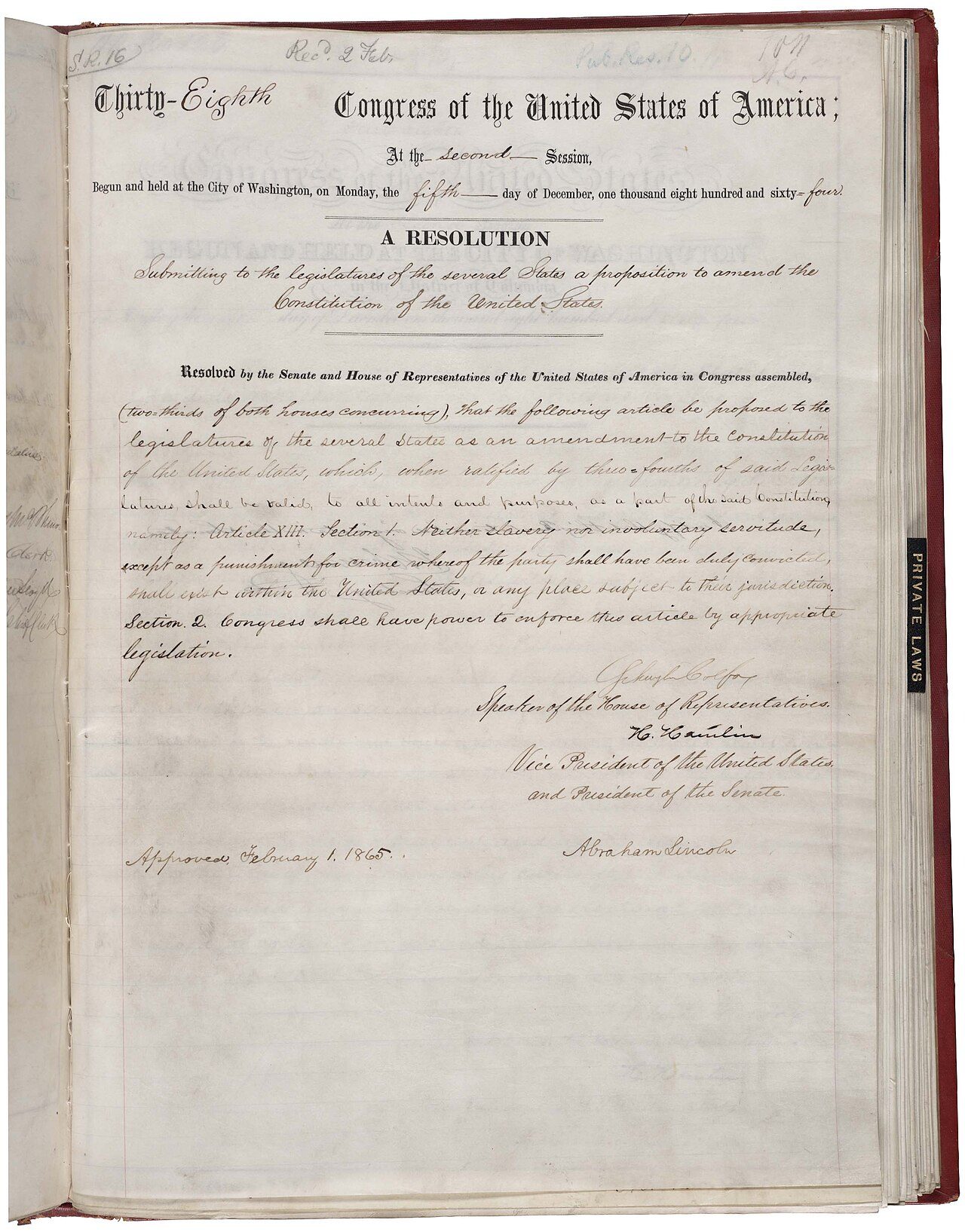
At a Glance
- Passed Congress
- Senate on 8 April 1864; the House on 31 January 1865, by 119 votes to 56
- Lincoln's approval
- 1 February 1865 — signed although presidents have no formal role in the amendment process
- Ratification completed
- 6 December 1865, when Georgia became the 27th of the 36 states to ratify
- Proclaimed
- 18 December 1865, certified by Secretary of State William H. Seward
- The text
- 'Neither slavery nor involuntary servitude, except as a punishment for crime… shall exist within the United States'
- Who it freed
- The people still legally enslaved in loyal states such as Kentucky and Delaware, whom the Emancipation Proclamation had never reached
Events on this day
- 1620Passengers from the Mayflower go ashore at Plymouth, Massachusetts, beginning the permanent English settlement of New England.
- 1865The Thirteenth Amendment is proclaimed part of the U.S. Constitution, abolishing slavery throughout the United States — the featured story above.
- 1892Tchaikovsky's ballet The Nutcracker premieres in St. Petersburg; initially a disappointment, it becomes the world's most performed Christmas ballet.
- 1916The Battle of Verdun ends after ten months, the longest battle of the First World War, with casualties estimated in the hundreds of thousands on each side.
- 1932The first NFL championship playoff game is played indoors, in Chicago, because of snow — the Chicago Bears beat the Portsmouth Spartans.
- 1941Japanese forces land on Hong Kong Island, beginning the assault that will take the British colony on Christmas Day.
- 1972President Nixon announces the 'Christmas bombing' of North Vietnam, the heaviest air raids of the Vietnam War.
- 2019The U.S. House of Representatives impeaches President Donald Trump for the first time, on charges of abuse of power and obstruction of Congress.
- 2022Argentina beats France on penalties in the World Cup final in Qatar, a 3–3 classic widely called the greatest final ever played.
Born on this day
- 1886Ty Cobb — American baseball player, the fiercest competitor of the game's early era, whose career batting average still stands as the record.
- 1943Keith Richards — English guitarist and co-founder of the Rolling Stones.
- 1946Steven Spielberg — American director of Jaws, E.T. and Schindler's List, the most commercially successful filmmaker in history.
- 1963Brad Pitt — American actor and producer, star of Fight Club and Oscar winner for 12 Years a Slave as a producer.
- 2001Billie Eilish — American singer-songwriter who won five Grammy Awards for her debut album while still a teenager.
Died on this day
- 1737Antonio Stradivari — Italian luthier whose violins, made in Cremona, remain the most prized string instruments in the world.
- 2006Joseph Barbera — American animator, co-creator of Tom and Jerry and co-founder of Hanna-Barbera, dead at 95.
- 2011Václav Havel — Czech playwright and dissident who became president of Czechoslovakia and then of the Czech Republic, dead at 75.
The featured story: the Thirteenth Amendment is proclaimed, 18 December 1865
Abraham Lincoln's Emancipation Proclamation of 1863 had freed enslaved people only in the states in rebellion, and only as a war measure that a future president or court might undo. In the border states that had stayed loyal — Kentucky and Delaware above all — slavery remained perfectly legal even as the Civil War ground towards its end. To abolish it everywhere and for ever required changing the Constitution itself. The Senate passed the Thirteenth Amendment in April 1864, but the House of Representatives at first fell short of the necessary two-thirds. Only after Lincoln's re-election, and with the president lobbying hard for the measure, did the House approve it on 31 January 1865, by 119 votes to 56. Lincoln signed the resolution on 1 February — a signature the amendment process does not require, but which fixed his name to the document for ever.
The amendment then went to the states, needing ratification by three-fourths of the thirty-six — twenty-seven states. Through 1865 the ratifications accumulated, from loyal states and from the reconstructed governments of the defeated South, several of which ratified as the price of readmission to the Union. On 6 December 1865 Georgia became the twenty-seventh state to ratify, and the amendment was complete in law. Twelve days later, on 18 December 1865, Secretary of State William H. Seward issued his certification that the amendment had been validly ratified and proclaimed it part of the Constitution of the United States. From that day, its words bound every state in the Union: 'Neither slavery nor involuntary servitude, except as a punishment for crime whereof the party shall have been duly convicted, shall exist within the United States, or any place subject to their jurisdiction.'
The proclamation changed the legal condition of the last enslaved Americans at a stroke. In Kentucky, where the Emancipation Proclamation had never applied, the people still held in slavery became free in law on the amendment's authority; in Delaware, slavery ended having never been touched by the war measures at all. The amendment was the first of the three Reconstruction Amendments — followed by the Fourteenth, guaranteeing citizenship and equal protection, and the Fifteenth, forbidding the denial of the vote by race — which together refounded the United States on a broader definition of freedom than the original Constitution had allowed.
Its one exception has echoed down the centuries: slavery and involuntary servitude remain permitted 'as a punishment for crime', a clause later used to sustain convict-leasing systems in the South and still debated in American law today. But the proclamation of 18 December 1865 remains one of the great hinge dates of the republic — the day the promise of 1776 was written into the Constitution's text itself, and the day the United States, four years and eight months after its civil war began over slavery, finally abolished the institution in every corner of its territory.
Why this date matters
December 18 is a date of formalities that change the world. Pilgrims step ashore and a colony exists; a secretary of state signs a certificate and four million people's descendants inherit a different country; a ballet opens to shrugs and becomes a ritual. The date specialises in the moment when something long fought over becomes official — ratified, proclaimed, premiered, recorded in the books. Even its spectacles have that quality: Verdun ends not with a charge but with exhaustion entered into the record, and a World Cup final is settled by the most procedural device in sport, the penalty shoot-out. On December 18, history signs the paperwork.
Sources
- Encyclopaedia Britannica — On This Day: December 18
- HISTORY — This Day in History: December 18
- National Archives — 13th Amendment to the U.S. Constitution: Abolition of Slavery (1865)
- National Archives — Resolution Proposing the Thirteenth Amendment
- Wikipedia — Thirteenth Amendment to the United States Constitution
The facts on this page were checked against these sources on 19 November 2026. The History Trail's permanent pages are researched and written for this site; the live profiles elsewhere on The History Trail are assembled automatically from Wikipedia and Wikidata.
About the Author
Researched and written by the The History Trail Editorial Team — the accountable editorial function behind this site's permanent story pages. The team works from the published sources cited on each page; it does not invent historians, reviewers or credentials, and it corrects errors openly.
Fact Check
Every load-bearing fact on this page traces to one of the sources listed above, and significant claims link to their source in the text. Our checking method is described on the methodology page; errors can be reported via the corrections page.
Sources & Citations
Cite this page as: The History Trail Editorial Team, The History Trail — this article's title, publication and update dates are shown beneath its headline. The full source list appears under Sources above; the site's source standards are on the sources page.