
Years
1859 in History
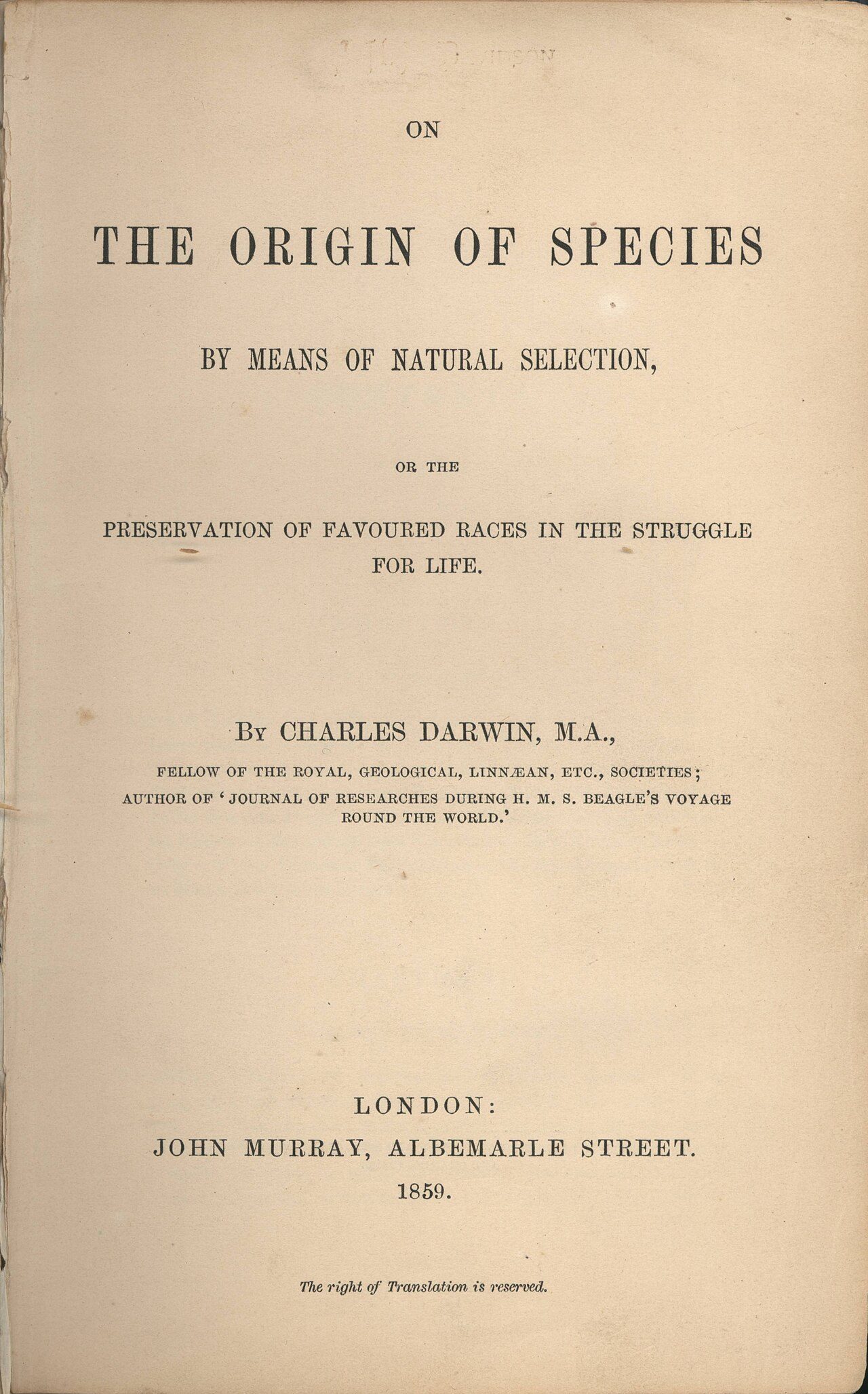
1859 is the year Charles Darwin published On the Origin of Species — the book, two decades in the making, that proposed evolution by natural selection and changed humanity's understanding of its own place in nature. Around it the year crowded in beginnings and warnings: ground was broken for the Suez Canal, Edwin Drake's well struck oil in Pennsylvania and launched the modern petroleum industry, and John Brown's raid on Harpers Ferry pushed the United States closer to civil war.
At a Glance
- Defining event
- On the Origin of Species published in London, 24 November — the 1,250-copy first edition taken up on the day
- The wait
- Darwin had the mechanism of natural selection by 1838 but gathered evidence for two decades before publishing
- The prompt
- Alfred Russel Wallace's 1858 manuscript, setting out the same theory, forced the joint presentation and the book
- The other industry born
- Edwin Drake's well strikes oil at Titusville, Pennsylvania, 27 August, launching the modern petroleum industry
- The warning
- John Brown seizes the federal arsenal at Harpers Ferry, 16 October; he is hanged on 2 December
- The canal
- Ground broken at Port Said for the Suez Canal, 25 April, Ferdinand de Lesseps striking the first pickaxe blow
The defining story: On the Origin of Species published
Darwin had returned from the Beagle voyage in 1836 with specimens and doubts, and by 1838, reading Malthus on population, he had the mechanism: in a world of struggle, favourable variations tend to be preserved and unfavourable ones destroyed — natural selection. Then, famously, he waited. He wrote a sketch in 1842 and a fuller essay in 1844, confessed the theory to a few trusted friends, and gathered evidence from pigeon fanciers, barnacles and seeds, settling into the life of an invalid country gentleman in Kent. The delay was not idleness: it was spent amassing the evidence — from barnacles, coral reefs, fossils and pigeon breeding — that made the eventual book so hard to argue with. In April 1859 he sent the first three chapters to his publisher; the rest followed at the pace of a man who knew exactly what he was releasing.
What ended the delay had arrived by post in June 1858: a manuscript from Alfred Russel Wallace, a young naturalist collecting in the Malay Archipelago, setting out the same theory of selection. Darwin, horrified and honourable in equal measure, let his friends Lyell and Hooker arrange a joint presentation of Wallace's paper and his own extracts to the Linnean Society that July — read to a room that little noticed what it had heard; the society's president remarked afterwards that the year had produced no striking discoveries. Darwin then set to work on what he called an abstract of his great planned book. Written in thirteen months, On the Origin of Species was that abstract: the compressed, urgent version, published by John Murray in London on 24 November 1859.
The book's argument was simple to state and radical in effect: all species have descended, with modification, from common ancestors, and the branching pattern of life results from natural selection — as many more individuals of each species are born than can possibly survive, there is a recurring struggle for existence, and any being that varies slightly in a manner profitable to itself will have a better chance of surviving, and thus be naturally selected. Common descent plus natural selection explained, in one framework, fossils, island species, embryology and the geography of life. The full edition of 1,250 copies was taken up by booksellers on the day of publication, and evolution by natural selection entered public debate. Darwin largely avoided the word 'evolution' itself in the book — the first edition argues for descent with modification without leaning on the term that now summarises the whole theory.
The rest of 1859 ran at the same tempo of beginnings. On 25 April ground was broken at Port Said for the Suez Canal, Ferdinand de Lesseps himself striking the first pickaxe blow. On 24 June France and Piedmont-Sardinia defeated Austria at the Battle of Solferino, where the suffering witnessed led Henry Dunant toward founding the Red Cross movement. On 27 August Edwin Drake's well struck oil at Titusville, Pennsylvania, launching the modern petroleum industry. And in October the year's warning sounded: on 16 October the abolitionist John Brown seized the federal arsenal at Harpers Ferry, Virginia, hoping to ignite a slave rebellion; U.S. Marines stormed the engine house two days later, and Brown was hanged at Charles Town on 2 December — a death that made him a martyr in the North and a warning in the South, seventeen months before the Civil War.
Timeline of 1859
- 27 January
Wilhelm II is born — the last German emperor and king of Prussia, whose reign will end in the First World War.
- 5 April
Charles Darwin sends the first three chapters of On the Origin of Species to his publisher.
- 25 April
Ground is broken at Port Said for the Suez Canal, Ferdinand de Lesseps striking the first pickaxe blow.
- 6 May
Alexander von Humboldt dies at 89 — the German naturalist whose Cosmos tried to describe the whole physical world.
- 22 May
Arthur Conan Doyle is born — the Scottish writer who will create Sherlock Holmes.
- 31 May
The great bell Big Ben is installed in the clock tower above the Houses of Parliament in London.
- 11 June
Klemens von Metternich dies — the Austrian statesman who dominated European diplomacy for three decades after Napoleon.
- 24 June
France and Piedmont-Sardinia defeat Austria at Solferino; the suffering witnessed there leads Dunant to found the Red Cross movement.
- 30 June
The French acrobat Charles Blondin crosses Niagara Falls on a tightrope, the first of his many crossings.
- 27 August
Edwin Drake's well strikes oil at Titusville, Pennsylvania, launching the modern petroleum industry.
- 15 September
Isambard Kingdom Brunel dies, days after his ship Great Eastern's maiden-voyage accident.
- 16 October
Abolitionist John Brown seizes the federal arsenal at Harpers Ferry, hoping to ignite a slave rebellion.
- 24 November
Darwin's On the Origin of Species is published in London; the 1,250-copy first edition is taken up on the day.
- 2 December
John Brown is hanged at Charles Town, Virginia, for the Harpers Ferry raid.
Why 1859 still matters
1859 still matters most for the book at its centre. The Origin did what earlier ideas about the transmutation of species had failed to do: it persuaded. Within a generation, evolution by common descent was the working assumption of biology, even where natural selection itself was still argued over, and modern biology still runs on Darwin's framework — genetics later supplied the mechanism of inheritance he lacked, but the pattern he saw in tortoises and iguanas in the 1830s is the pattern every life scientist still works within. Darwin was buried in Westminster Abbey, the ultimate British accolade for a man whose book had challenged the account of creation his countrymen grew up with. The two-decade wait was part of the achievement: by 1859 Darwin could answer objections from a stock of evidence no rival could match, and the joint presentation with Wallace showed the theory was in the evidence, not in one man's fancy.
But 1859 was also the year the modern world's fuel and its American crisis both announced themselves. Drake's Titusville well launched the petroleum industry that would power the next century and a half, and ground broken at Port Said began the canal that would shorten the world's trade routes. Against those beginnings stands Harpers Ferry: Brown's raid failed in two days, but his hanging divided American opinion so sharply — martyr in the North, warning in the South — that the road to civil war, seventeen months away, grew visibly shorter. The year even buried the old order as it went: Metternich, the architect of post-Napoleonic Europe, and Humboldt, the last great universal naturalist of the age before specialisation, both died in 1859, the year the modern world published its operating manual.
1859 on The History Trail
Darwin's book dominates 1859 on The History Trail, with the year's oil strike, battle and raid told on their own days.
- November 24 in History — On the Origin of Species is published in London.
- October 16 in History — John Brown seizes the federal arsenal at Harpers Ferry.
- June 24 in History — the Battle of Solferino, whose aftermath leads to the Red Cross.
- August 27 in History — Drake's well strikes oil at Titusville, Pennsylvania.
- April 5 in History — Darwin sends the first three chapters of the Origin to his publisher.
- Charles Darwin — the naturalist's full story, from the Beagle voyage to the twenty-year wait.
Sources
- Encyclopaedia Britannica — On This Day: April 5
- Encyclopaedia Britannica — On This Day: April 25
- Encyclopaedia Britannica — On This Day: June 24
- Encyclopaedia Britannica — On This Day: August 27
- Encyclopaedia Britannica — On This Day: September 15
- Encyclopaedia Britannica — On This Day: October 16
The facts on this page were checked against these sources on 19 November 2026. The History Trail's permanent pages are researched and written for this site; the live profiles elsewhere on The History Trail are assembled automatically from Wikipedia and Wikidata.
About the Author
Researched and written by the The History Trail Editorial Team — the accountable editorial function behind this site's permanent story pages. The team works from the published sources cited on each page; it does not invent historians, reviewers or credentials, and it corrects errors openly.
Fact Check
Every load-bearing fact on this page traces to one of the sources listed above, and significant claims link to their source in the text. Our checking method is described on the methodology page; errors can be reported via the corrections page.
Sources & Citations
Cite this page as: The History Trail Editorial Team, The History Trail — this article's title, publication and update dates are shown beneath its headline. The full source list appears under Sources above; the site's source standards are on the sources page.