
Years
1858 in History
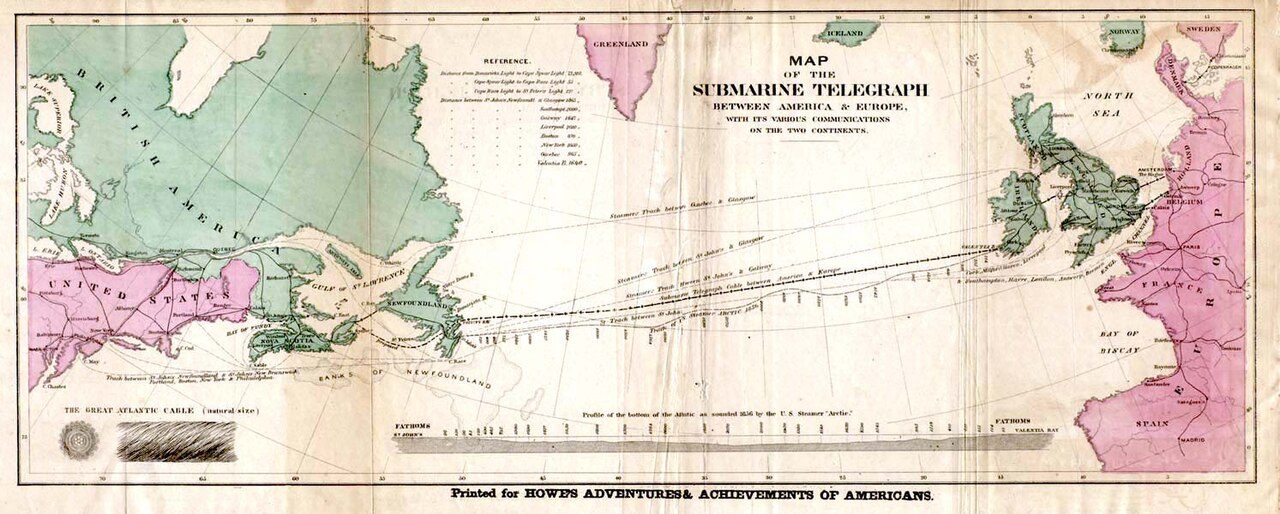
1858 is the year the Atlantic shrank: on 5 August the first transatlantic telegraph cable was completed between Ireland and Newfoundland, and on 16 August Queen Victoria sent its first official message to President Buchanan. The cable failed within weeks, but it proved an ocean could be crossed by words in a day instead of ten days by ship. The same summer, papers by Darwin and Wallace announced evolution by natural selection in London.
At a Glance
- Defining event
- First transatlantic telegraph message, 16 August 1858
- The cable
- Completed under Cyrus Field, 5 August, linking Ireland and Newfoundland
- Evolution announced
- Darwin and Wallace papers read jointly to the Linnean Society, 1 July
- Japan opens further
- Harris Treaty signed with the United States, 29 July
- America argues
- Lincoln and Douglas open their famous debates, 21 August
- Born this year
- Max Planck, Rudolf Diesel, Theodore Roosevelt and Giacomo Puccini
The defining story: a wire under the ocean
Until 1858 a message could cross the Atlantic no faster than a ship — about ten days on a good passage. The telegraph had already bound the towns of Britain and America by wire; the audacious next step was a cable under the ocean itself, some 2,500 miles of it between Ireland and Newfoundland. Two warships lent by the two governments, HMS Agamemnon and USS Niagara, each carrying half the cable, met in mid-Atlantic and spliced their halves together on 29 July. On 5 August the cable was complete, running from Valentia Island to Trinity Bay, and the two shores were connected by wire for the first time in history.
The formal exchange came on 16 August, when Queen Victoria sent a message down the line to President James Buchanan, congratulating him, in the surviving text, 'upon the successful completion of this great international work'. Buchanan replied in kind. Words had crossed the ocean not in days but within the day, travelling along a wire lying in darkness two miles beneath the waves, and the exchange was reported everywhere as a wonder — fireworks, sermons and editorials about the annihilation of distance.
Then the miracle failed. The cable's signals weakened, garbled and died; by 1 September, barely a month after completion, it had effectively ceased to work, its insulation cooked by the ever-higher voltages driven through it to force faint signals along the line. It took eight more years, a far larger ship and the hard lessons of 1858 — gentler voltages, better insulation — before a durable cable was laid in 1866. But August 1858 remains the birthday of instant intercontinental communication.
The cable shared its summer with a quieter announcement of equal weight. On 18 June Charles Darwin received Alfred Russel Wallace's paper on evolution, prompting him to publish his own theory; on 1 July papers by both men, setting out evolution by natural selection, were read jointly to the Linnean Society in London. In America, on 21 August, Abraham Lincoln and Stephen Douglas opened their famous debates in the contest for an Illinois Senate seat, and on 29 July the United States and Japan signed the Harris Treaty, opening Japanese ports to American trade.
Timeline of 1858
- 11 January
Harry Gordon Selfridge, the American retailer who founded Selfridges in London, is born.
- 11 February
Marie-Bernarde Soubirous, aged 14, reports the first of 18 visions of the Virgin Mary at Lourdes in southern France.
- 18 March
Rudolf Diesel, the German engineer who invented the engine that bears his name, is born.
- 23 April
Max Planck, the German physicist who founded quantum theory, is born.
- 18 June
Charles Darwin receives Alfred Russel Wallace's paper on evolution, prompting him to publish his own theory.
- 1 July
Papers by Darwin and Wallace on evolution by natural selection are read jointly to the Linnean Society in London.
- 29 July
The United States and Japan sign the Harris Treaty, opening Japanese ports to American trade.
- 5 August
The first transatlantic telegraph cable is completed under Cyrus Field, linking Ireland with Newfoundland.
- 16 August
Queen Victoria sends the first official message through the new cable to President Buchanan.
- 21 August
Abraham Lincoln and Stephen Douglas open their famous series of debates in Illinois.
- 15 September
The Overland Mail Company sends out its first stages, beginning regular transcontinental mail service to California.
- 27 October
Theodore Roosevelt, the future 26th president of the United States, is born in New York City.
- 20 November
Selma Lagerlöf, the Swedish novelist who became the first woman to win the Nobel Prize for Literature, is born.
- 22 December
Giacomo Puccini, Italian composer of La Bohème, Tosca and Madama Butterfly, is born.
Why 1858 still matters
The failed cable mattered more than many successes: it proved the concept, taught the engineering lessons — above all gentler voltages and better insulation — and made the durable 1866 cable possible. From that line descends the whole wired and fibred world, in which an ocean is no barrier to a sentence. 16 August 1858 is the first day news could outrun weather, ships and armies across an ocean.
The Linnean Society reading changed the other kind of distance — the one between species. Darwin and Wallace presented together, priority shared, set the theory of evolution by natural selection formally before the scientific world. The Lincoln-Douglas debates, meanwhile, made Lincoln a national figure on the question that would define his presidency, and the Harris Treaty extended America's Pacific opening begun by Perry four years earlier.
The births of 1858 seeded the next century's physics, engineering and politics: Max Planck would found quantum theory, Rudolf Diesel gave his name to an engine, Theodore Roosevelt reached the White House, and Selma Lagerlöf and Giacomo Puccini remade literature and opera. A year of wires and theories, it connected continents twice over — by cable, and by an idea.
1858 on The History Trail
A cable, a theory and a famous debate lead this year on The History Trail.
- August 16 in History — Queen Victoria sends the first official transatlantic telegraph message.
- August 5 in History — The first transatlantic telegraph cable is completed.
- July 1 in History — Darwin and Wallace are read jointly to the Linnean Society.
- August 21 in History — Lincoln and Douglas open their famous debates.
- July 29 in History — The United States and Japan sign the Harris Treaty.
- September 15 in History — The Overland Mail begins regular transcontinental service.
Sources
- Encyclopaedia Britannica — On This Day: August 16
- Science Museum — Sending messages across the Atlantic
- Encyclopaedia Britannica — On This Day: July 1
- Encyclopaedia Britannica — On This Day: August 21
- Encyclopaedia Britannica — On This Day: September 15
- Encyclopaedia Britannica — On This Day: July 29
The facts on this page were checked against these sources on 19 November 2026. The History Trail's permanent pages are researched and written for this site; the live profiles elsewhere on The History Trail are assembled automatically from Wikipedia and Wikidata.
About the Author
Researched and written by the The History Trail Editorial Team — the accountable editorial function behind this site's permanent story pages. The team works from the published sources cited on each page; it does not invent historians, reviewers or credentials, and it corrects errors openly.
Fact Check
Every load-bearing fact on this page traces to one of the sources listed above, and significant claims link to their source in the text. Our checking method is described on the methodology page; errors can be reported via the corrections page.
Sources & Citations
Cite this page as: The History Trail Editorial Team, The History Trail — this article's title, publication and update dates are shown beneath its headline. The full source list appears under Sources above; the site's source standards are on the sources page.