
On This Day
November 24 in History
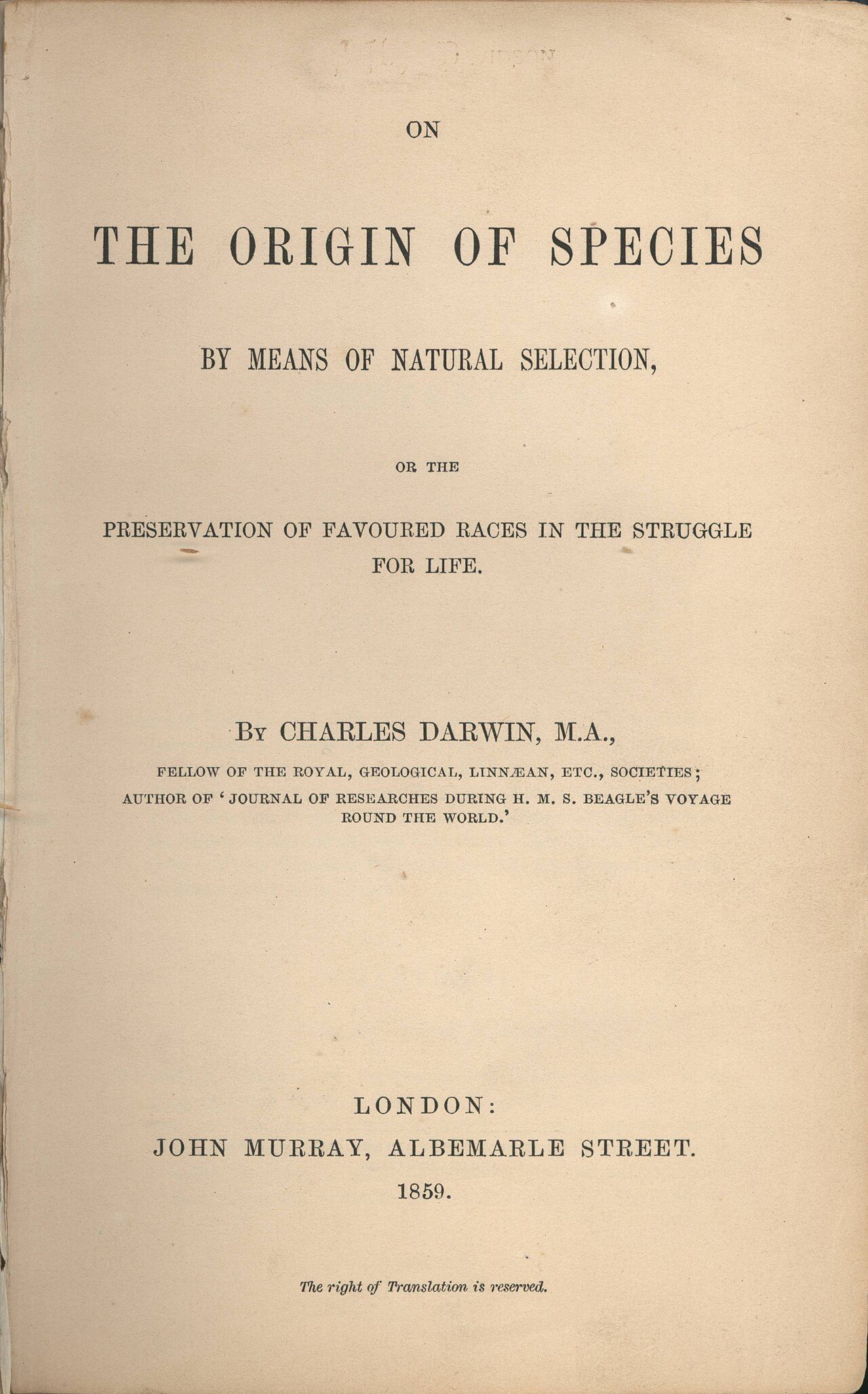
On 24 November 1859, the London publisher John Murray issued Charles Darwin's On the Origin of Species by Means of Natural Selection — 1,250 copies of a book, two decades in the making, that proposed evolution by natural selection and changed humanity's understanding of its own place in nature. The edition sold out on the first day. November 24 is also the day Tasman sighted Tasmania in 1642, Jack Ruby shot Lee Harvey Oswald on live television in 1963, and Toulouse-Lautrec was born in 1864.
Choose another date: open the On This Day calendar to browse events, births and deaths for any day of the year.
At a Glance
- The author
- Charles Darwin, 50, who had conceived natural selection in 1838 and delayed publishing for twenty years
- The trigger
- A letter in June 1858 from Alfred Russel Wallace, outlining the same theory from the Malay Archipelago
- The book
- An 'abstract' of Darwin's planned larger work, published by John Murray in an edition of 1,250 copies
- The argument
- Species evolve by descent with modification, as natural selection preserves favourable variations
- The omission
- The book barely discusses human evolution — one sentence promises that light will be thrown on the origin of man
- The reception
- Sold out on publication day; six editions followed in Darwin's lifetime amid fierce public debate
Events on this day
- 1642Dutch navigator Abel Janszoon Tasman sights the island that now bears his name, Tasmania, while seeking a sea route eastward from Batavia toward Chile.
- 1859Charles Darwin's On the Origin of Species is published in London — the featured story above.
- 1863In the 'Battle Above the Clouds', Union troops capture Lookout Mountain above Chattanooga, Tennessee, beginning the lifting of the Confederate siege.
- 1877Anna Sewell's novel Black Beauty, the autobiography of a horse, is published in London; it transforms attitudes to animal welfare.
- 1928The Federal Industrial Institution for Women, the first United States federal prison for women, opens at Alderson, West Virginia.
- 1932The FBI's crime laboratory — later the FBI Laboratory — opens in Washington, D.C., with one full-time employee and a borrowed microscope.
- 1947Ten Hollywood writers and directors — the Hollywood Ten — are cited for contempt of Congress for refusing to testify before the House Un-American Activities Committee.
- 1963Jack Ruby shoots Lee Harvey Oswald, the accused assassin of President Kennedy, in the basement of Dallas police headquarters, live on television.
- 1971A hijacker who gives his name as D. B. Cooper parachutes from a Northwest Orient airliner over the Pacific Northwest with $200,000 in ransom money and is never found.
- 1991Freddie Mercury, lead singer of Queen, dies in London — he is listed among this day's deaths below.
Born on this day
- 1849John Froelich — American inventor who built the first successful petrol-powered traction engine, the ancestor of the modern tractor.
- 1849Frances Hodgson Burnett — English-American author of The Secret Garden and A Little Princess.
- 1864Henri de Toulouse-Lautrec — French artist whose posters and paintings captured the nightlife of Montmartre.
- 1868Scott Joplin — American composer, the King of Ragtime, creator of the Maple Leaf Rag and The Entertainer.
- 1897Lucky Luciano — Sicilian-born American crime boss who organised the modern American Mafia's national syndicate.
Died on this day
- 1807Joseph Brant (Thayendanegea) — Mohawk leader who fought alongside the British in the American Revolution and worked for his people's land rights in Canada.
- 1957Diego Rivera — Mexican muralist whose vast public works retold his country's history, dead at 70 in Mexico City.
- 1963Lee Harvey Oswald — the accused assassin of President Kennedy, shot dead by Jack Ruby on live television at 24.
- 1991Freddie Mercury — lead singer of Queen, dead at 45 of bronchial pneumonia brought on by AIDS, a day after publicly confirming his illness.
- 1991Eric Carr — drummer of the rock band Kiss, dead of cancer at 41 on the same day as Freddie Mercury.
The featured story: On the Origin of Species is published, 24 November 1859
Darwin had returned from the Beagle voyage in 1836 with specimens and doubts, and by 1838, reading Malthus on population, he had the mechanism: in a world of struggle, favourable variations tend to be preserved and unfavourable ones destroyed — natural selection. Then, famously, he waited. He wrote a sketch in 1842 and a fuller essay in 1844, confessed the theory to a few trusted friends, gathered evidence from pigeon fanciers, barnacles and seeds, and settled into the life of an invalid country gentleman in Kent — while the idea, as he put it, was his 'child' that he could not yet face publishing.
What ended the delay arrived by post in June 1858: a manuscript from Alfred Russel Wallace, a young naturalist collecting in the Malay Archipelago, setting out the same theory of selection. Darwin, horrified and honourable in equal measure, let his friends Lyell and Hooker arrange a joint presentation of Wallace's paper and his own extracts to the Linnean Society that July — read to a room that little noticed what it had heard. Darwin then set to work on what he called an abstract of his great planned book. Written in thirteen months, On the Origin of Species was that abstract: the compressed, urgent version, published by John Murray on 24 November 1859.
The book argued from things readers could check: the breeding of pigeons and dogs, the distribution of species on islands, the succession of fossils, the family resemblances of embryos. Its single long argument built, case by case, to descent with modification — all living things related by common ancestry, shaped by selection acting on variation. On human beings Darwin said almost nothing, one sentence only, promising that light would be thrown on the origin of man and his history. Everyone understood the implication anyway, and the argument that followed — in reviews, sermons, caricatures and the famous Oxford debate of 1860 — was really about that sentence.
The first edition's 1,250 copies were taken by the trade on publication day, and Darwin revised the book through six editions, answering critics and, in places, retreating. Wallace, with a generosity rare in science, spent his life calling the theory Darwinism. Modern biology has filled in what Darwin lacked — he knew nothing of genes or the mechanism of inheritance — but the framework of 1859 remains the framework: one tree of life, branching by selection. It is difficult to name a book, after the scriptures, that has more thoroughly rearranged how its readers understand the world.
Why this date matters
November 24 is the day the modern world got two of its defining explanations and one of its defining mysteries. Darwin's book explained life itself by patient accumulation — of evidence over twenty years, of small changes over ages. The date's later entries run on the same theme of consequences compounding: a hijacker who vanished into the night in 1971 and was never identified, a gunman walking into a police basement in 1963 in front of the cameras, and a singer's death in 1991 that announced a plague to millions. Small causes, enormous effects: the day practises what Darwin preached.
Sources
- Encyclopaedia Britannica — On This Day: November 24
- HISTORY — What Happened on November 24
- Encyclopaedia Britannica — On the Origin of Species
- Smithsonian Magazine — Darwin and evolution (topic coverage)
The facts on this page were checked against these sources on 19 November 2026. The History Trail's permanent pages are researched and written for this site; the live profiles elsewhere on The History Trail are assembled automatically from Wikipedia and Wikidata.
About the Author
Researched and written by the The History Trail Editorial Team — the accountable editorial function behind this site's permanent story pages. The team works from the published sources cited on each page; it does not invent historians, reviewers or credentials, and it corrects errors openly.
Fact Check
Every load-bearing fact on this page traces to one of the sources listed above, and significant claims link to their source in the text. Our checking method is described on the methodology page; errors can be reported via the corrections page.
Sources & Citations
Cite this page as: The History Trail Editorial Team, The History Trail — this article's title, publication and update dates are shown beneath its headline. The full source list appears under Sources above; the site's source standards are on the sources page.