
On This Day
August 27 in History
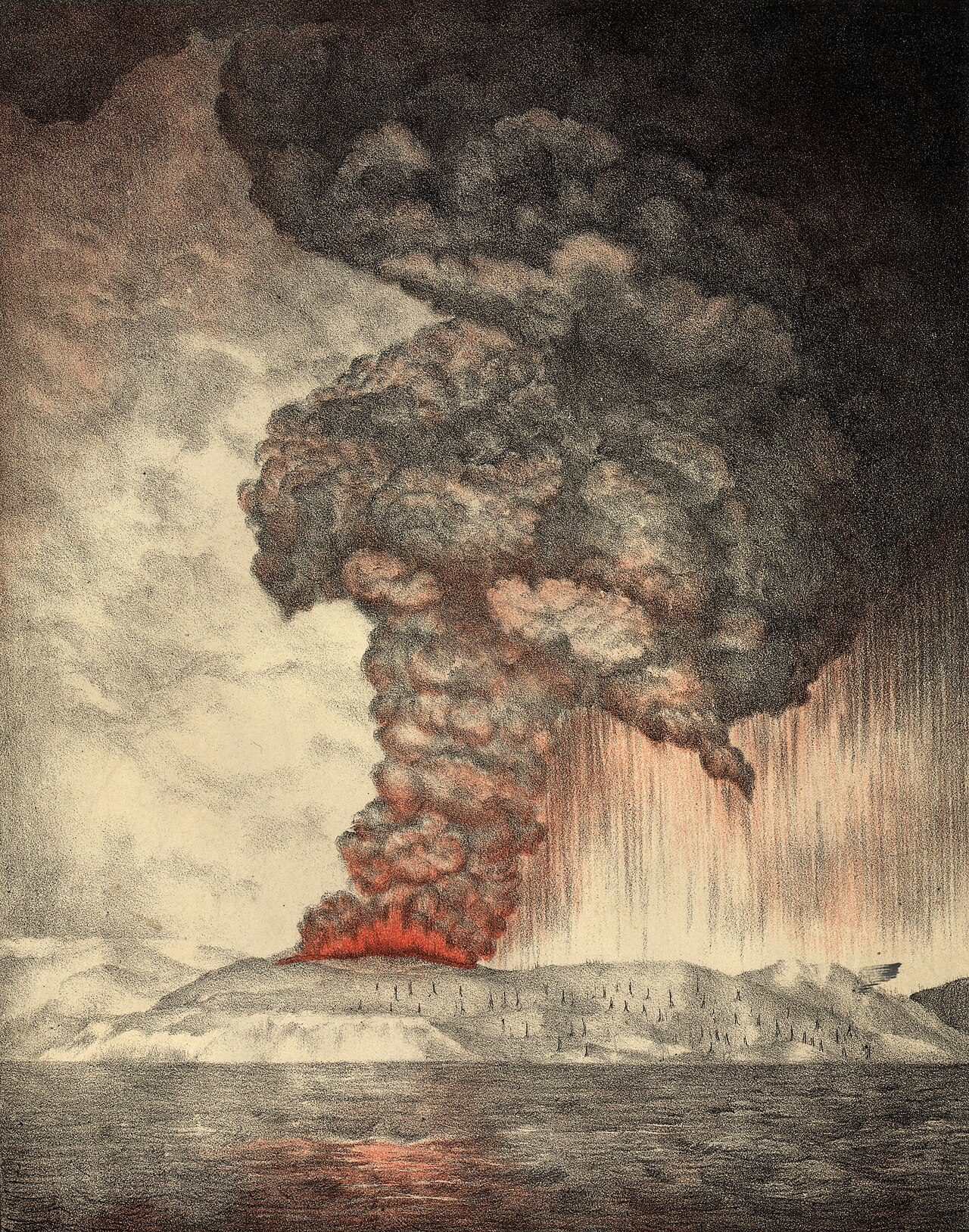
On 27 August 1883 the Indonesian volcano Krakatoa destroyed itself in a series of explosions heard 3,000 miles away, generating tsunamis that killed an estimated 36,000 people. August 27 is also the day Drake struck oil at Titusville, the Anglo-Zanzibar War lasted 38 minutes, and Lord Mountbatten was assassinated.
Choose another date: open the On This Day calendar to browse events, births and deaths for any day of the year.
At a Glance
- The place
- Krakatoa island, in the Sunda Strait between Java and Sumatra, then in the Dutch East Indies
- The climax
- Four enormous explosions on the morning of 27 August 1883, the largest at about 10:02 local time
- The sound
- Heard in Perth, Australia, and on Rodrigues Island near Mauritius, some 4,800 km away, the loudest sound in recorded history
- The killer
- Tsunamis up to about 35 metres high that swept away coastal towns including Anjer and Teluk Betung
- The toll
- An estimated 36,000 deaths, the great majority by drowning
- The aftermath
- Global temperatures fell by about 1.2 degrees Celsius; a new island, Anak Krakatau, rose from the caldera from 1927
Events on this day
- 1776British forces defeat Washington's army at the Battle of Long Island, the largest battle of the American Revolutionary War.
- 1859Edwin Drake's well strikes oil at Titusville, Pennsylvania, launching the modern petroleum industry.
- 1883Krakatoa destroys itself in a cataclysmic eruption — the featured story above.
- 1896The Anglo-Zanzibar War, the shortest war in recorded history, is fought and finished in about 38 minutes.
- 1939The Heinkel He 178 makes the first flight of a jet aircraft, days before the Second World War begins.
- 1962NASA launches Mariner 2, which becomes the first spacecraft to fly by another planet, Venus.
- 1979An IRA bomb kills Lord Mountbatten aboard his boat in Ireland; hours later, 18 British soldiers die at Warrenpoint.
- 1991Moldova declares independence from the Soviet Union.
- 2003Mars passes closer to Earth than at any time in nearly 60,000 years.
- 2008Barack Obama accepts the Democratic nomination for president in Denver.
Born on this day
- 1770Georg Wilhelm Friedrich Hegel — German philosopher of history and dialectic.
- 1871Theodore Dreiser — American novelist of Sister Carrie and An American Tragedy.
- 1890Man Ray — American artist and photographer at the heart of Dada and Surrealism.
- 1908Lyndon B. Johnson — 36th president of the United States, who escalated the Vietnam War and passed the Great Society laws.
- 1908Don Bradman — Australian cricketer whose batting average of 99.94 remains sport's most famous statistic.
- 1961Tom Ford — American fashion designer and film director.
- 1979Aaron Paul — American actor who played Jesse Pinkman in Breaking Bad.
Died on this day
- 1963W. E. B. Du Bois — American scholar and civil rights founder, dead at 95 in Ghana, on the eve of the March on Washington.
- 1965Le Corbusier — Swiss-French architect who defined modernist building, dead while swimming at 77.
- 1967Brian Epstein — manager who took the Beatles from Liverpool clubs to the world, dead at 32.
- 1975Haile Selassie — emperor of Ethiopia for four decades, dead a year after his deposition, in disputed circumstances.
- 1979Lord Mountbatten — British statesman and last viceroy of India, assassinated by the IRA at 79.
- 1990Stevie Ray Vaughan — American blues guitarist, killed in a helicopter crash at 35 after a concert.
The featured story: Krakatoa destroys itself, 27 August 1883
Krakatoa had been grumbling since May 1883, entertaining tourists who sailed out to watch its smoking cone. On Sunday 26 August the eruption turned violent, and by the next morning the island in the Sunda Strait was tearing itself apart. Four colossal explosions punctuated the morning of 27 August, the greatest at about ten o'clock, heard as distant cannon fire in Perth, Western Australia, and on Rodrigues Island in the Indian Ocean, nearly 5,000 kilometres away. It remains the loudest sound in recorded history, and its pressure wave was registered on barographs around the world, circling the Earth three and a half times.
The sound killed no one. The sea did. As the volcano's emptying magma chamber collapsed, two-thirds of the island fell into the ocean, displacing the water into a series of tsunamis. Waves reported at up to 35 metres struck the coasts of Java and Sumatra without warning, erasing the lighthouse town of Anjer, sweeping away Teluk Betung, and destroying more than 160 villages. An estimated 36,000 people died, most of them in minutes, including nearly everyone on the shores nearest the strait. A Dutch warship was carried two miles inland and left stranded in the jungle.
Then the sky changed. Krakatoa had thrown an estimated 20 cubic kilometres of rock and ash into the stratosphere, veiling the Earth in a sulphate haze. For years afterwards the world watched blood-red sunsets, blue moons and a halo around the sun named Bishop's Ring; artists such as William Ascroft in London sketched the lurid evenings hundreds of times. Global average temperatures fell by about 1.2 degrees Celsius, and weather patterns stayed disturbed for half a decade, the nineteenth century's clearest lesson that a single volcano can edit the climate of a planet.
The Royal Society's investigation, published in 1888 under G. J. Symons, became a model of global scientific reporting, assembled from hundreds of eyewitnesses, tide gauges and barographs. The caldera left by the collapse stayed quiet until 1927, when a new cone breached the surface at the same spot. Sailors named it Anak Krakatau, the child of Krakatoa. It has been growing, and occasionally reminding the strait's coasts of 1883, ever since.
Why this date matters
August 27 is the loudest date in the calendar, literally: its centrepiece was heard on another continent's far side. But the day is also about beginnings disguised as endings. An island vanished and a new one eventually rose in its place; a well in Pennsylvania struck oil and started the age that would warm the world Krakatoa cooled; the first jet flew six days before the war it would transform. Even its assassinations and early deaths, Mountbatten, Du Bois, Vaughan, read as hinges between eras rather than full stops. It is also, fittingly, the anniversary of W. E. B. Du Bois's death in exile in Ghana in 1963, the night before the March on Washington crowned the movement he had helped to found more than half a century earlier.
Sources
- Encyclopaedia Britannica — On This Day: August 27
- HISTORY — What Happened on August 27
- Smithsonian Institution, Global Volcanism Program — Krakatoa 1883 image collection
- Encyclopaedia Britannica — Edwin Drake
- Wikimedia Commons — Krakatoa eruption lithograph

The facts on this page were checked against these sources on 19 November 2026. The History Trail's permanent pages are researched and written for this site; the live profiles elsewhere on The History Trail are assembled automatically from Wikipedia and Wikidata.
About the Author
Researched and written by the The History Trail Editorial Team — the accountable editorial function behind this site's permanent story pages. The team works from the published sources cited on each page; it does not invent historians, reviewers or credentials, and it corrects errors openly.
Fact Check
Every load-bearing fact on this page traces to one of the sources listed above, and significant claims link to their source in the text. Our checking method is described on the methodology page; errors can be reported via the corrections page.
Sources & Citations
Cite this page as: The History Trail Editorial Team, The History Trail — this article's title, publication and update dates are shown beneath its headline. The full source list appears under Sources above; the site's source standards are on the sources page.