
On This Day
June 24 in History
On 24 June 1948 the Soviet Union sealed the roads, railways and canals into West Berlin, gambling that two million people could be starved into submission. The Western answer — an airlift that supplied a city from the sky for eleven months — defined the early Cold War. June 24 is also the day Napoleon invaded Russia, Cabot reached North America and Messi was born.
Choose another date: open the On This Day calendar to browse events, births and deaths for any day of the year.
At a Glance
- The blockade
- From 24 June 1948 the Soviet Union blocked all road, rail and canal access to West Berlin
- The city
- More than two million people in the Western sectors, 110 miles inside the Soviet occupation zone
- The trigger
- The Western allies' currency reform and moves toward a West German state
- The answer
- The Berlin Airlift, flying in food, coal and supplies around the clock
- The record day
- Nearly 13,000 tons delivered in twenty-four hours at the operation's April 1949 peak
- The end
- The Soviets lifted the blockade on 12 May 1949; the airlift ran on until September 1949
Events on this day
- 1497John Cabot lands on the coast of North America, the first European to reach the mainland since the Vikings.
- 1675King Philip's War begins in New England as Wampanoag warriors attack the settlement of Swansea, Massachusetts.
- 1717Four London lodges found the first Masonic Grand Lodge, the governing body of modern Freemasonry.
- 1812Napoleon leads some 600,000 troops of the Grande Armee across the Niemen river, beginning his invasion of Russia.
- 1821Simon Bolivar defeats Spanish royalist forces at the Battle of Carabobo, securing Venezuela's independence.
- 1859France and Piedmont-Sardinia defeat Austria at the Battle of Solferino; the suffering witnessed there leads Henry Dunant to found the Red Cross movement.
- 1932A bloodless coup in Siam ends the absolute monarchy and begins Thailand's constitutional era.
- 1947The pilot Kenneth Arnold reports objects 'flying like saucers' over Mount Rainier, the sighting that launches the modern UFO era.
- 1948The Soviet Union blocks all land routes to West Berlin, beginning the Berlin Blockade — the featured story above.
- 2010Julia Gillard is sworn in as Australia's first female prime minister.
- 2021A condominium tower collapses at Surfside, Florida, killing 98 people.
- 2022The United States Supreme Court, in Dobbs v. Jackson, overturns Roe v. Wade and ends the constitutional right to abortion.
Born on this day
- 1519Theodore Beza — French theologian who succeeded John Calvin as leader of the Reformation in Geneva.
- 1831Henry Howard Molyneux Herbert, 4th Earl of Carnarvon — British statesman associated with Canadian confederation and South African policy.
- 1895Jack Dempsey — American boxer, world heavyweight champion from 1919 to 1926.
- 1901Harry Partch — American composer who built his own instruments to play music in a 43-tone scale.
- 1915Sir Fred Hoyle — British astronomer who coined the phrase 'big bang' and championed the steady-state theory.
- 1941Julia Kristeva — Bulgarian-born French philosopher, linguist and literary theorist.
- 1987Lionel Messi — Argentine footballer, eight-time Ballon d'Or winner and captain of Argentina's 2022 World Cup-winning team.
Died on this day
- 1519Lucrezia Borgia — Italian noblewoman of the Borgia family, duchess consort of Ferrara, dead at 39.
- 1795William Smellie — Scottish printer and compiler of the first edition of the Encyclopaedia Britannica, dead at 55.
- 1908Grover Cleveland — the only United States president to serve two non-consecutive terms, dead at Princeton at 71.
- 1935Carlos Gardel — Argentine tango singer, the voice of the tango, killed in an air crash in Colombia at 44.
The featured story: the Berlin Blockade begins, 24 June 1948
On 24 June 1948 the Soviet Union closed every road, railway and canal linking West Berlin to the Western zones of Germany, and the first great crisis of the Cold War began. West Berlin — the American, British and French sectors of the former capital — sat 110 miles inside the Soviet occupation zone, with a population of more than two million. Britannica records that the blockade intensified that day when the Soviet Union announced that the Western Allied powers no longer had any rights in Berlin. Electricity from Soviet-sector power stations was cut, and food and coal deliveries by land stopped. The Western garrisons and the city's people faced a simple calculation: a city of that size needed thousands of tons of supplies a day, and none could now arrive by surface.
The blockade grew out of the collapse of four-power rule in Germany. The Western allies, moving to rebuild their zones as a single economy, had introduced a new currency, the Deutschmark, days earlier; the Soviets answered with a currency of their own and then with the blockade, calculating that the West would either abandon Berlin or abandon its plans for a West German state. Withdrawal was politically impossible and a land convoy, forced through, risked war. The American military governor, General Lucius Clay, backed the third option, the one the British had already begun sketching: supply the city entirely by air, using the three air corridors guaranteed in writing by the wartime agreements.
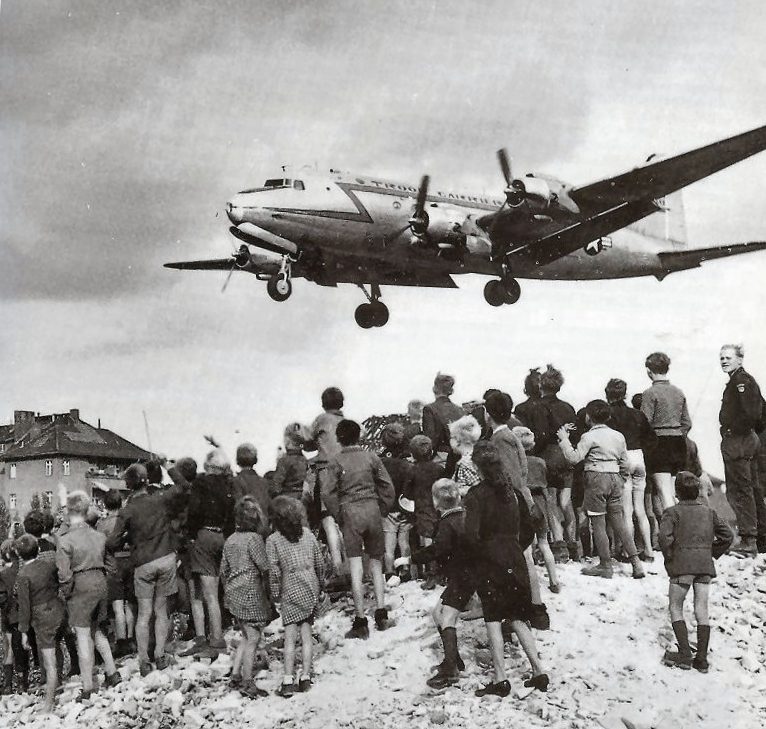
The airlift that followed was an industrial operation conducted in the sky. American C-54s and British transport aircraft, later joined by flying boats that landed on the Havel lake, flew around the clock in all weather, landing at Tempelhof, Gatow and the new airfield built at Tegel by Berliners themselves. At the peak, aircraft were landing in Berlin every few minutes; on the record 'Easter Parade' day of April 1949 the fleet delivered nearly 13,000 tons in twenty-four hours. In total the airlift carried in more than two million tons of food, coal and supplies. It also acquired a human face: the pilot Gail Halvorsen began dropping handkerchief-parachute parcels of sweets for Berlin's children, and the 'candy bombers' became the enduring image of the operation.
The blockade failed on its own terms. Far from prising the West out of Berlin, it welded West Berliners to the Western allies, discredited the Soviet Union in German eyes, and accelerated exactly what Moscow had hoped to prevent: the founding of the Federal Republic of Germany and the NATO alliance in 1949. On 12 May 1949 the Soviets lifted the surface blockade, having gained nothing; the airlift continued until September to build up reserves. Berlin remained divided, and crises over it would return, culminating in the Wall of 1961 — but the lesson of 1948 stood: the city could be held, at ruinous expense and risk, and both sides knew it.
Why this date matters
June 24, midsummer's day in the old calendar, is a date of crossings and sieges. Cabot reached a new continent on it in 1497 and Napoleon crossed into Russia on it in 1812, at the head of the largest army Europe had ever seen, toward the disaster that defines overreach. In 1948 the pattern inverted: Berlin was cut off, and the answer to a siege was not a march but an air bridge — logistics as strategy, coal and flour as weapons. Between those poles the day holds quieter foundings, a Grand Lodge in a London alehouse and the Red Cross conceived on the field of Solferino. It is a date that asks how societies supply, relieve and endure.
Sources
- Encyclopaedia Britannica — On This Day: June 24
- HISTORY — What Happened on June 24
- Encyclopaedia Britannica — Berlin Blockade
- HISTORY — Soviets blockade West Berlin
The facts on this page were checked against these sources on 19 November 2026. The History Trail's permanent pages are researched and written for this site; the live profiles elsewhere on The History Trail are assembled automatically from Wikipedia and Wikidata.
About the Author
Researched and written by the The History Trail Editorial Team — the accountable editorial function behind this site's permanent story pages. The team works from the published sources cited on each page; it does not invent historians, reviewers or credentials, and it corrects errors openly.
Fact Check
Every load-bearing fact on this page traces to one of the sources listed above, and significant claims link to their source in the text. Our checking method is described on the methodology page; errors can be reported via the corrections page.
Sources & Citations
Cite this page as: The History Trail Editorial Team, The History Trail — this article's title, publication and update dates are shown beneath its headline. The full source list appears under Sources above; the site's source standards are on the sources page.