
Years
1846 in History
1846 is a year of things found by calculation and founded by bequest. On 23 September Johann Galle found Neptune at the Berlin Observatory, within about a degree of where Urbain Le Verrier's mathematics had placed it — the first planet found by calculation. On 10 August the Smithsonian Institution was created in Washington. The same year the United States declared war on Mexico, the Saints began their exodus from Nauvoo, and ether was first publicly demonstrated as a surgical anaesthetic.
At a Glance
- Defining event
- Neptune is discovered at Berlin, 23 September 1846, within about a degree of Le Verrier's predicted position
- The bequest
- The Smithsonian Institution is created by act of Congress, 10 August, from James Smithson's fortune
- The donor
- James Smithson, an English scientist who died in 1829 and never visited the United States
- War declared
- The United States formally declares war on Mexico, 13 May
- Borders settled
- The Oregon Treaty fixes the Canada–U.S. border along the 49th parallel, 15 June
- Painless surgery
- William Morton publicly demonstrates ether as a surgical anaesthetic, 16 October — 'Ether Day'
The defining story: a planet found on paper
Neptune was found twice: first on paper, then in the sky. By the 1840s Uranus, discovered in 1781, refused to follow the path Newton's laws prescribed for it, and astronomers faced a choice between doubting Newton and believing in an eighth planet whose gravity was tugging it off course. Two young mathematicians, working independently and in rivalry, chose the planet: John Couch Adams in Cambridge and Urbain Le Verrier in Paris each computed where the invisible body had to be. Adams finished first but could not persuade British astronomers to search promptly; a half-hearted Cambridge search actually recorded Neptune twice without recognising it.
Le Verrier, meeting the same indifference in Paris, wrote instead to a stranger — Johann Galle at the Berlin Observatory — enclosing his predicted position. The letter arrived on 23 September 1846; that evening Galle, with his assistant Heinrich d'Arrest, turned the observatory's telescope to the spot and found Neptune within about a degree of the predicted place. D'Arrest suggested checking a new star chart, which showed a 'star' that was not on it; the object's movement against the background stars the following night confirmed a planet. It was the first planet found by mathematics — a triumph of calculation over the telescope.
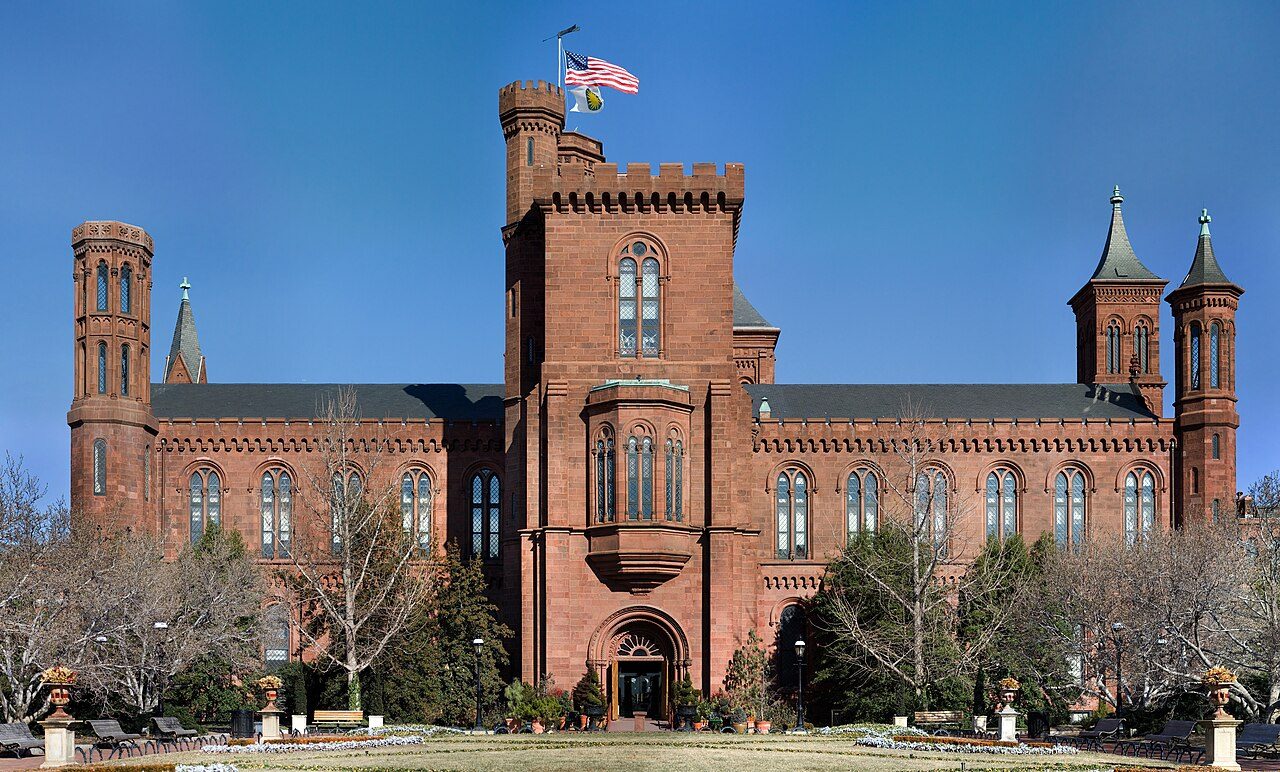
The year's other foundation was founded on paper too. James Smithson, an English chemist who died in 1829 having never visited the United States, left his fortune, should his nephew die without heirs, 'for the increase and diffusion of knowledge'. After a decade of debate over the bequest, President James K. Polk signed the act establishing the Smithsonian Institution on 10 August 1846. Its first home, the red sandstone 'Castle' above, still stands on the National Mall in Washington.
Around those two acts of faith in knowledge, 1846 was a year of force. The Saints began their exodus from Nauvoo, Illinois, on 4 February, two years after Joseph Smith's killing. President Polk asked Congress to declare war on Mexico on 11 May, claiming American blood had been shed on American soil, and the United States formally declared war on 13 May; in June settlers proclaimed the Bear Flag Republic in California, and on 15 June the Oregon Treaty fixed the Canada–U.S. border along the 49th parallel to the Pacific. On 16 October, at Massachusetts General Hospital, dentist William Morton publicly demonstrated ether as a surgical anaesthetic — 'Ether Day', the birthday of painless surgery, in the year that also patented the saxophone and the lockstitch sewing machine.
Timeline of 1846
- 4 February
Members of the Church of Jesus Christ of Latter-day Saints begin their exodus from Nauvoo, Illinois.
- 11 May
President James K. Polk asks Congress to declare war on Mexico.
- 13 May
The United States formally declares war on Mexico.
- 14 June
American settlers proclaim the Bear Flag Republic in California, revolting against Mexican rule.
- 15 June
Britain and the United States sign the Oregon Treaty, fixing the Canada–U.S. border along the 49th parallel.
- 19 June
The first recorded baseball game under modern rules is played at the Elysian Fields in Hoboken, New Jersey.
- 28 June
Adolphe Sax receives a French patent for the saxophone.
- 9 July
U.S. naval forces raise the American flag at Yerba Buena, the settlement that becomes San Francisco.
- 10 August
The Smithsonian Institution is created by act of Congress in Washington.
- 10 September
Elias Howe receives the first U.S. patent for a sewing machine using a lockstitch design.
- 23 September
Galle and d'Arrest observe Neptune at Berlin, where Le Verrier's calculations predicted it.
- 16 October
Dentist William Morton publicly demonstrates ether as a surgical anaesthetic at Massachusetts General Hospital.
- 28 December
Iowa is admitted to the Union as the 29th state.
Why 1846 still matters
1846 still matters because it proved two kinds of reach. Neptune's discovery was the supreme vindication of Newtonian astronomy: a planet no one had knowingly seen was deduced from another planet's misbehaviour and found the same evening the letter arrived. It changed what 'discovery' meant — and completed the story Herschel began in 1781, when Uranus, the planet whose straying betrayed Neptune, was itself the first planet found by telescope. Only one spacecraft, Voyager 2 in 1989, has ever visited the world Galle saw.
The Smithsonian's creation gave the United States its national attic and laboratory: an institution for 'the increase and diffusion of knowledge', funded by a foreigner who never saw the country, argued over for a decade, and grown into the world's largest museum and research complex. Its Castle, raised on the Mall, remains the visible signature of the bequest — knowledge endowed, improbably, by a stranger's will.
The year's other legacies are written on maps and in operating theatres. The Mexican-American War begun in May 1846 would transfer the Southwest to the United States; the Oregon Treaty drew the northern border that still stands; the Bidlack Treaty of 12 December gave the United States transit rights across Panama, a foothold that led eventually to the Panama Canal. Ether Day ended surgery's age of agony, and the Donner Party, which left Independence, Missouri, on 12 May, supplied the year's cautionary tale of the westward road.
1846 on The History Trail
A calculated planet, an endowed museum and a declared war — 1846 day by day.
- September 23 in History — Neptune is discovered — the featured story of the calculated planet.
- August 10 in History — The Smithsonian Institution is created.
- May 13 in History — The United States declares war on Mexico.
- October 16 in History — Ether is demonstrated as a surgical anaesthetic.
- June 15 in History — The Oregon Treaty fixes the northern border.
- December 28 in History — Iowa becomes the 29th state.
Sources
- HISTORY — This Day in History: September 23
- American Physical Society — September 23, 1846: Neptune's Existence Observationally Confirmed
- Smithsonian Institution — A Brief History of the Smithsonian Institution
- Smithsonian Institution Archives — General History
- Encyclopaedia Britannica — On This Day: May 13
- Encyclopaedia Britannica — On This Day: October 16
The facts on this page were checked against these sources on 19 November 2026. The History Trail's permanent pages are researched and written for this site; the live profiles elsewhere on The History Trail are assembled automatically from Wikipedia and Wikidata.
About the Author
Researched and written by the The History Trail Editorial Team — the accountable editorial function behind this site's permanent story pages. The team works from the published sources cited on each page; it does not invent historians, reviewers or credentials, and it corrects errors openly.
Fact Check
Every load-bearing fact on this page traces to one of the sources listed above, and significant claims link to their source in the text. Our checking method is described on the methodology page; errors can be reported via the corrections page.
Sources & Citations
Cite this page as: The History Trail Editorial Team, The History Trail — this article's title, publication and update dates are shown beneath its headline. The full source list appears under Sources above; the site's source standards are on the sources page.