
Years
1844 in History
1844 joined a new age of instant words to an old violence. On 24 May Samuel Morse demonstrated his telegraph, sending 'What hath God wrought?' from Washington to Baltimore. Five weeks later, on 27 June, Joseph Smith, founder of the Latter Day Saint movement, was shot by a mob that stormed Carthage Jail — a killing that sent his followers west under Brigham Young. The same year saw the Dominican Republic founded, the last great auks killed and the YMCA born in London.
At a Glance
- Defining event
- Joseph Smith is killed by a mob at Carthage Jail, Illinois, 27 June 1844
- The message
- Samuel Morse demonstrates the telegraph, 24 May — 'What hath God wrought?' from Washington to Baltimore
- The succession
- The largest body of Saints follows Brigham Young west to the Great Salt Lake in 1847
- An extinction
- The last two great auks are killed on Eldey Island, Iceland — some sources date the killing to 3 July instead
- A movement founded
- George Williams founds the YMCA in London, 6 June
- A patent
- Charles Goodyear receives his patent for vulcanised rubber, 15 June
The defining story: the killing at Carthage
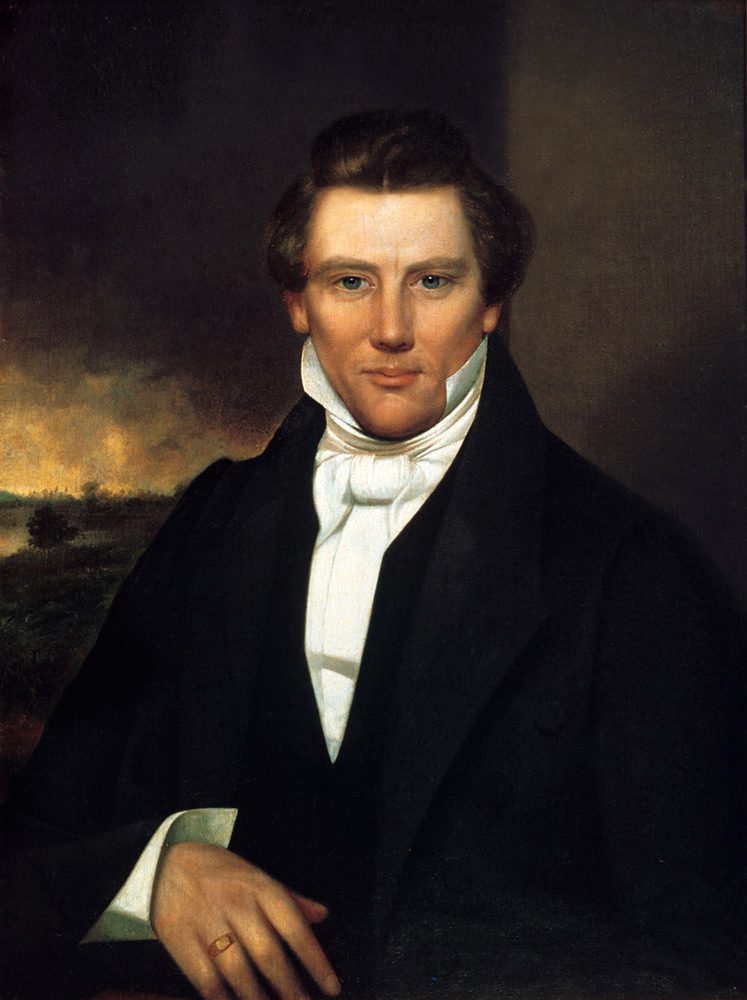
Joseph Smith had built, in fourteen years, one of the most remarkable movements of the American frontier. The Book of Mormon, which he published in 1830 as a translation of ancient golden plates, drew converts first to Ohio, then Missouri, where violence drove them out, and finally to Nauvoo, Illinois, a city the Saints built on the Mississippi until it rivalled Chicago in size. There Smith's authority became civil as well as spiritual: he was mayor of Nauvoo, lieutenant-general of its militia and, by 1844, a candidate for president of the United States. The portrait above, from about 1842, shows him two years before his death, long owned by his son Joseph Smith III.
The charge that put him in jail grew from an act of censorship. Smith, as mayor, had ordered the destruction of the press of the Nauvoo Expositor after a single issue — a paper published by dissident Latter Day Saints that had accused him of plural marriage and theocratic rule. Arrested on charges arising from the destruction, Smith and his brother Hyrum were held at Carthage Jail, under a governor's promise of protection that the militia guarding the jail could not be trusted to keep.
On the afternoon of 27 June 1844 a mob with blackened faces stormed the jail. Joseph Smith and his brother Hyrum were shot and killed; Smith was 38 years old. Five men were later tried for the murders, and all were acquitted. The killing made Smith a martyr to his followers, and the succession that followed decided the movement's future: the largest body of Saints followed Brigham Young, and under him made the migration to Utah — the exodus from Nauvoo that began in February 1846 and reached the Great Salt Lake in 1847.
Five weeks before Carthage, the year had announced a different future. On 24 May Samuel Morse demonstrated his telegraph, sending the message 'What hath God wrought?' from Washington to Baltimore — the first instant long-distance communication, and the beginning of the end of news travelling at the speed of a horse. Around those poles the year turned: on 27 February the Dominican Republic declared independence from Haiti; on 28 February a cannon exploded aboard USS Princeton, killing senior officials while President Tyler, below deck, escaped; on 3 June the last two great auks were killed on Eldey Island, Iceland — though some sources date the killing to 3 July instead — and the species was extinct; and on 6 June George Williams founded the Young Men's Christian Association in London.
Timeline of 1844
- 27 February
The Dominican Republic declares its independence from Haiti, founding the modern Dominican state.
- 28 February
A cannon explodes aboard USS Princeton on the Potomac, killing senior government officials; President Tyler escapes unharmed.
- 24 May
Samuel Morse demonstrates his telegraph, sending 'What hath God wrought?' from Washington to Baltimore.
- 3 June
The last two great auks are killed on Eldey Island, Iceland, and the species is extinct; some sources date the killing to 3 July instead.
- 6 June
George Williams founds the Young Men's Christian Association (YMCA) in London.
- 15 June
Charles Goodyear receives his patent for vulcanised rubber, the process that makes the tyre age possible.
- 26 June
President John Tyler marries Julia Gardiner — the first U.S. president to marry while in office.
- 27 June
Joseph Smith, founder of the Latter Day Saint movement, is killed by a mob at Carthage, Illinois.
- 25 July
Thomas Eakins, the American realist painter of The Gross Clinic, is born in Philadelphia.
- 15 October
Friedrich Nietzsche, whose assaults on conventional morality reshaped modern thought, is born.
- 22 October
Sarah Bernhardt, the most famous stage performer of her era, is born in Paris.
- 25 November
Karl Benz, who will build the first practical automobile, is born in Germany.
Why 1844 still matters
1844 still matters for the distance between its two headline events. Morse's telegraph began the compression of the world: within a generation, news, markets and wars would move at electrical speed, and the message chosen for the demonstration — a line of Scripture asking what God had wrought — captured both the wonder and the unease of the invention. Smith's killing marks the counter-current: a republic that could transmit words instantly still settled religious difference, at Carthage, with a mob, and acquitted the men tried for it.
The migration that followed Carthage reshaped the American West. Brigham Young's Saints built Utah, and the church Smith founded became a global faith; Carthage Jail is preserved as a shrine, and Smith is honoured by his followers as a martyr. The movement organised by Smith in 1830 had survived its founder's murder — the test most new religions fail.
The year's quieter entries seeded the next century's texture: Goodyear's vulcanised rubber patent made the tyre age possible; the YMCA became a worldwide movement; and the great auk's extinction — two birds killed for collectors on an Icelandic island — became an early emblem of species loss by human hands. The births of Nietzsche on 15 October and Karl Benz on 25 November supplied, respectively, modern philosophy's great critic and the automobile's builder.
1844 on The History Trail
A telegraph, a martyr and an extinction — 1844 day by day.
- June 27 in History — Joseph Smith is killed by a mob — the featured story of Carthage.
- May 24 in History — Morse demonstrates the telegraph.
- June 3 in History — The last great auks are killed on Eldey Island.
- June 6 in History — The YMCA is founded in London.
- February 27 in History — The Dominican Republic declares independence.
- October 15 in History — Friedrich Nietzsche is born.
Sources
- Encyclopaedia Britannica — Joseph Smith
- HISTORY — What Happened on June 27
- https://www.britannica.com/on-this-day/June-27
- HISTORY — This Day in History: May 24
- Encyclopaedia Britannica — On This Day: June 3
- Encyclopaedia Britannica — On This Day: June 6
The facts on this page were checked against these sources on 19 November 2026. The History Trail's permanent pages are researched and written for this site; the live profiles elsewhere on The History Trail are assembled automatically from Wikipedia and Wikidata.
About the Author
Researched and written by the The History Trail Editorial Team — the accountable editorial function behind this site's permanent story pages. The team works from the published sources cited on each page; it does not invent historians, reviewers or credentials, and it corrects errors openly.
Fact Check
Every load-bearing fact on this page traces to one of the sources listed above, and significant claims link to their source in the text. Our checking method is described on the methodology page; errors can be reported via the corrections page.
Sources & Citations
Cite this page as: The History Trail Editorial Team, The History Trail — this article's title, publication and update dates are shown beneath its headline. The full source list appears under Sources above; the site's source standards are on the sources page.