
On This Day
June 15 in History
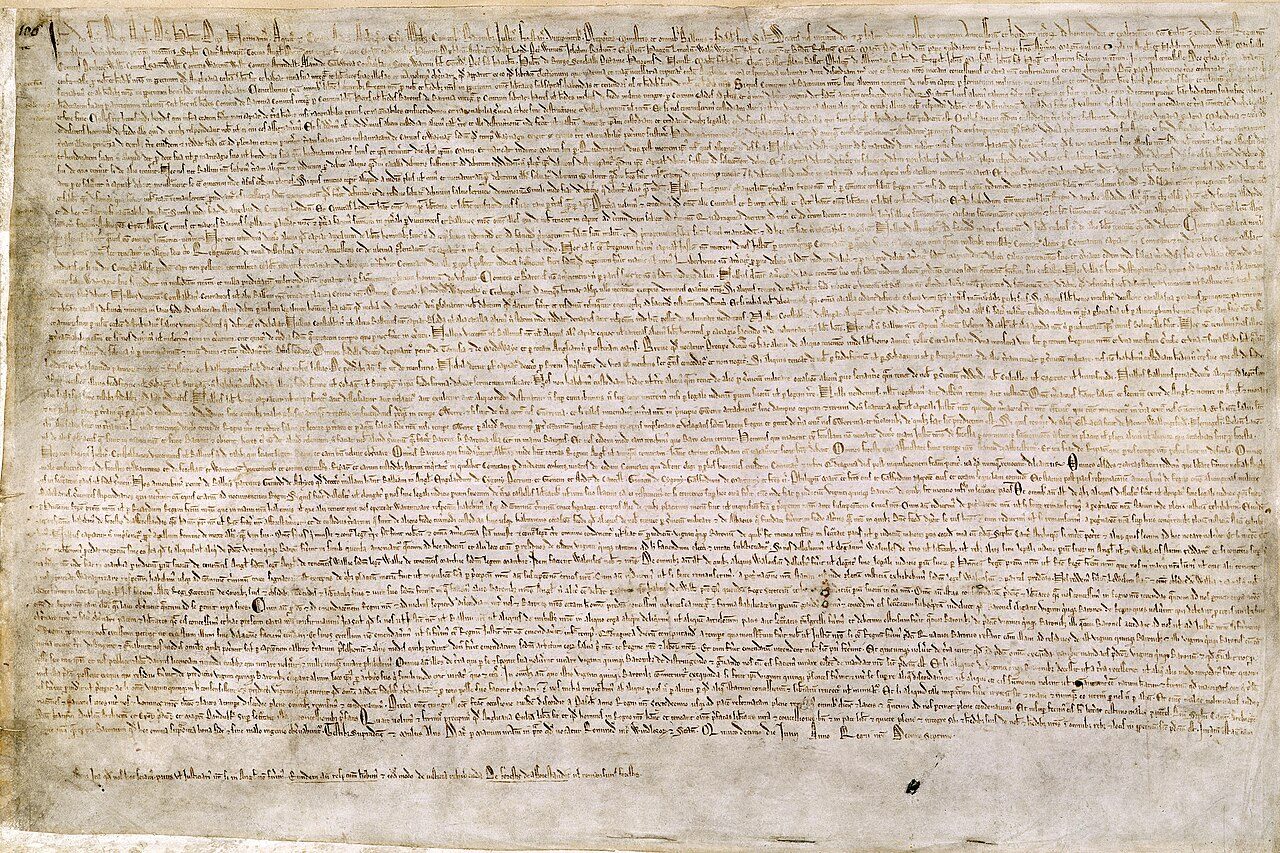
On 15 June 1215, at Runnymede on the Thames, King John sealed Magna Carta — the charter that first put into writing the idea that a king's power has legal limits. June 15 is also the day of the first documented blood transfusion, Goodyear's rubber patent, and the photographs that proved a galloping horse leaves the ground.
Choose another date: open the On This Day calendar to browse events, births and deaths for any day of the year.
At a Glance
- The place
- Runnymede, a meadow on the Thames between Windsor and Staines, neutral ground between king and barons
- The act
- King John applied his great seal on 15 June 1215 — he did not sign; charters were sealed, not signed
- The text
- 63 clauses in Latin covering feudal dues, the Church, widows' rights, weights and measures, and justice
- The famous clauses
- 39 and 40: no free man punished except by lawful judgement; justice not to be sold, denied or delayed
- The immediate fate
- Pope Innocent III annulled the charter within weeks; civil war followed and John died in 1216
- The survival
- Reissued in 1216, 1217 and 1225 for Henry III; four copies of the 1215 text survive
Events on this day
- 1215King John seals Magna Carta at Runnymede under pressure from his barons — the featured story above.
- 1667Jean-Baptiste Denis performs the first fully documented human blood transfusion, giving a teenage boy sheep's blood; the boy survives.
- 1775The Continental Congress appoints George Washington commander-in-chief of the Continental Army.
- 1844Charles Goodyear receives his patent for vulcanised rubber, the process that makes the tyre age possible.
- 1846Britain and the United States sign the Oregon Treaty, fixing the Canada–US border along the 49th parallel to the Pacific.
- 1878Eadweard Muybridge photographs a galloping horse in sequence in California, proving all four hooves leave the ground — a founding moment of the motion picture.
- 1919Alcock and Brown land in an Irish bog, completing the first nonstop transatlantic flight after sixteen hours aloft.
- 1944American Marines storm ashore on Saipan in the Marianas, opening one of the Pacific War's bloodiest battles.
- 1977Spain votes in its first free general election since 1936, two years after Franco's death.
- 2001The Shanghai Cooperation Organisation is founded by China, Russia and four Central Asian states.
Born on this day
- 1843Edvard Grieg — Norwegian composer whose lyric pieces and Peer Gynt suites made Norway's folk voice classical.
- 1914Yuri Andropov — Soviet intelligence chief who became general secretary of the Communist Party in 1982.
- 1946Demis Roussos — Greek singer whose soaring solo hits sold tens of millions of records in the 1970s.
- 1964Courteney Cox — American actress who found fame as Monica in Friends.
- 1969Ice Cube — American rapper and actor, from N.W.A polemicist to Hollywood leading man.
- 1969Oliver Kahn — German goalkeeper, captain of club and country and the 2002 World Cup's outstanding player.
Died on this day
- 1849James K. Polk — 11th president of the United States, dead at 53 just three months after leaving office.
- 1888Frederick III — German emperor for only 99 days before throat cancer killed him, in the Year of the Three Emperors.
- 1996Ella Fitzgerald — American jazz singer, the 'First Lady of Song', dead at 79.
- 2019Franco Zeffirelli — Italian director of operas and of the beloved 1968 Romeo and Juliet, dead at 96.
The featured story: Magna Carta is sealed at Runnymede, 15 June 1215
On 15 June 1215, in a water-meadow at Runnymede beside the Thames between Windsor and Staines, King John of England put his great seal to the document the world knows as Magna Carta — the Great Charter. He did not sign it; medieval kings authenticated with a seal, and the wax impression was pressed to a text of 63 clauses, in abbreviated Latin, that his rebellious barons had essentially dictated. It was a peace treaty meant to end a civil war, negotiated by Archbishop Stephen Langton between a king who had run out of money, allies and excuses, and barons who had seized London and renounced their allegiance.
John had earned the confrontation. He had lost Normandy and most of England's French possessions, quarrelled with the Pope until England lay under interdict and he himself was excommunicated, bought his way back by surrendering his kingdom to Rome as a papal fief, and financed it all with feudal dues raised to extortionate levels, ransoms, fines and seizures of hostages. When his final attempt to recover France collapsed at Bouvines in 1214, the barons' patience ended. The charter they imposed limited the sums heirs owed for their inheritances, protected widows and the Church, standardised weights and measures — and, in its famous clauses 39 and 40, promised that no free man would be imprisoned or dispossessed except by lawful judgement of his equals or the law of the land, and that justice would not be sold, denied or delayed.
As a peace treaty it failed within weeks. John appealed to the Pope, who annulled the charter that August as shameful and demeaning; both sides went to war, the barons invited Prince Louis of France to take the throne, and by the time John died of dysentery in October 1216 England was half occupied. What saved the charter was his death: the regents of his nine-year-old son, Henry III, reissued it in 1216 and again in 1217 and 1225, each time to buy loyalty — and a document issued to win a war became, by repetition, part of the furniture of English law.
Its afterlife outgrew its origins entirely. Most of its clauses concerned feudal technicalities and have been repealed; only a handful remain in force. But clauses 39 and 40 were taken up by seventeenth-century lawyers fighting the Stuart kings, carried to America by colonists who read them as the birthright of every English subject, and echoed in the Fifth Amendment's guarantee of due process. A failed peace deal between a bad king and his barons became, over eight centuries, the world's most famous symbol of the idea that no ruler stands above the law.
Why this date matters
June 15 is the calendar's great day for documents and demonstrations. Its centrepiece is a charter that failed as a treaty and triumphed as an idea; around it cluster a patent that made modern transport possible, a treaty that drew a continental border, a sequence of photographs that invented cinema's basic fact, and a doctor in Paris transfusing sheep's blood into a boy because nobody yet knew why it should not work. The day's pattern is experiment under pressure: kings, inventors and physicians all finding out, in public, what the limits were.
Sources
- Encyclopaedia Britannica — On This Day: June 15
- HISTORY — What Happened on June 15
- The National Archives — Magna Carta, 1215
- Wikimedia Commons — Magna Carta (British Library Cotton MS Augustus II.106)

The facts on this page were checked against these sources on 19 November 2026. The History Trail's permanent pages are researched and written for this site; the live profiles elsewhere on The History Trail are assembled automatically from Wikipedia and Wikidata.
About the Author
Researched and written by the The History Trail Editorial Team — the accountable editorial function behind this site's permanent story pages. The team works from the published sources cited on each page; it does not invent historians, reviewers or credentials, and it corrects errors openly.
Fact Check
Every load-bearing fact on this page traces to one of the sources listed above, and significant claims link to their source in the text. Our checking method is described on the methodology page; errors can be reported via the corrections page.
Sources & Citations
Cite this page as: The History Trail Editorial Team, The History Trail — this article's title, publication and update dates are shown beneath its headline. The full source list appears under Sources above; the site's source standards are on the sources page.