
On This Day
August 10 in History
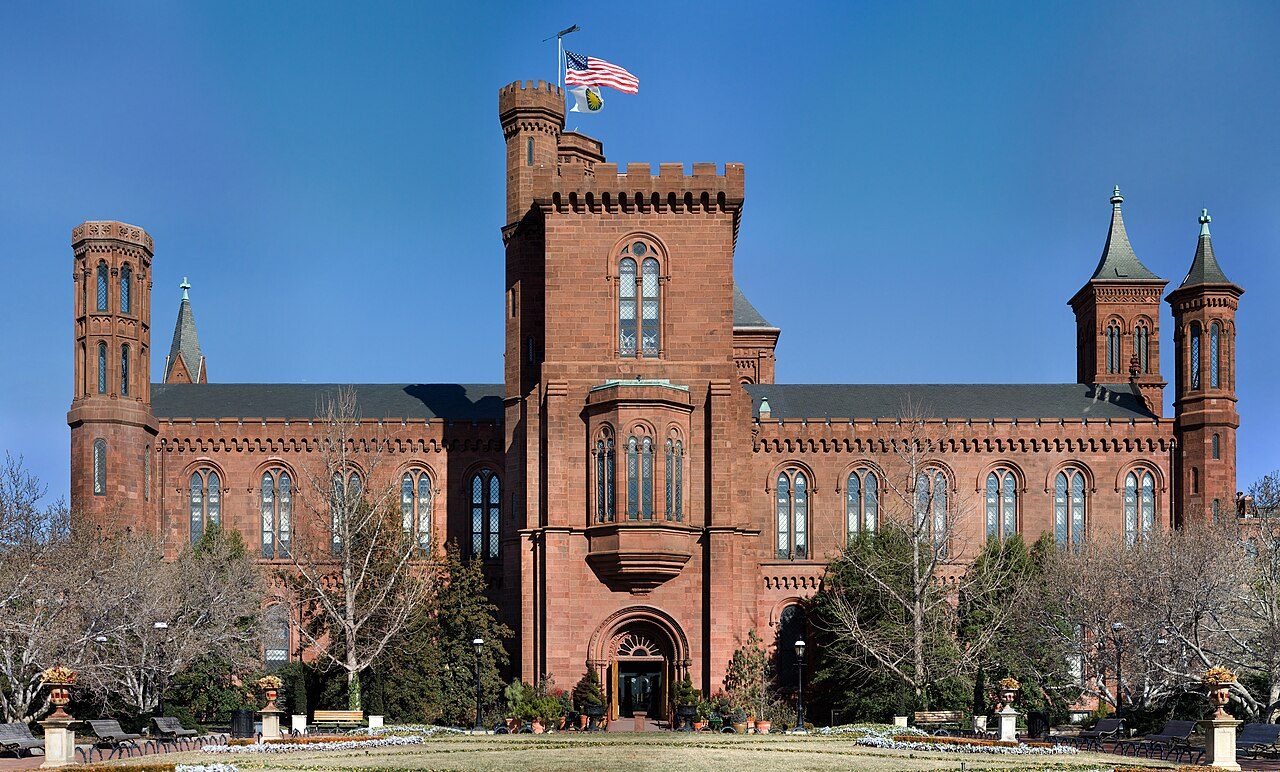
On 10 August 1846, President James K. Polk signed the act creating the Smithsonian Institution — now the world's largest museum and research complex, founded with the fortune of an English scientist, James Smithson, who never once visited the United States and never explained his gift. August 10 is also the day the Louvre opened, Japan accepted the Allied terms in 1945, and the 'Son of Sam' killer was caught.
Choose another date: open the On This Day calendar to browse events, births and deaths for any day of the year.
At a Glance
- The donor
- James Smithson (1765–1829), an English chemist and mineralogist who never visited the United States
- The bequest
- His will leaves his estate, should his nephew die without heirs, to the United States to found an establishment 'for the increase and diffusion of knowledge'
- The money
- 104,960 gold sovereigns delivered to the US Mint in 1838, recoined to $508,318.46
- The debate
- Congress accepts the gift on 1 July 1836, then argues for a decade over whether it should fund a university, a library, a museum or an observatory
- The founding
- 10 August 1846 — President James K. Polk signs the act establishing the Smithsonian as a trust administered by a Board of Regents
- The institution today
- The world's largest museum, education and research complex: 21 museums, the National Zoo and nine research facilities
Events on this day
- 1776News of the American Declaration of Independence reaches London, more than a month after its adoption in Philadelphia.
- 1792A revolutionary crowd storms the Tuileries Palace in Paris; Louis XVI is suspended from power and imprisoned, and the French monarchy effectively falls.
- 1793The Louvre opens in Paris as a public museum, installed in the palace of the French kings.
- 1846The Smithsonian Institution is created by an act of Congress in Washington — the featured story above.
- 1912Virginia Stephen marries Leonard Woolf; together they will found the Hogarth Press and stand at the centre of the Bloomsbury circle.
- 1921Franklin D. Roosevelt, on holiday at Campobello Island, is stricken with the illness — diagnosed as polio — that leaves him unable to walk unaided for the rest of his life.
- 1927The site of Mount Rushmore in South Dakota is dedicated, and carving of the colossal presidential faces begins.
- 1937The first patent for an electric guitar is granted in the United States, to George Beauchamp, for his lap-steel design.
- 1945Japan informs the Allies that it accepts the terms of the Potsdam Declaration, one day after the bombing of Nagasaki — the effective end of the Second World War.
- 1977Postal worker David Berkowitz is arrested in Yonkers, New York, ending the 'Son of Sam' murders in which he killed six people and wounded seven.
- 1993Ruth Bader Ginsburg is sworn in as a justice of the United States Supreme Court, the second woman to sit on the court.
Born on this day
- 1810Camillo Benso, Count of Cavour — Piedmontese statesman, the political architect of the unification of Italy.
- 1874Herbert Hoover — American mining engineer, organiser of wartime food relief, and 31st president of the United States.
- 1898Jack Haley — American actor best remembered as the Tin Man in The Wizard of Oz.
- 1902Norma Shearer — Canadian-American actress, one of the defining stars of MGM's golden age.
- 1960Antonio Banderas — Spanish actor of The Mask of Zorro, Desperado and Pain and Glory.
- 1997Kylie Jenner — American media personality and cosmetics entrepreneur.
Died on this day
- 1896Otto Lilienthal — German aviation pioneer, killed in a glider crash; his experiments in flight directly inspired the Wright brothers.
- 1915Henry Moseley — English physicist who ordered the chemical elements by atomic number, killed at Gallipoli at the age of 27.
- 1923Joaquín Sorolla — Spanish painter famed for his luminous scenes of Mediterranean beaches and gardens.
- 1945Robert H. Goddard — American physicist and pioneer of the liquid-fuelled rocket.
- 2008Isaac Hayes — American soul singer, songwriter and composer of the theme from Shaft.
The featured story: the Smithsonian Institution is created, 10 August 1846
James Smithson was an English chemist and mineralogist of comfortable means and restless curiosity, a fellow of the Royal Society who published papers on subjects from mineral analysis to the chemistry of a lady's teardrop. In 1826 he drew up a will with an unusual clause. His fortune would go to his nephew; but if the nephew died without children, the whole estate was to pass 'to the United States of America, to found at Washington, under the name of the Smithsonian Institution, an establishment for the increase and diffusion of knowledge among men'. Smithson died at Genoa in 1829. He had never visited the United States, had no known American connections, and left no explanation. His motives remain, in the Smithsonian's own words, mysterious.
The contingency came to pass. The nephew died childless in 1835, and the young United States found itself the heir of an Englishman it had never heard of. Congress debated whether it could even accept such a gift before voting, on 1 July 1836, to accept the legacy and pledge the faith of the nation to the trust. President Andrew Jackson sent the diplomat Richard Rush to England to claim the estate through the courts. Rush succeeded, sold Smithson's properties, and shipped the proceeds home: in September 1838 the mint at Philadelphia received 105 sacks containing 104,960 gold sovereigns, recoined to a total of $508,318.46 — a very large fortune by the standards of the day.
Then came a decade of argument about what 'the increase and diffusion of knowledge' should mean. Congressmen proposed a university, a national library, an observatory, a museum, a teacher-training college, a scientific institute; the money sat in the Treasury while the schemes competed, and at one point was nearly lost altogether when bonds bought with it defaulted. The compromise that finally passed gathered several of the schemes into one establishment: a library, a museum, galleries, lectures and research, governed not by the government of the day but by a self-perpetuating Board of Regents. On 10 August 1846, Congress passed the act and President James K. Polk signed it the same day. The Smithsonian Institution existed.
From the red sandstone 'Castle' that rose on the National Mall in the following decade, the institution grew into what the Smithsonian itself now calls the world's largest museum, education and research complex: 21 museums, the National Zoo and nine research facilities, holding some 157 million objects and specimens. Its first secretary, Joseph Henry, set its pattern of research; its museums became the nation's attic and its laboratory at once. The strangest part of the story is the founder's absence from it. Smithson's papers, minerals and personal effects, shipped to Washington as relics, were mostly destroyed when fire gutted the Castle's upper floor in 1865. The man who created the institution left it almost nothing but money, a name, and eleven words of instruction — which proved to be enough.
Why this date matters
August 10 is the calendar's day for inheritances and the institutions built from them. On it, a revolution inherited a palace and made it the Louvre; a young republic inherited an Englishman's fortune and made it the Smithsonian; news of America's own founding document reached the capital that had lost it. Its other entries carry the same charge of things passing from one order to another — a monarchy falling in Paris in 1792, an empire accepting defeat in 1945, a future president struck down by illness in 1921 and rising anyway. What is handed over, this date suggests, matters less than what is built with it.
Sources
- Encyclopaedia Britannica — On This Day: August 10
- HISTORY — What Happened on August 10
- Smithsonian Institution — A Brief History of the Smithsonian Institution
- Smithsonian Institution Archives — General History
The facts on this page were checked against these sources on 19 November 2026. The History Trail's permanent pages are researched and written for this site; the live profiles elsewhere on The History Trail are assembled automatically from Wikipedia and Wikidata.
About the Author
Researched and written by the The History Trail Editorial Team — the accountable editorial function behind this site's permanent story pages. The team works from the published sources cited on each page; it does not invent historians, reviewers or credentials, and it corrects errors openly.
Fact Check
Every load-bearing fact on this page traces to one of the sources listed above, and significant claims link to their source in the text. Our checking method is described on the methodology page; errors can be reported via the corrections page.
Sources & Citations
Cite this page as: The History Trail Editorial Team, The History Trail — this article's title, publication and update dates are shown beneath its headline. The full source list appears under Sources above; the site's source standards are on the sources page.