
Years
1775 in History
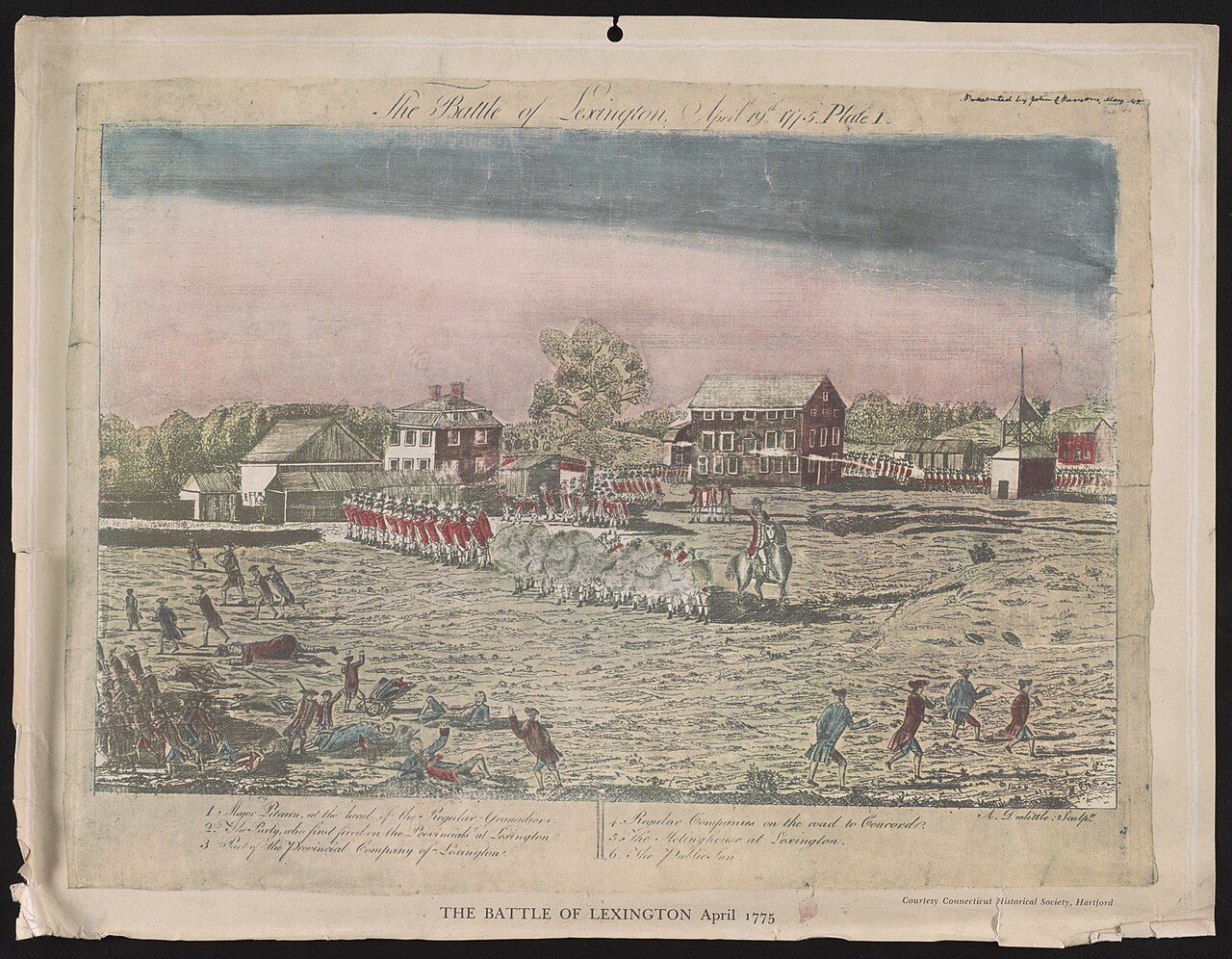
1775 is the year argument became war. On 19 April British regulars marching to seize militia stores at Concord clashed with Massachusetts militia at Lexington and at Concord's North Bridge, opening the American Revolutionary War. Within weeks the colonies had an army, a commander-in-chief and a currency, and by December their forces were attacking Quebec — while Jane Austen was born in England and Daniel O'Connell in Ireland.
At a Glance
- Defining event
- Battles of Lexington and Concord, 19 April 1775 — the American Revolutionary War begins
- The warning
- Paul Revere rides from Boston on 18 April to warn that British troops are marching
- The commander
- George Washington, appointed commander-in-chief on 15 June and in command at Cambridge from 3 July
- The costly lesson
- Bunker Hill, 17 June — a British victory so costly it emboldens the rebellion
- New institutions
- Continental Army (14 June), a naval force (13 October), Marines (10 November) and a postal system under Benjamin Franklin (26 July)
- Closed the year
- The failed American assault on Quebec City in a snowstorm, 31 December
The defining story: the shots at Lexington and Concord
The crisis had been building in words before it broke out in gunfire. On 23 March Patrick Henry told the second Virginia Convention at St John's Church, Richmond, in his 'give me liberty or give me death' speech, that Virginia should arm against Britain. In Massachusetts, British commander General Thomas Gage planned a quieter move: a march from Boston to seize the militia's military stores at Concord before the rebellion could equip itself.
Secrecy failed on the night of 18 April, when Paul Revere rode from Boston to warn that British troops were on the march. The next morning, 19 April, the column met Massachusetts militia on Lexington Green, and then at Concord's North Bridge. The clashes at Lexington and Concord opened the American Revolutionary War: what had been a dispute about rights and taxes inside an empire was now a shooting war between that empire and its own colonies.
The colonies responded by building a state at speed. The Second Continental Congress, presided over by John Hancock from 24 May, created the United States Army on 14 June, appointed George Washington commander-in-chief the next day, and authorised $2 million in bills of credit — the first Continental currency — on 22 June. Washington took command at Cambridge on 3 July, and on 6 July Congress issued its Declaration on the Causes and Necessity of Taking Up Arms, explaining to Britain and the world why the colonies were fighting. On 17 June, meanwhile, the Battle of Bunker Hill outside Boston had already shown the war's character: a British victory, but one so costly that it emboldened the rebellion it was meant to crush.
Yet 1775 was not a clean break. On 1 September the Olive Branch Petition, the colonies' last appeal for reconciliation, was presented in London, and King George III refused to receive it. In the autumn Congress authorised a first naval force on 13 October and two battalions of Marines on 10 November, and American forces carried the war north, capturing Montreal on 13 November. The year ended in a snowstorm at Quebec City on 31 December, where an American assault failed, General Richard Montgomery was killed and Benedict Arnold was wounded — a reminder that the new war would be long, northern and uncertain.
Timeline of 1775
- 23 March
Patrick Henry delivers his 'give me liberty or give me death' speech at Richmond, urging Virginia to arm against Britain.
- 18 April
Paul Revere rides from Boston to warn that British troops are marching on Lexington and Concord.
- 19 April
The Battles of Lexington and Concord open the American Revolutionary War.
- 24 May
John Hancock is elected president of the Second Continental Congress in Philadelphia.
- 14 June
The Continental Congress creates the United States Army, authorising companies of riflemen for one year's service.
- 15 June
The Continental Congress appoints George Washington commander-in-chief of the Continental Army.
- 17 June
The Battle of Bunker Hill is fought outside Boston — a British victory so costly it emboldens the rebellion.
- 3 July
George Washington takes command of the Continental Army at Cambridge, Massachusetts.
- 26 July
Congress establishes a postal system for the united colonies and appoints Benjamin Franklin the first postmaster general.
- 1 September
The Olive Branch Petition is presented in London; King George III refuses to receive the colonies' last appeal for reconciliation.
- 13 October
The Continental Congress authorises the first American naval force, the seed of the United States Navy.
- 10 November
The Continental Congress creates two battalions of Marines at Philadelphia — the founding of the United States Marine Corps.
- 31 December
American forces attack Quebec City in a snowstorm; General Richard Montgomery is killed and Benedict Arnold wounded.
Why 1775 still matters
1775 matters because it is the year a political argument acquired an army, a treasury and a flagless but functioning state. The institutions improvised that summer — an army created on 14 June, a commander appointed the next day, paper money authorised a week later, a navy and marines in the autumn, a postal system under Franklin — were the working machinery of a nation that had not yet declared itself one. Independence, when it came in 1776, was proclaimed by a Congress that had already been governing and fighting for a year.
The year also set the war's enduring pattern: local militia and a continental army fighting a professional imperial force, with Canada as a second front and reconciliation still being attempted even as the shooting continued. The Olive Branch Petition and the invasion of Canada belonged to the same year, and that doubleness — fighting Britain while still petitioning its king — explains both the caution and the radicalism of what followed.
Beyond the war, 1775 quietly seeded other futures. Jane Austen, born on 16 December, would anatomise the society Britain was fighting to hold together; Daniel O'Connell, born on 6 August, would build mass peaceful politics in Ireland; and Friedrich Schelling, born on 27 January, became a central figure of German idealism. The year of the first shots was also a year of first breaths.
1775 on The History Trail
The first year of the American Revolutionary War, told day by day.
- April 19 in History — Battles of Lexington and Concord — the featured story of the war's first day.
- April 18 in History — Paul Revere rides to warn that British troops are marching.
- June 17 in History — The Battle of Bunker Hill, a British victory that cost too much.
- July 26 in History — Congress creates a postal system and makes Benjamin Franklin postmaster general.
- November 10 in History — Congress creates two battalions of Marines at Philadelphia.
- December 16 in History — Jane Austen is born in England.
Sources
- Encyclopaedia Britannica — On This Day: April 19
- HISTORY — What Happened on April 19
- National Park Service — Minute Man National Historical Park: April 19, 1775
- Encyclopaedia Britannica — On This Day: June 17
- Encyclopaedia Britannica — On This Day: March 23
- Encyclopaedia Britannica — On This Day: December 31
The facts on this page were checked against these sources on 19 November 2026. The History Trail's permanent pages are researched and written for this site; the live profiles elsewhere on The History Trail are assembled automatically from Wikipedia and Wikidata.
About the Author
Researched and written by the The History Trail Editorial Team — the accountable editorial function behind this site's permanent story pages. The team works from the published sources cited on each page; it does not invent historians, reviewers or credentials, and it corrects errors openly.
Fact Check
Every load-bearing fact on this page traces to one of the sources listed above, and significant claims link to their source in the text. Our checking method is described on the methodology page; errors can be reported via the corrections page.
Sources & Citations
Cite this page as: The History Trail Editorial Team, The History Trail — this article's title, publication and update dates are shown beneath its headline. The full source list appears under Sources above; the site's source standards are on the sources page.