
On This Day
April 19 in History
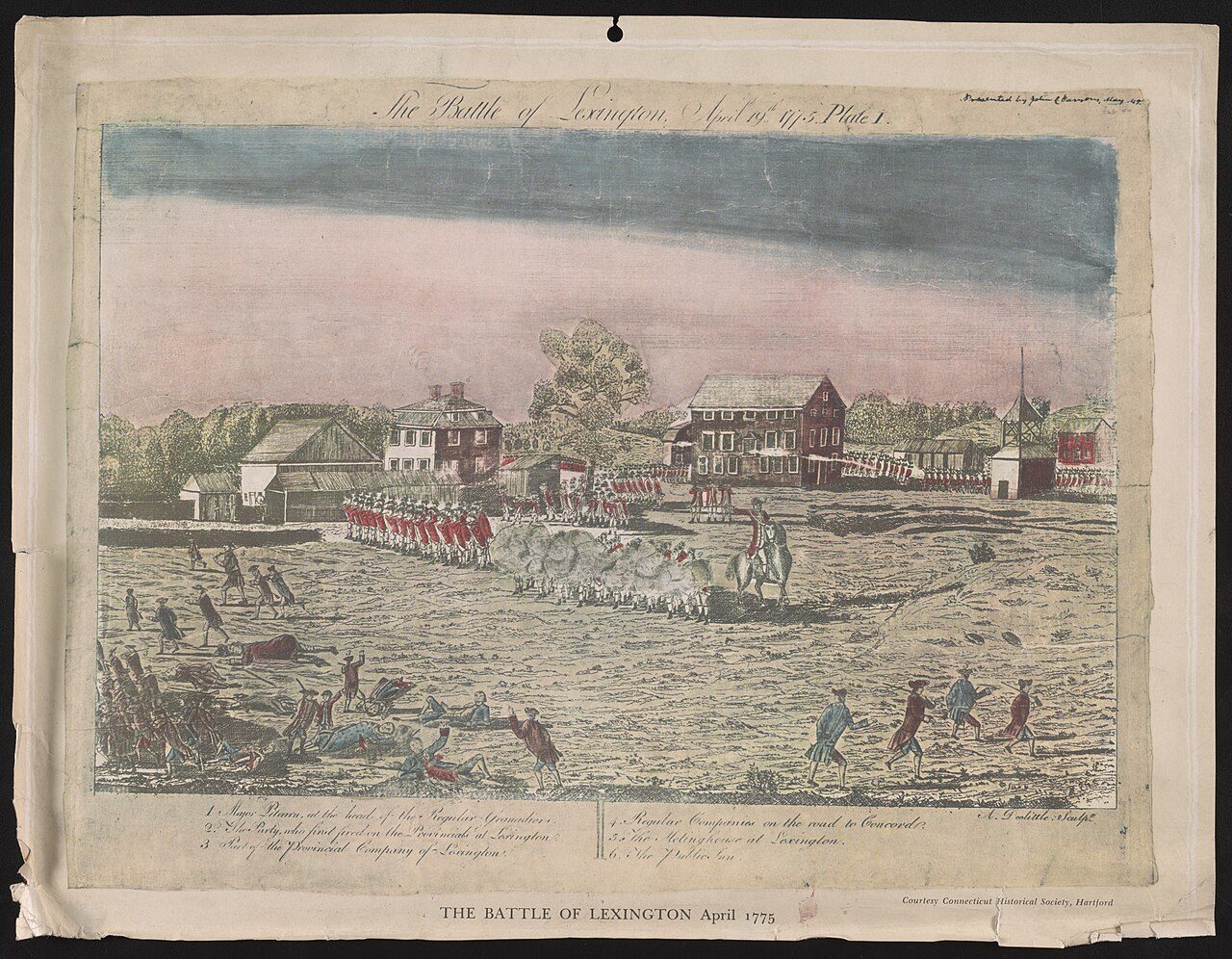
On 19 April 1775, at dawn on Lexington Green and by mid-morning at Concord's North Bridge, Massachusetts militiamen and British regulars fired the first shots of the American Revolutionary War. By nightfall the king's troops were besieged in Boston and a rebellion had become a war. April 19 is also the day the Warsaw Ghetto rose in 1943 and Charles Darwin died in 1882.
Choose another date: open the On This Day calendar to browse events, births and deaths for any day of the year.
At a Glance
- The mission
- About 700 British regulars under Lt. Col. Francis Smith march from Boston to seize colonial military stores at Concord
- Lexington, dawn
- Militiamen under Captain John Parker face the column on Lexington Green; a shot — no one knows whose — is followed by a volley that kills 8 Americans
- Concord, about 9:30 a.m.
- At the North Bridge, militia are ordered to fire on the king's troops for the first time and drive them back
- The retreat
- The column fights its way 16 miles back to Charlestown under fire from thousands of gathering militia; only a relief brigade saves it
- The cost
- British: 73 killed, 174 wounded, 53 missing. American: 49 killed, 39 wounded, 5 missing
- The result
- The siege of Boston begins that night; the Revolutionary War runs for eight years
Events on this day
- 1775The Battles of Lexington and Concord open the American Revolutionary War — the featured story above.
- 1897The first Boston Marathon is run, with fifteen starters; John J. McDermott wins in 2 hours 55 minutes.
- 1943The Warsaw Ghetto Uprising begins, as Jewish fighters resist the final Nazi deportations; the unequal battle lasts nearly four weeks.
- 1943Swiss chemist Albert Hofmann deliberately takes LSD and rides his bicycle home — the first acid trip, later celebrated as Bicycle Day.
- 1975India's first satellite, Aryabhata, is launched by the Soviet Union, making India the eleventh nation with a satellite in orbit.
- 1993The 51-day siege at Waco, Texas, ends in fire; about 80 Branch Davidians, including their leader David Koresh, die.
- 1995A truck bomb destroys the Alfred P. Murrah Federal Building in Oklahoma City, killing 168 people — then the worst terrorist attack on American soil.
- 2005Cardinal Joseph Ratzinger is elected pope as Benedict XVI.
- 2013After a day-long manhunt that shut down Boston, the surviving Marathon bombing suspect is captured hiding in a boat in Watertown.
Born on this day
- 1903Eliot Ness — American prohibition agent whose 'Untouchables' pursued Al Capone in Chicago.
- 1933Jayne Mansfield — American actress and one of the defining screen blondes of the 1950s.
- 1935Dudley Moore — English comedian and actor of Arthur, and half of a famous double act with Peter Cook.
- 1946Tim Curry — English actor who created Dr Frank-N-Furter in The Rocky Horror Show.
- 1981Hayden Christensen — Canadian actor who played Anakin Skywalker in the Star Wars prequels.
Died on this day
- 1824Lord Byron — English Romantic poet, dead of fever at Missolonghi while supporting the Greek war of independence, at 36.
- 1882Charles Darwin — English naturalist whose theory of evolution by natural selection remade biology, dead at Down House at 73.
- 1906Pierre Curie — French physicist, co-discoverer of radium and polonium, killed by a carriage in a Paris street at 46.
- 1967Konrad Adenauer — first chancellor of West Germany, who anchored the republic in the West, dead at 91.
The featured story: Lexington and Concord, 19 April 1775
The expedition was a police action that became a war. General Thomas Gage, the British commander in Boston, had orders to arrest the rebellion's momentum before it armed itself, and on the night of 18 April he sent some 700 grenadiers and light infantry under Lieutenant Colonel Francis Smith across the Charles River to destroy the Massachusetts militia's stores at Concord, sixteen miles inland. Secrecy failed at once. Boston's patriots had watched the preparations for days, and as the column crossed, Paul Revere, William Dawes and a network of riders spread the alarm through every village on the road. By the time the regulars reached Lexington at dawn, the colony was awake and arming.
On Lexington Green about 77 militiamen under Captain John Parker stood in two ranks — not blocking the road, Parker insisted afterwards, but making a statement. Major John Pitcairn rode forward ordering them to disperse. Parker, outnumbered perhaps ten to one and with no intention of fighting a pitched battle, ordered his men to scatter. In that moment a shot rang out — from a regular, a militiaman, or a bystander; two centuries of inquiry have never settled it. The regulars, without orders, fired a ragged volley and charged with bayonets. Eight Lexington men were killed and ten wounded; one regular was slightly hurt. The column marched on to Concord, congratulating itself.
At Concord the arithmetic had changed. Hundreds of militia from the surrounding towns gathered on the hills above the North Bridge while the regulars searched the town — finding little, since the stores had been dispersed — and set fire to gun carriages. Seeing the smoke, the militia advanced on the bridge believing the town was burning. The regulars fired first this time, killing two. Major John Buttrick gave the Revolution its first order to return fire — 'Fire, fellow soldiers, for God's sake, fire!' — and the militia's volley killed three regulars and drove the rest back into Concord. Emerson later called the shot at the bridge the shot heard round the world.
The march back was the day's real battle. Nearly 4,000 militia lined the road to Charlestown behind walls, trees and houses, and for six hours the column bled — at Meriam's Corner, at the Bloody Angle, through Lexington again, where a relief brigade with cannon under Lord Percy barely saved Smith's men from destruction. By dark the regulars were under the guns of the fleet at Charlestown, having lost 273 men killed, wounded and missing, against 95 American casualties. Around Boston an army of militia was already digging in. The siege had begun, and with it an eight-year war that ended in an independent United States.
Why this date matters
April 19 is the date on which resistance announces itself. At Lexington it was farmers on a green; in 1943, in the Warsaw Ghetto, it was starved prisoners rising against the machinery of extermination, knowing they could not win. The date also carries the dark mirror of those risings — the federal siege at Waco ending in fire in 1993 and the Oklahoma City bombing, timed to that anniversary, in 1995. No April day asks harder questions about what defiance is for, and what it costs, and the argument begins, every time, with who fired first.
Sources
- Encyclopaedia Britannica — On This Day: April 19
- HISTORY — What Happened on April 19
- National Park Service — Minute Man National Historical Park: April 19, 1775
- Encyclopaedia Britannica — Battles of Lexington and Concord
The facts on this page were checked against these sources on 19 November 2026. The History Trail's permanent pages are researched and written for this site; the live profiles elsewhere on The History Trail are assembled automatically from Wikipedia and Wikidata.
About the Author
Researched and written by the The History Trail Editorial Team — the accountable editorial function behind this site's permanent story pages. The team works from the published sources cited on each page; it does not invent historians, reviewers or credentials, and it corrects errors openly.
Fact Check
Every load-bearing fact on this page traces to one of the sources listed above, and significant claims link to their source in the text. Our checking method is described on the methodology page; errors can be reported via the corrections page.
Sources & Citations
Cite this page as: The History Trail Editorial Team, The History Trail — this article's title, publication and update dates are shown beneath its headline. The full source list appears under Sources above; the site's source standards are on the sources page.