
Years
1620 in History
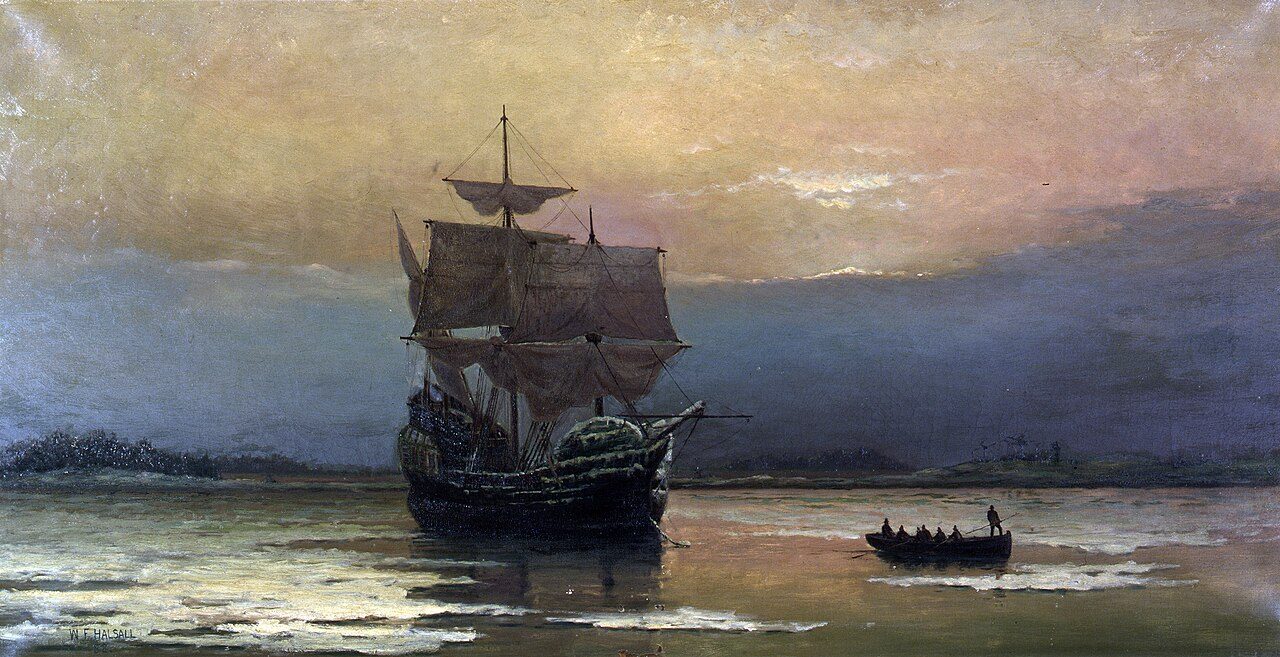
1620 is the year of the Mayflower. After the leaking Speedwell was abandoned, the Mayflower sailed alone from Plymouth, England, in September carrying 102 passengers, endured a 66-day crossing, and anchored off Cape Cod — far north of where her patent allowed her to settle. There, on 21 November, 41 passengers signed the Mayflower Compact, creating a civil body politic, before going ashore in December to found Plymouth Colony, the first permanent English settlement in New England.
At a Glance
- Defining event
- The Mayflower Compact, signed aboard ship off Cape Cod on 21 November by 41 passengers
- The ship
- The Mayflower, an ordinary merchantman of about 180 tons — no contemporary image or full description survives
- The passengers
- 102 passengers — Separatist families alongside other travellers, servants and crew
- The crossing
- 66 days from Plymouth, England, after the leaking Speedwell turned back and was abandoned
- The problem
- The ship anchored outside the Virginia Company's patent, where some argued no one owed obedience to anyone
- Closed the year
- Passengers go ashore at Plymouth in December and construction of the settlement begins
The defining story: the Mayflower Compact
The voyage nearly failed before it began. The Separatists from Holland arrived on the Speedwell, a smaller vessel meant to accompany the Mayflower, and the two ships set out together from Southampton on 15 August 1620. The Speedwell proved unseaworthy — she leaked and was twice forced back into port. The expedition consolidated: some passengers gave up, the rest crowded aboard the Mayflower with what supplies could be transferred, and on 16 September the Mayflower sailed from Plymouth, England, alone — late in the season, into the autumn Atlantic, with 102 passengers packed into a working cargo ship of about 180 tons. Among them were William Bradford, the colony's future governor, and Captain Myles Standish, its military leader. The ship herself was no one's idea of a flagship: an ordinary merchantman, square-rigged, whose exact appearance went unrecorded.
After 66 days of storms the ship sighted Cape Cod instead of her destination, the mouth of the Hudson River, where the Virginia Company's patent entitled the settlers to plant their colony. Attempts to sail south met dangerous shoals and contrary winds, and the company anchored in what is now Provincetown Harbor, hundreds of miles north of the patent's bounds — in legal limbo. Outside the territory the patent covered, some of the non-Separatist passengers argued that when they came ashore they would owe obedience to no one. The colony risked dissolving into argument before a single house was built.
The compact was the answer, drawn up and signed aboard the anchored ship on 21 November 1620 — 11 November by the old calendar the settlers themselves used. In fewer than two hundred words the signers, describing themselves as loyal subjects of King James, covenanted to combine themselves into a civil body politic, to frame just and equal laws, ordinances, acts and constitutions for the general good of the colony, and to promise all due submission and obedience to them. Forty-one men signed, including servants as well as gentlemen — a breadth unusual for the time — though women, who could not vote or hold office, did not.
Only then did settlement begin. In December the passengers went ashore at Plymouth, and a week after the ship anchored there, construction began on the first permanent European settlement in New England. The Mayflower herself served as the colony's shelter and storehouse through its first winter before sailing home the following April. The landing had been a navigational failure — the wrong coast, the wrong jurisdiction, the wrong season — and everything famous about 1620 happened because of it.
Timeline of 1620
- 16 February
Frederick William, the future Great Elector of Brandenburg, is born — the ruler who will rebuild his state after the Thirty Years' War.
- 15 August
The Mayflower and the Speedwell set sail from Southampton for America; the leaking Speedwell soon turns back.
- September
The Speedwell is abandoned after twice being forced back; her passengers crowd aboard the Mayflower.
- 16 September
The Mayflower sets sail from Plymouth, England, carrying 102 passengers toward North America.
- November
After a 66-day crossing the Mayflower anchors off Cape Cod, far north of the territory her patent covers.
- 21 November
Forty-one passengers sign the Mayflower Compact, agreeing to form a civil body politic and obey its laws.
- 18 December
Passengers from the Mayflower go ashore at Plymouth, beginning the permanent English settlement of New England.
- 23 December
One week after the Mayflower anchors at Plymouth, construction begins on the settlement.
Why 1620 still matters
1620 matters because of what a two-hundred-word improvisation became. The Mayflower Compact was a practical instrument, not a declaration of independence — its signers professed loyalty to King James, and Britannica describes it as the first framework of government written and enacted in the territory that became the United States. But it grounded a government's authority in the agreement of the governed, in writing, before a single house was built, and later generations remembered it as a founding act of self-government in America. The ship that missed her destination gave New England its beginning: had the Mayflower reached the Hudson as planned, the Separatists would have been absorbed into Virginia's orbit, and Plymouth would never have existed as a separate colony with its own institutions.
The year's legacy also runs in another direction. For the Wampanoag, whose homeland the passengers settled, the Mayflower marks the beginning of colonisation and its costs — a perspective marked each year in the National Day of Mourning at Plymouth. The ship thus carries two histories at once: a founding voyage in the American story, and an arrival with devastating consequences in the Wampanoag one. Even the ship herself resists tidy memory. No detailed description or contemporary portrait of her survives, her true fate remains unknown, and every painting and replica — including the famous Mayflower II of 1957 — is an informed reconstruction of what a 180-ton merchantman of 1620 probably looked like. What survives intact is the document: fewer than two hundred words, signed in a harbour the signers had never meant to reach.
1620 on The History Trail
The Mayflower's voyage fills 1620 on The History Trail, from the false start at Southampton to the building of Plymouth.
- November 21 in History — the Mayflower Compact is signed off Cape Cod.
- September 16 in History — the Mayflower sets sail from Plymouth, England, with 102 passengers.
- August 15 in History — the Mayflower and Speedwell set sail together from Southampton.
- December 18 in History — the passengers go ashore at Plymouth, Massachusetts.
- Mayflower — the full story of the ship, her troubled start and her unknown fate.
Sources
- Encyclopaedia Britannica — On This Day: February 16
- Encyclopaedia Britannica — On This Day: August 15
- Encyclopaedia Britannica — On This Day: September 16
- Encyclopaedia Britannica — On This Day: November 21
- Encyclopaedia Britannica — Mayflower Compact
- Encyclopaedia Britannica — On This Day: December 18
- Encyclopaedia Britannica — On This Day: December 23
The facts on this page were checked against these sources on 19 November 2026. The History Trail's permanent pages are researched and written for this site; the live profiles elsewhere on The History Trail are assembled automatically from Wikipedia and Wikidata.
About the Author
Researched and written by the The History Trail Editorial Team — the accountable editorial function behind this site's permanent story pages. The team works from the published sources cited on each page; it does not invent historians, reviewers or credentials, and it corrects errors openly.
Fact Check
Every load-bearing fact on this page traces to one of the sources listed above, and significant claims link to their source in the text. Our checking method is described on the methodology page; errors can be reported via the corrections page.
Sources & Citations
Cite this page as: The History Trail Editorial Team, The History Trail — this article's title, publication and update dates are shown beneath its headline. The full source list appears under Sources above; the site's source standards are on the sources page.