
On This Day
December 16 in History
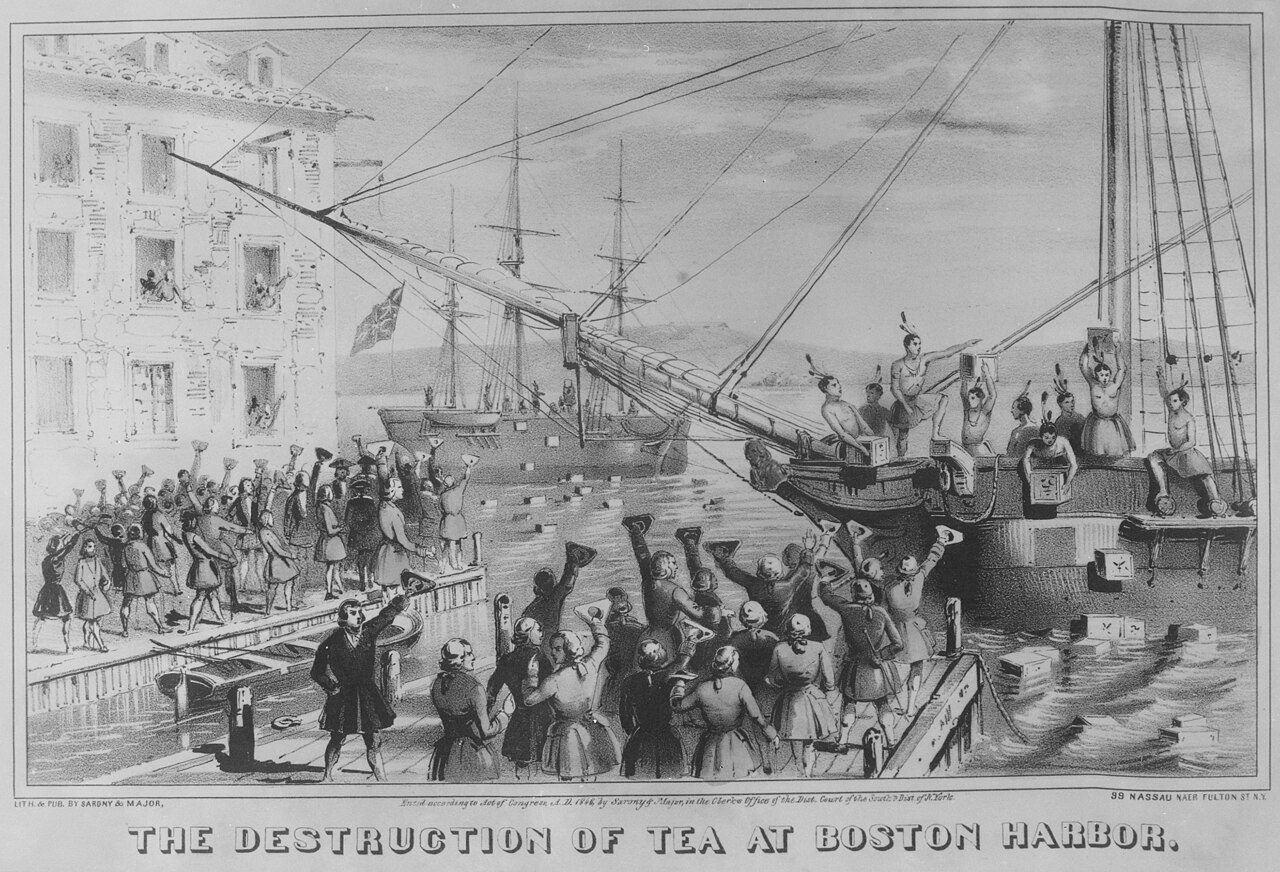
On the night of 16 December 1773, dozens of colonists disguised as Mohawk Indians boarded three ships in Boston Harbor and threw 342 chests of East India Company tea into the water — the Boston Tea Party, the protest that pushed Britain and its American colonies towards revolution. December 16 is also the day the Battle of the Bulge began in 1944 and Jane Austen was born.
Choose another date: open the On This Day calendar to browse events, births and deaths for any day of the year.
At a Glance
- The cargo
- 342 chests of East India Company tea, valued at about £18,000
- The ships
- The Dartmouth, the Eleanor and the Beaver, moored at Griffin's Wharf, Boston
- The men
- About 60 colonists, many of them disguised as Mohawk Indians
- The cause
- The Tea Act of 1773 let the East India Company sell tea directly in America while keeping the Townshend duty the colonists rejected as taxation without representation
- The trigger
- Governor Thomas Hutchinson refused to let the tea ships leave Boston without unloading
- The reply
- Parliament answered with the Coercive (Intolerable) Acts, including the Boston Port Bill closing the harbour, which united the colonies against Britain
Events on this day
- 1631Mount Vesuvius erupts in one of its most violent eruptions of the modern era, devastating towns around the Bay of Naples.
- 1653Oliver Cromwell becomes Lord Protector of the Commonwealth, effectively ruler of England, Scotland and Ireland.
- 1773Colonists dump 342 chests of East India Company tea into Boston Harbor in the Boston Tea Party — the featured story above.
- 1893Dvořák's Symphony No. 9, 'From the New World', premieres at Carnegie Hall in New York, an instant triumph.
- 1914German warships bombard the English coastal towns of Hartlepool and Scarborough, killing more than a hundred civilians and outraging British opinion.
- 1944Germany launches its last great offensive of the Second World War in the Ardennes, beginning the Battle of the Bulge.
- 1950President Truman declares a national emergency as the Korean War turns against UN forces after China's intervention.
- 1960Two airliners collide over New York City; one crashes in Brooklyn and the other on Staten Island, killing 134 people in the worst U.S. aviation disaster to that date.
- 1998The United States and Britain begin four nights of air strikes on Iraq, Operation Desert Fox, after Baghdad obstructs UN weapons inspectors.
- 2009James Cameron's Avatar is released; it becomes the highest-grossing film of all time.
Born on this day
- 1775Jane Austen — English novelist of Pride and Prejudice and Emma, whose six major novels were published with little fame in her lifetime.
- 1899Noël Coward — English playwright, composer and actor, the wit behind Private Lives and Blithe Spirit.
- 1901Margaret Mead — American anthropologist whose Coming of Age in Samoa made her the most famous anthropologist of her century.
- 1917Arthur C. Clarke — British science-fiction writer of 2001: A Space Odyssey and visionary of the communications satellite.
- 1928Philip K. Dick — American novelist whose stories of unstable reality inspired Blade Runner and The Man in the High Castle.
Died on this day
- 1859Wilhelm Grimm — German scholar who, with his brother Jacob, collected the fairy tales that bear their name, dead at 73.
- 1965W. Somerset Maugham — English novelist and playwright, author of Of Human Bondage, dead in France at 91; his death is officially dated 16 December, though some biographers give 15 December.
- 1980Colonel Sanders (Harland Sanders) — American founder of Kentucky Fried Chicken, dead at 90.
- 1985Paul Castellano — American Mafia boss, head of the Gambino family, shot dead outside a New York steakhouse in a hit ordered by John Gotti.
- 2009Roy E. Disney — American studio executive, nephew of Walt Disney, who twice reshaped the company his family founded.
The featured story: the Boston Tea Party, 16 December 1773
The tea that went into Boston Harbor on 16 December 1773 was, legally speaking, a bargain. Parliament's Tea Act of that year had been designed to rescue the financially troubled East India Company by letting it sell tea directly to the American colonies, undercutting smuggled Dutch tea and colonial merchants alike. But the tea still carried the Townshend duty — a tax levied by a Parliament in which the colonists had no representatives. To accept the cheap tea, colonial leaders argued, was to accept the principle of taxation without representation; in port after port, consignees were forced to resign and ships turned away. In Boston, the consignees refused to resign, and Hutchinson refused to let the ships leave without unloading.
Three tea ships, the Dartmouth, the Eleanor and the Beaver, lay at Griffin's Wharf with their cargoes still aboard while the dispute hardened into deadlock. When it became clear that Governor Thomas Hutchinson would neither let the ships sail nor spare the tea the duty, the protest moved to the wharf: on the night of 16 December, dozens of men — Britannica puts the number at about 60 — many thinly disguised as Mohawk Indians, boarded the three ships and methodically hauled up, smashed open and emptied 342 chests of tea into the harbour.
The destroyed tea belonged to the East India Company and was valued at some £18,000 — a fortune. The disguises fooled no one and were meant to make a point rather than conceal identities: the men presented themselves not as a mob but as Americans, acting outside the law of an empire they no longer recognised as just. The participants mostly kept their names secret for decades, and the event itself was not even called a 'tea party' until the following century; at the time it was simply 'the destruction of the tea'.
London's answer turned a Boston dispute into an American revolution. Parliament replied with the Coercive Acts — the 'Intolerable Acts' of colonial phrase — closing the port of Boston until the tea was paid for, curtailing Massachusetts self-government and allowing troops to be quartered in the town. Intended to isolate Massachusetts, the acts united the colonies instead: the other colonies sent aid to blockaded Boston and delegates to the First Continental Congress. Within sixteen months, British troops and colonial militia were shooting at each other at Lexington and Concord. The road from Griffin's Wharf ran directly to war — which is why a night of methodical, almost polite property destruction remains one of the founding acts of the United States.
Why this date matters
December 16 is a day of thresholds crossed in the dark. Cromwell takes power over three kingdoms; a volcano buries Neapolitan towns; German guns open the last great battle of a world war and, thirty years earlier, shell English seaside towns at breakfast. But the date's defining act is quieter than any of them: men with soot-darkened faces methodically emptying tea chests into black water, careful to break nothing else. December 16 keeps returning to the moment before violence — the last protest, the first offensive, the point at which an argument becomes a war — and asking how close the world came to turning back.
Sources
- Encyclopaedia Britannica — On This Day: December 16
- HISTORY — This Day in History: December 16
- Encyclopaedia Britannica — Boston Tea Party
- Library of Congress — Destruction of tea at Boston Harbor
The facts on this page were checked against these sources on 19 November 2026. The History Trail's permanent pages are researched and written for this site; the live profiles elsewhere on The History Trail are assembled automatically from Wikipedia and Wikidata.
About the Author
Researched and written by the The History Trail Editorial Team — the accountable editorial function behind this site's permanent story pages. The team works from the published sources cited on each page; it does not invent historians, reviewers or credentials, and it corrects errors openly.
Fact Check
Every load-bearing fact on this page traces to one of the sources listed above, and significant claims link to their source in the text. Our checking method is described on the methodology page; errors can be reported via the corrections page.
Sources & Citations
Cite this page as: The History Trail Editorial Team, The History Trail — this article's title, publication and update dates are shown beneath its headline. The full source list appears under Sources above; the site's source standards are on the sources page.