
Years
1776 in History
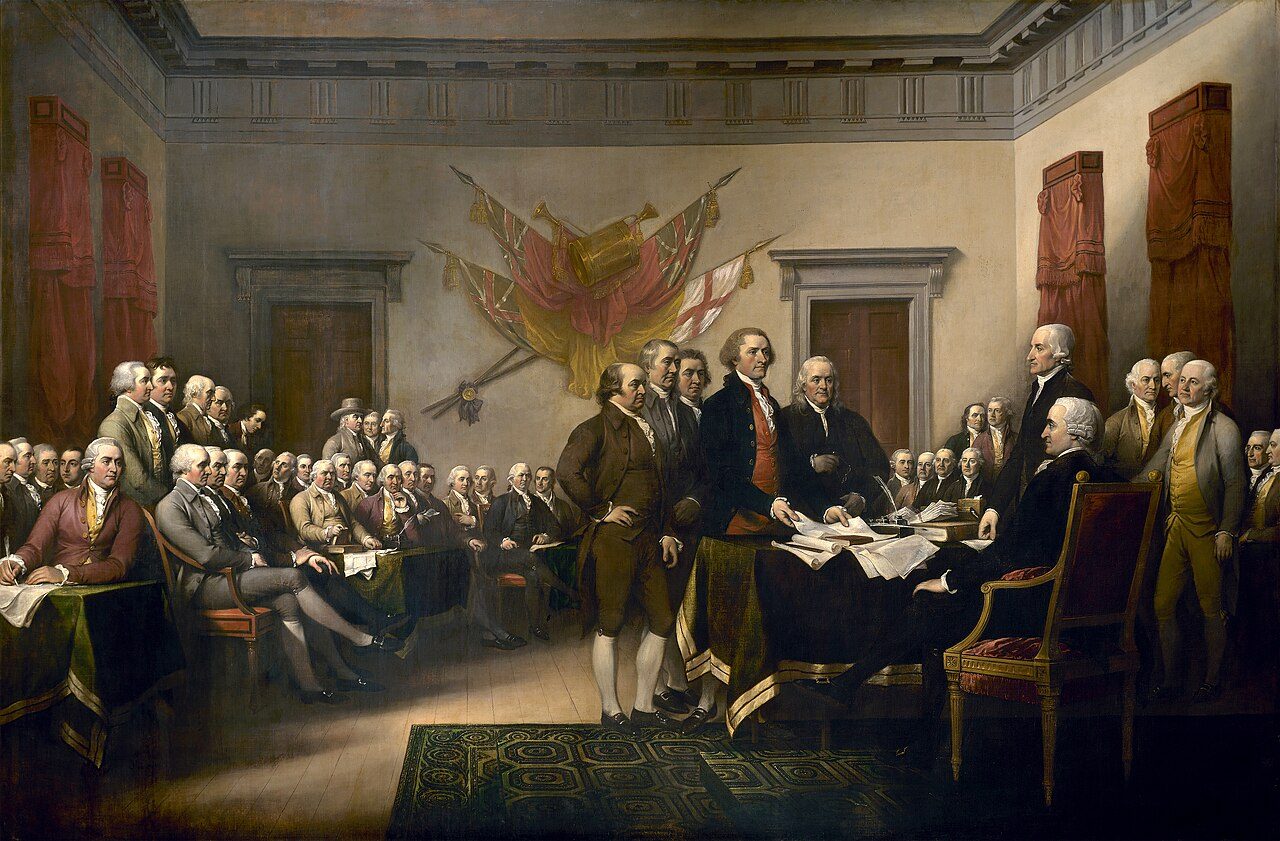
1776 is the year the United States declared itself. Thomas Paine's Common Sense made the public case in January, Washington drove the British from Boston in March, and on 4 July the Continental Congress adopted the Declaration of Independence in Philadelphia. The autumn brought defeats around New York and a retreat across New Jersey — until, on Christmas night, Washington crossed the icy Delaware and won the young republic's first great victory at Trenton.
At a Glance
- Defining event
- The Declaration of Independence adopted in Philadelphia, 4 July
- The decision
- The Lee Resolution, 2 July — Congress votes that the colonies are free and independent states
- The argument
- Thomas Paine's Common Sense, published 10 January, sells hundreds of thousands of copies
- First success
- British evacuate Boston, 17 March, after Washington fortifies Dorchester Heights overnight
- The name
- Congress declares the nation to be the 'United States' of America, 9 September, replacing 'United Colonies'
- Closed the year
- Washington crosses the Delaware on Christmas night and defeats the Hessians at Trenton, 26 December
The defining story: the Declaration of Independence
The year opened with an argument. On 10 January Thomas Paine published Common Sense, a pamphlet in plain language arguing that an island should not rule a continent and that monarchy itself was the problem; it sold hundreds of thousands of copies and turned independence from a remedy for grievances into a positive good. In March came the revolution's first success: Boston had been under siege for eleven months, but Colonel Henry Knox had hauled captured cannon from Fort Ticonderoga over frozen New England, and on the night of 4 March more than 1,200 American soldiers, with some 300 oxcarts of earth, timber and pre-built defences, fortified Dorchester Heights in a single night. General Howe, waking to a fortress where none had stood at dusk, evacuated Boston on 17 March, sailing for Halifax with more than a thousand Loyalists. Washington marched his army to New York to prepare its defence, while in June Virginia adopted its Declaration of Rights, drafted by George Mason — a model for a later American Bill of Rights.
The decision preceded the document. Richard Henry Lee of Virginia proposed that the colonies declare themselves free and independent states, and on 2 July Congress adopted the independence section of his resolution — the vote for independence itself. Congress had appointed a committee of five on 11 June — Thomas Jefferson, John Adams, Benjamin Franklin, Roger Sherman and Robert Livingston — and delegated the drafting to Jefferson, who wrote the text between 11 and 28 June. Congress debated and revised it for two days, cutting about a quarter of the draft, including Jefferson's longest grievance, a passage blaming George III for the slave trade. On 4 July it adopted the Declaration: a philosophy in its opening — all men are created equal, governments derive their just powers from the consent of the governed — a long list of grievances against the king, and a conclusion dissolving the political bands with Britain.
What the public first read was print, not parchment. The approved text was printed overnight as the Dunlap broadsides, bearing only John Hancock's and Charles Thomson's names, and read aloud to troops and crowds — its first public reading came in Philadelphia on 8 July. Only on 19 July did Congress order the Declaration engrossed on parchment, and most delegates signed that copy on 2 August: 56 signatures in all. News of independence reached London on 10 August. In the same weeks, Captain James Cook sailed from England on his third and final Pacific voyage, Adam Smith's Wealth of Nations — published in London on 9 March — began its own quieter revolution, and Benjamin Franklin, in October, sailed for France to win the support the new nation could not survive without.
The war then nearly undid the declaration. British forces landed on Long Island on 22 August and, on 27 August, defeated Washington's army in the largest battle of the war; the Americans escaped across the East River, but on 15 September the British landed at Kip's Bay and occupied New York City, which they would hold for the rest of the war. Fort Washington fell on 16 November with some 2,800 American prisoners, General Charles Lee was captured at a New Jersey tavern on 13 December, and Washington's shrinking army was chased across New Jersey and over the Delaware. On 19 December Paine published the first of The American Crisis essays, opening with the words 'These are the times that try men's souls'. A week later Washington acted on them: on Christmas night he led about 2,400 men back across the ice-choked river in a storm, marched through the night, and on 26 December surprised and defeated the Hessian garrison at Trenton — the first great victory of the republic the Declaration had proclaimed.
Timeline of 1776
- 10 January
Thomas Paine publishes Common Sense, the pamphlet that makes the case for American independence.
- 9 March
Adam Smith's The Wealth of Nations is published in London, founding modern economics.
- 17 March
British forces evacuate Boston after Washington fortifies Dorchester Heights with Knox's Ticonderoga cannon.
- 12 June
Virginia adopts its Declaration of Rights, drafted by George Mason — a model for the American Bill of Rights.
- 2 July
Congress adopts the Lee Resolution, declaring the colonies free and independent states — the vote for independence itself.
- 4 July
The Continental Congress adopts the Declaration of Independence in Philadelphia.
- 2 August
Most delegates sign the engrossed copy of the Declaration of Independence — 56 signatures in all.
- 27 August
British forces defeat Washington's army at the Battle of Long Island, the largest battle of the Revolutionary War.
- 7 September
The American submersible Turtle attempts the first submarine attack in warfare against HMS Eagle in New York Harbor; it fails.
- 9 September
Congress formally declares the name of the new nation to be the 'United States' of America.
- 15 September
British forces land at Kip's Bay and occupy New York City, which they hold for the rest of the war.
- 26 October
Benjamin Franklin sails from Philadelphia for France, sent to win French support for the Revolution.
- 19 December
Paine publishes the first American Crisis essay, opening 'These are the times that try men's souls'.
- 26 December
Washington's army, having crossed the icy Delaware in the night, defeats the Hessian garrison at Trenton.
Why 1776 still matters
1776 still matters because the Declaration outgrew the war it announced. At the time its practical work was diplomatic: a united declaration made foreign alliance — above all with France — possible, and committed thirteen quarrelling colonies publicly to a war they could not now settle separately. It announced separation but did not accomplish it; complete separation still had to be won by force over seven more years. Its transformation into something larger came later, above all under Abraham Lincoln, who treated its proposition that all men are created equal as the nation's founding creed and dated the Union from 1776 at Gettysburg. Abolitionists, suffragists and civil-rights campaigners repeatedly held America to its words, and later declarations abroad — from Haiti and Latin America to Vietnam in 1945, which quoted it directly — borrowed its language and logic.
The year also compressed a whole civilisation's cross-currents into twelve months. The Wealth of Nations founded modern economics in London in March; David Hume, the great sceptic of the Enlightenment, died in August; the Turtle attempted the first submarine attack in warfare in September; Congress gave the new nation its permanent name the same month; and five students at William and Mary founded Phi Beta Kappa in December. A year remembered for a single document was, in truth, a year in which an old order's philosophy, economics and warfare were all being rewritten at once — and in which the document survived its own authors' worst winter only because an army crossed a frozen river on Christmas night.
1776 on The History Trail
1776 is one of The History Trail's richest years, with two featured stories and the Declaration's own story page.
- July 4 in History — the Declaration of Independence is adopted in Philadelphia.
- March 17 in History — the British evacuate Boston after the overnight fortification of Dorchester Heights.
- December 25 in History — Washington leads about 2,400 men across the ice-choked Delaware on Christmas night.
- December 26 in History — the victory at Trenton, the young republic's first great success.
- January 10 in History — Paine publishes Common Sense, the pamphlet that made the case for independence.
- United States Declaration of Independence — the document's drafting, editing, signing and long afterlife in full.
Sources
- Encyclopaedia Britannica — On This Day: January 10
- National Park Service — Dorchester Heights
- Encyclopaedia Britannica — On This Day: July 2
- Encyclopaedia Britannica — On This Day: July 4
- National Archives — Declaration of Independence (1776)
- HISTORY — What Happened on August 2
- Encyclopaedia Britannica — On This Day: September 9
- Encyclopaedia Britannica — On This Day: October 26
The facts on this page were checked against these sources on 19 November 2026. The History Trail's permanent pages are researched and written for this site; the live profiles elsewhere on The History Trail are assembled automatically from Wikipedia and Wikidata.
About the Author
Researched and written by the The History Trail Editorial Team — the accountable editorial function behind this site's permanent story pages. The team works from the published sources cited on each page; it does not invent historians, reviewers or credentials, and it corrects errors openly.
Fact Check
Every load-bearing fact on this page traces to one of the sources listed above, and significant claims link to their source in the text. Our checking method is described on the methodology page; errors can be reported via the corrections page.
Sources & Citations
Cite this page as: The History Trail Editorial Team, The History Trail — this article's title, publication and update dates are shown beneath its headline. The full source list appears under Sources above; the site's source standards are on the sources page.