
Years
1492 in History
1492 is the year the medieval world ended twice over. In January, Granada — the last Muslim state in Iberia — surrendered to Ferdinand and Isabella, closing nearly eight centuries of Muslim rule. In October, Christopher Columbus, sailing west for those same monarchs in search of Asia, made landfall in the Bahamas and began sustained contact between Europe and the Americas. Between those bookends, Spain also ordered the expulsion of its Jews.
At a Glance
- Defining event
- Columbus makes landfall in the Bahamas, 12 October, on the island the Taíno called Guanahani
- Opened the year
- Fall of Granada, 2 January — Boabdil surrenders the Alhambra, ending Muslim rule in Iberia
- The fleet
- The Niña, the Pinta and the Santa María, sailing from Palos on 3 August
- The decree
- The Alhambra Decree, 31 March, ordering the expulsion of practicing Jews from Spain
- In Rome
- The first papal conclave held in the Sistine Chapel elects Rodrigo Borgia as Pope Alexander VI, 11 August
- Closed the year
- The Santa María wrecked off Hispaniola, 25 December; her timbers build the fort of La Navidad
The defining story: Columbus reaches the Americas
The year began with an ending. The Emirate of Granada, founded in 1238, was the last fragment of Muslim Iberia, surviving for two and a half centuries by diplomacy, tribute and the shelter of the Sierra Nevada. But the marriage of Isabella of Castile and Ferdinand of Aragon had united its two great Christian neighbours, who from 1482 waged a deliberate war of conquest against it, while Granada's own rulers tore the emirate apart in civil war — the emir Abu'l-Hasan Ali challenged by his son Boabdil, who was captured by the Castilians, released, and set to fighting his father and then his uncle as a Christian client. By the spring of 1491 the Catholic Monarchs' army sat before the capital, and on 25 November 1491 Boabdil signed the Treaty of Granada. On 2 January 1492 he surrendered the city and the Alhambra, and nearly eight centuries of Muslim rule in Iberia were over.
Victory made the monarchs receptive to another gamble. Christopher Columbus, a Genoese sailor, had spent years arguing that Asia could be reached by crossing the Atlantic westward. Educated Europeans knew the Earth was round; the argument was about its size, and Columbus's estimate was far too small — the geographers who doubted him were mostly right. But in January 1492, fresh from the conquest of Granada, Ferdinand and Isabella agreed to back the attempt. The year's darker settlement came on 31 March, when the Catholic Monarchs issued the Alhambra Decree, ordering the expulsion of practicing Jews from Spain — one of the great forced migrations of the age, set in motion by the same court that was about to reshape the map of the world.
Three ships were fitted out at Palos, on the Tinto River: the Santa María, a relatively large carrack serving as flagship, and two smaller caravels, the Niña and the Pinta, crewed largely by local seamen under the Pinzón brothers. The fleet sailed on 3 August 1492, went first south to the Canary Islands, where the Pinta's rudder had to be repaired, and set out again from La Gomera on 6 September into an ocean no European had crossed at that latitude. The passage took five weeks. By 10 October the crews, out of sight of land for more than a month and fearing dwindling provisions and contrary winds, had begun to lose patience and complain openly. Columbus held them to the course, promising that land was near.
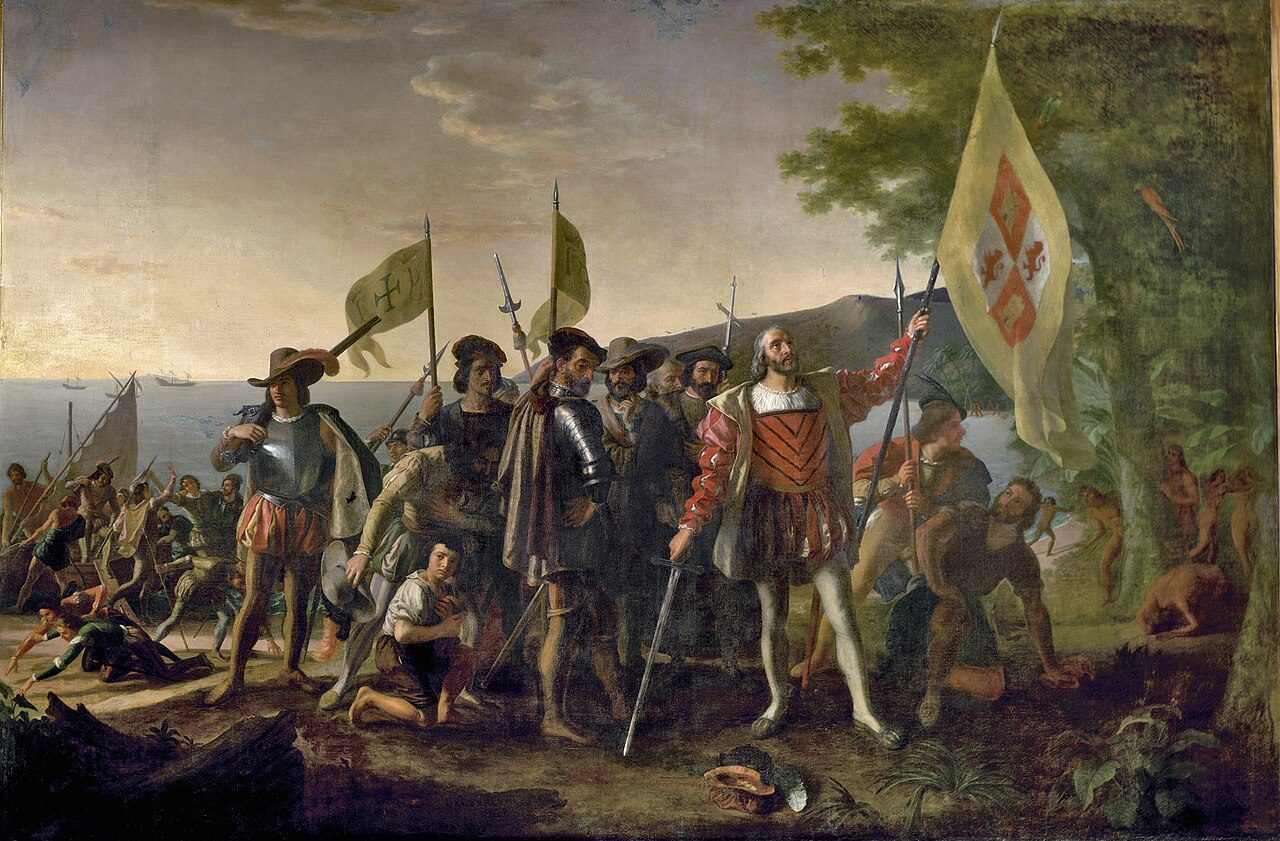
Land was sighted from the Pinta in the early hours of 12 October — traditionally credited to the lookout Rodrigo de Triana — and at dawn Columbus went ashore on a low, green island in the Bahamas. Its people, Lucayan Taíno, called it Guanahani; Columbus named it San Salvador, 'Holy Saviour', and formally claimed it for Spain. The Taíno came out to the ships with gifts of parrots, cotton and spears; Columbus's journal praised their generosity in one passage and, in another, calculated how easily they might be subjugated — the two impulses that would define the encounter. The fleet explored on, and the year closed with a wreck: on 25 December the Santa María ran aground off Hispaniola and was lost, her timbers used to build a fort Columbus named La Navidad, 'Christmas'.
Timeline of 1492
- 2 January
Boabdil, the last Nasrid emir, surrenders Granada and the Alhambra to Ferdinand and Isabella, ending Muslim rule in Iberia.
- January
Fresh from the conquest of Granada, Ferdinand and Isabella agree to back Columbus's westward voyage to Asia.
- 31 March
Spain's Catholic Monarchs issue the Alhambra Decree, ordering the expulsion of practicing Jews from Spain.
- 3 August
Columbus sets sail from Palos with the Niña, the Pinta and the Santa María, seeking a westward route to Asia.
- August
The fleet calls at the Canary Islands, where the Pinta's rudder is repaired and supplies are taken on.
- 11 August
The first papal conclave ever held in the Sistine Chapel elects Rodrigo Borgia as Pope Alexander VI.
- 6 September
The fleet sets out again from La Gomera in the Canaries, into an ocean no European has crossed at that latitude.
- 10 October
After more than a month out of sight of land, the crews begin to lose patience and complain openly; Columbus holds the course.
- 12 October
Columbus's expedition makes landfall in the Bahamas, on the island the Taíno called Guanahani.
- 25 December
The Santa María runs aground off Hispaniola and is lost; her timbers are used to build the fort of La Navidad.
Why 1492 still matters
1492 still matters because its two great events pulled in opposite directions at once. The fall of Granada completed the making of a single Spanish monarchy out of the peninsula's divided kingdoms — a state-building project finished, fittingly, by contract rather than assault: Granada was never stormed, and the Treaty of Granada ran to dozens of articles protecting Muslim worship, property and law. Yet within a decade the crown repudiated that treaty and ordered Granada's Muslims to convert or leave, and the Alhambra Decree had already shown the new Spain's intolerance in the year of its triumph. The unified kingdom that emerged in 1492 was powerful, confident and confessional all at once.
The October landfall opened a larger transformation. Sustained contact between Europe and the Americas — two hemispheres that had been apart for millennia — transformed both, in ways that ran from crops and commerce to conquest and catastrophe for the peoples Columbus encountered. Columbus himself never accepted what he had found: he had sailed for Asia on a badly underestimated Earth, and the learned geographers who doubted his distances had been right. That is the year's deepest irony. Its most consequential voyage succeeded because its premise was wrong, and its most orderly event, a surrender signed in advance, was undone by the victors within ten years. 1492 is remembered as a beginning; it was also, for Granada's Muslims and Spain's Jews, an ending — and both truths belong to the same twelve months.
1492 on The History Trail
1492 carries three of The History Trail's featured stories, from the Alhambra in January to a shipwreck on Christmas Day.
- January 2 in History — Boabdil surrenders Granada and the Alhambra to Ferdinand and Isabella.
- August 3 in History — Columbus sets sail from Palos with his three ships.
- October 12 in History — the landfall on Guanahani that began sustained contact between Europe and the Americas.
- March 31 in History — the Alhambra Decree orders the expulsion of practicing Jews from Spain.
- December 25 in History — the Santa María is wrecked off Hispaniola and La Navidad is built from her timbers.
Sources
- HISTORY — Reconquest of Spain
- Encyclopaedia Britannica — On This Day: January 2
- Encyclopaedia Britannica — On This Day: March 31
- Encyclopaedia Britannica — Christopher Columbus: The First Voyage
- Encyclopaedia Britannica — On This Day: August 3
- Encyclopaedia Britannica — On This Day: August 11
- Encyclopaedia Britannica — On This Day: October 12
- HISTORY — What Happened on October 12
The facts on this page were checked against these sources on 19 November 2026. The History Trail's permanent pages are researched and written for this site; the live profiles elsewhere on The History Trail are assembled automatically from Wikipedia and Wikidata.
About the Author
Researched and written by the The History Trail Editorial Team — the accountable editorial function behind this site's permanent story pages. The team works from the published sources cited on each page; it does not invent historians, reviewers or credentials, and it corrects errors openly.
Fact Check
Every load-bearing fact on this page traces to one of the sources listed above, and significant claims link to their source in the text. Our checking method is described on the methodology page; errors can be reported via the corrections page.
Sources & Citations
Cite this page as: The History Trail Editorial Team, The History Trail — this article's title, publication and update dates are shown beneath its headline. The full source list appears under Sources above; the site's source standards are on the sources page.