
Years
1996 in History
1996 is remembered for a chess match in Philadelphia: on 10 February IBM's Deep Blue beat world champion Garry Kasparov in a game — the first such win by a computer under classical conditions — before Kasparov recovered to win the match 4–2 a week later. The same year quietly produced Dolly the sheep, the first mammal cloned from an adult cell.
At a Glance
- Defining event
- Deep Blue defeats Kasparov in game one in Philadelphia, 10 February
- The answer
- Kasparov wins the final game on 17 February to take the match 4–2
- The machine
- Deep Blue could evaluate around one hundred million chess positions a second
- Science
- Dolly the sheep is born on 5 July, the first mammal cloned from an adult cell — announced the following year
- Tragedy
- A gunman murders 16 children and their teacher at Dunblane Primary School, 13 March
- Closed the year
- A peace accord signed in Guatemala City on 29 December ends the country's 36-year civil war
The defining story: the machine wins a game, the man wins the match
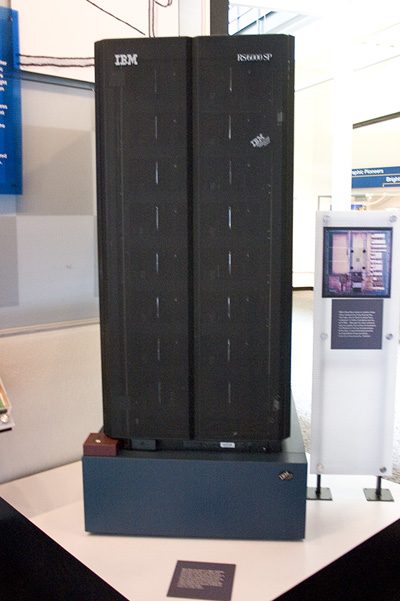
Chess had been the chosen test of machine intelligence since the dawn of computing — the game at which, it was said, a computer would have to truly think. By the 1990s the thinking was mostly arithmetic at terrifying speed. Deep Blue, built by IBM from a Carnegie Mellon project and refined by a team including Feng-hsiung Hsu and Murray Campbell, working with grandmaster consultants, could evaluate around one hundred million chess positions every second, guided by an opening book and an evaluation function tuned over years. Its opponent in Philadelphia in February 1996 was Garry Kasparov, world champion since 1985 and rated the strongest player in history.
The first game, on 10 February, began with Kasparov's Sicilian Defence steered into the Alapin Variation, away from his deepest preparation. Deep Blue played with a calm, positional patience that unsettled observers — this was not supposed to be what machines did — and when Kasparov's position deteriorated he resigned after thirty-seven moves, just over three hours into the game. It was the first time in history that a reigning world champion had lost to a computer under normal tournament conditions, with a full time control and the world watching.
What happened next is why the match, not just the game, defines 1996. Kasparov studied the machine the way he would a human rival — except that its weaknesses were of a new kind. It had no plan, only evaluation; it could be lured into closed positions where long-term judgement mattered more than calculation, and it could not learn from game to game. Kasparov changed his openings, played patient, anti-computer chess, and won the second game. Two draws followed. Then he won the fifth, and on 17 February he won the sixth and last, sealing the match four points to two.
The result told the world the future was coming but had not, quite, arrived. Kasparov later wrote that in one game he glimpsed a new kind of intelligence across the board — then spent the rest of the match proving a human could still adapt faster than the programmers could. The reprieve lasted barely a year: the machine that beat Kasparov in a game in February 1996 was dismantled after its upgraded successor won the rematch in 1997. But February 1996 is the hinge — the first game lost, and the last match won.
Timeline of 1996
- 8 January
François Mitterrand, president of France for fourteen years, dies — the longest-serving president of the Fifth Republic.
- 10 February
IBM's Deep Blue defeats Garry Kasparov in the first game of their Philadelphia match.
- 17 February
Garry Kasparov defeats Deep Blue in the final game to win their six-game match 4–2.
- 13 March
A gunman murders 16 children and their teacher at Dunblane Primary School in Scotland, the deadliest mass shooting in British history.
- 23 March
Lee Teng-hui wins Taiwan's first direct presidential election, held under Chinese missile threats in the strait.
- 3 April
FBI agents arrest Theodore Kaczynski at his Montana cabin, ending the 18-year hunt for the Unabomber.
- 25 June
A truck bomb at the Khobar Towers housing complex in Saudi Arabia kills 19 American airmen.
- 5 July
Dolly the sheep is born near Edinburgh, the first mammal cloned from an adult cell.
- 17 July
TWA Flight 800 explodes off Long Island shortly after take-off for Paris, killing all 230 people aboard.
- 27 July
A pipe bomb explodes in Centennial Olympic Park during the Atlanta Olympics, killing one person and injuring 111.
- 13 September
Rapper Tupac Shakur dies at 25 of wounds from a drive-by shooting in Las Vegas six days earlier.
- 12 November
A Saudi airliner and a Kazakh cargo plane collide in mid-air near New Delhi, killing 349 people.
- 4 December
NASA launches Mars Pathfinder, carrying the Sojourner rover that will land on Mars the following July.
- 29 December
A peace accord is signed in Guatemala City, formally ending the country's 36-year civil war.
Why 1996 still matters
The Philadelphia match fixed the terms on which humanity would meet machine intelligence: not as a single dramatic defeat, but as an adaptation race. Kasparov won in 1996 precisely because he could change and the machine, between games, could only be adjusted by its programmers. That asymmetry — the argument Kasparov started about what a machine may change mid-contest — is still the argument underneath every debate about artificial intelligence and its rules.
The year's other scientific landmark arrived in silence. Dolly the sheep was born near Edinburgh on 5 July, the first mammal cloned from an adult cell — though her birth was not announced until the following year, when it reopened the ethics of biology for a generation. Between a computer that could out-calculate the world chess champion and a sheep copied from a single cell, 1996 announced the two technologies that would define the coming century's arguments about what humans may build.
The year's violence was of the older kinds: Dunblane, the deadliest mass shooting in British history; the Khobar Towers truck bomb, which killed 19 American airmen; TWA Flight 800 off Long Island, killing all 230 aboard; and a pipe bomb in Centennial Olympic Park during the Atlanta Games. Against them, the year closed with a peace accord in Guatemala City ending a 36-year civil war — a reminder that 1996's endings were not all technological.
1996 on The History Trail
Deep Blue and Kasparov lead this year on The History Trail, with two featured days a week apart.
- February 10 in History — Deep Blue defeats Kasparov in a game — a featured story of 1996.
- February 17 in History — Kasparov defeats Deep Blue to win the match — the second featured story.
- July 5 in History — Dolly the sheep is born near Edinburgh.
- March 13 in History — The Dunblane Primary School massacre in Scotland.
- December 29 in History — A peace accord ends Guatemala's 36-year civil war.
- HIV/AIDS — The History Trail's story of HIV and AIDS.
Sources
- Encyclopaedia Britannica — On This Day: February 10
- HISTORY — What Happened on February 17
- Encyclopaedia Britannica — On This Day: March 13
- Encyclopaedia Britannica — On This Day: December 29
The facts on this page were checked against these sources on 19 November 2026. The History Trail's permanent pages are researched and written for this site; the live profiles elsewhere on The History Trail are assembled automatically from Wikipedia and Wikidata.
About the Author
Researched and written by the The History Trail Editorial Team — the accountable editorial function behind this site's permanent story pages. The team works from the published sources cited on each page; it does not invent historians, reviewers or credentials, and it corrects errors openly.
Fact Check
Every load-bearing fact on this page traces to one of the sources listed above, and significant claims link to their source in the text. Our checking method is described on the methodology page; errors can be reported via the corrections page.
Sources & Citations
Cite this page as: The History Trail Editorial Team, The History Trail — this article's title, publication and update dates are shown beneath its headline. The full source list appears under Sources above; the site's source standards are on the sources page.