
Things
HIV/AIDS
On 5 June 1981 the US Centers for Disease Control reported a rare pneumonia in five young men in Los Angeles. It was the first public signal of a new pandemic. What followed was the fastest identification of a new disease agent in history to that date — and one of the hardest fights over treatment, stigma and access.
At a Glance
- First official report
- CDC Morbidity and Mortality Weekly Report, 5 June 1981
- Syndrome named
- Acquired Immune Deficiency Syndrome (AIDS), by the CDC in 1982
- Virus isolated
- Pasteur Institute, Paris, 1983 — Barré-Sinoussi, Montagnier and colleagues
- Cause confirmed
- A retrovirus, announced 1984; later named HIV
- First blood test licensed
- 1985 — blood banks begin screening the US supply
- First antiretroviral approved
- AZT (zidovudine), US FDA, 1987
- Nobel Prize
- Physiology or Medicine, 2008 — Barré-Sinoussi and Montagnier, for discovering HIV
Introduction
The epidemic's official beginning is unusually precise. On 5 June 1981, the United States Centers for Disease Control and Prevention issued its first warning, in its Morbidity and Mortality Weekly Report, about a relatively rare form of pneumonia among a small group of young gay men in Los Angeles. Weeks later came a second report, of an unusual occurrence of Kaposi's sarcoma, a rare skin cancer, among young gay men. Both diseases were ones a healthy young immune system should have fended off. Something was disabling immunity itself.
Scientists believe HIV was present years before that first case reached public attention, but 1981 is where the recorded history starts. In 1982 the CDC established the term Acquired Immune Deficiency Syndrome — AIDS. The early label used in media, gay-related immune deficiency, mistakenly suggested an inherent link with homosexuality; cases were meanwhile appearing in people who injected drugs, in recipients of blood products, in women and in Africa. The syndrome was defined before its cause was known, and the search for that cause became an international race.
Background
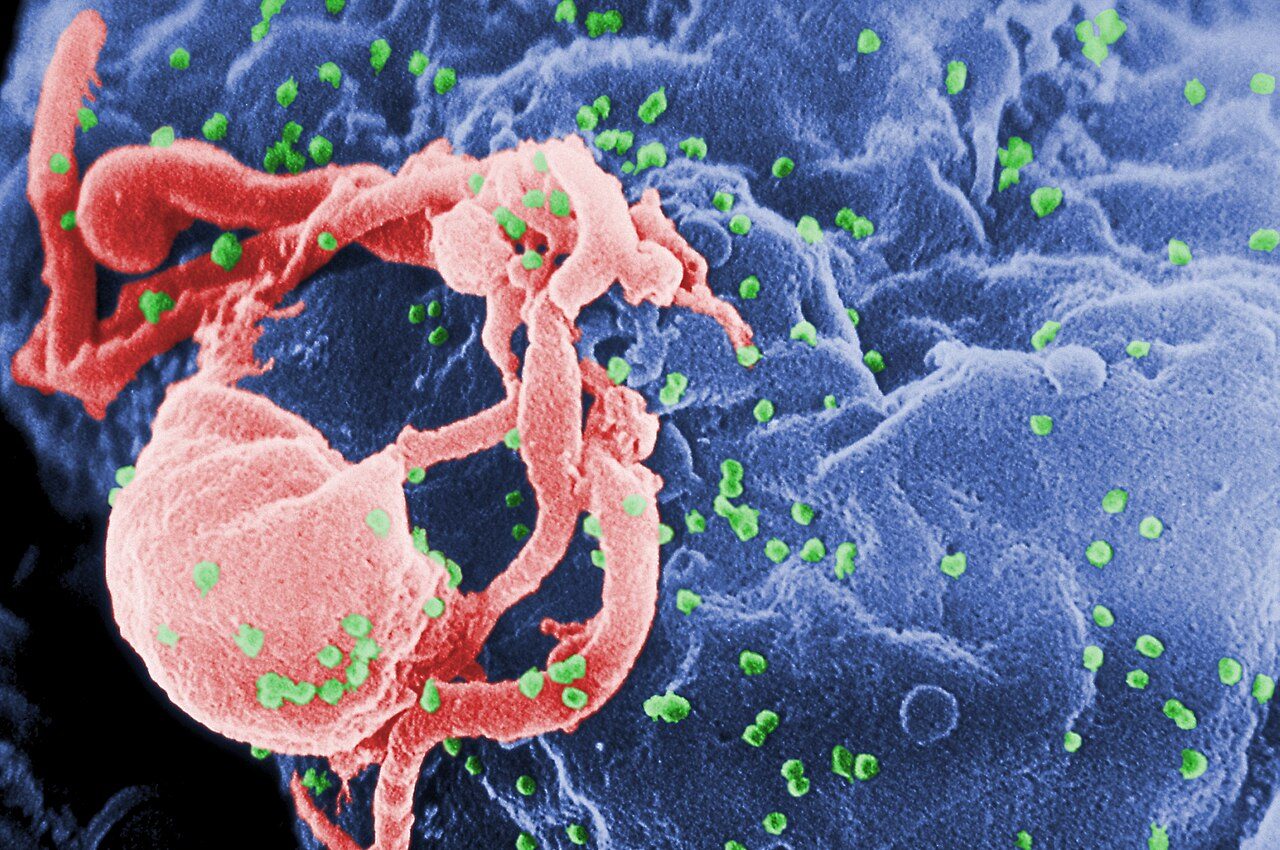
At the Pasteur Institute in Paris, Françoise Barré-Sinoussi and Luc Montagnier reasoned that AIDS might be caused by an unknown retrovirus. Working from the swollen lymph nodes characteristic of the early stage of the disease, they isolated and cultured lymph node cells from patients, detected the activity of reverse transcriptase — a direct sign of retrovirus replication — and found retroviral particles budding from the infected cells. The virus, which they called lymphadenopathy-associated virus, infected and killed lymphocytes and reacted with antibodies from infected patients. Their description was published in 1983.
In the United States, Robert Gallo's laboratory at the National Cancer Institute cultivated the same virus, calling it HTLV-III, and in 1984 the US Department of Health and Human Services announced that a retrovirus caused AIDS. The two names were later unified as the human immunodeficiency virus, HIV. Priority between Paris and Bethesda was disputed for years, but the scientific result was settled quickly: by 1985 the first HIV test was licensed, and blood banks began screening the blood supply — the discovery had become a defence within four years of the first report.
Timeline
- 5 June 1981
The CDC reports rare pneumonia in young gay men in Los Angeles — the official beginning of the epidemic.
- 1982
The CDC establishes the term Acquired Immune Deficiency Syndrome; community organisations such as Gay Men's Health Crisis form in New York.
- 1983
Montagnier's Pasteur Institute team isolates the virus later named HIV and publishes its findings; WHO begins international surveillance.
- 1984
US health authorities announce that a retrovirus causes AIDS, following Gallo's laboratory work at the National Cancer Institute.
- 1985
The first HIV test is licensed by the FDA; blood banks begin screening the United States blood supply.
- 1987
AZT, the first antiretroviral drug, is approved by the FDA; the activist group ACT UP is established in New York.
- 1988
WHO declares the first World AIDS Day, on 1 December.
- 1990
The Ryan White CARE Act becomes US law, funding community-based care for people with AIDS.
- 1996
The Vancouver International AIDS Conference highlights the effectiveness of HAART — combination antiretroviral therapy — and US AIDS cases decline for the first time.
- 2008
Barré-Sinoussi and Montagnier share the Nobel Prize in Physiology or Medicine for the discovery of HIV.
Significance
The Nobel Committee in 2008 observed that never before had science and medicine been so quick to discover and identify the origin of a new disease entity. That speed had concrete consequences: a blood test within four years protected transfusion supplies, and drug development followed within six. Yet the epidemic's history is equally a record of what science alone could not settle — stigma that attached to the first communities affected, the activism of ACT UP that changed how quickly drugs were approved, and the global inequality of access once effective therapy existed.
The turning point in treatment came in 1996, when combination antiretroviral therapy, HAART, was shown to be highly effective; new AIDS cases in the United States declined for the first time, and deaths fell by more than forty percent the following year, largely due to HAART. Brazil that year became the first developing country to distribute antiretrovirals nationally. The epidemic thereby split into two histories — one in which HIV became a manageable chronic infection, and one, where treatment arrived late, in which it remained a mass killer.
Legacy
HIV generated a novel pandemic, and the response generated new institutions: UNAIDS began operations in 1996 to coordinate the global effort, the Global Fund followed, and in 2003 the United States launched PEPFAR, a five-year, fifteen-billion-dollar programme against AIDS, tuberculosis and malaria in hard-hit countries. AIDS was the first disease ever debated on the floor of the UN General Assembly, in 1987 — a measure of how completely it had escaped the category of a purely medical problem.
For medicine, the legacy includes the blood-screening regime, accelerated drug-approval pathways shaped by activism, and the demonstration that a retrovirus could cause a slow, immune-destroying human disease. For the historical record, the epidemic stands as the moment a new disease was identified almost in real time — its science dated to the month, its social history still being written.
Sources
- NobelPrize.org — The Nobel Prize in Physiology or Medicine 2008, Illustrated Presentation
- KFF — Global HIV/AIDS Timeline
- Institut Pasteur — Nobel Prize in Medicine 2008 awarded to Barré-Sinoussi and Montagnier
The facts on this page were checked against these sources on 19 November 2026. The History Trail's permanent pages are researched and written for this site; the live profiles elsewhere on The History Trail are assembled automatically from Wikipedia and Wikidata.
About the Author
Researched and written by the The History Trail Editorial Team — the accountable editorial function behind this site's permanent story pages. The team works from the published sources cited on each page; it does not invent historians, reviewers or credentials, and it corrects errors openly.
Fact Check
Every load-bearing fact on this page traces to one of the sources listed above, and significant claims link to their source in the text. Our checking method is described on the methodology page; errors can be reported via the corrections page.
Sources & Citations
Cite this page as: The History Trail Editorial Team, The History Trail — this article's title, publication and update dates are shown beneath its headline. The full source list appears under Sources above; the site's source standards are on the sources page.