
On This Day
December 29 in History
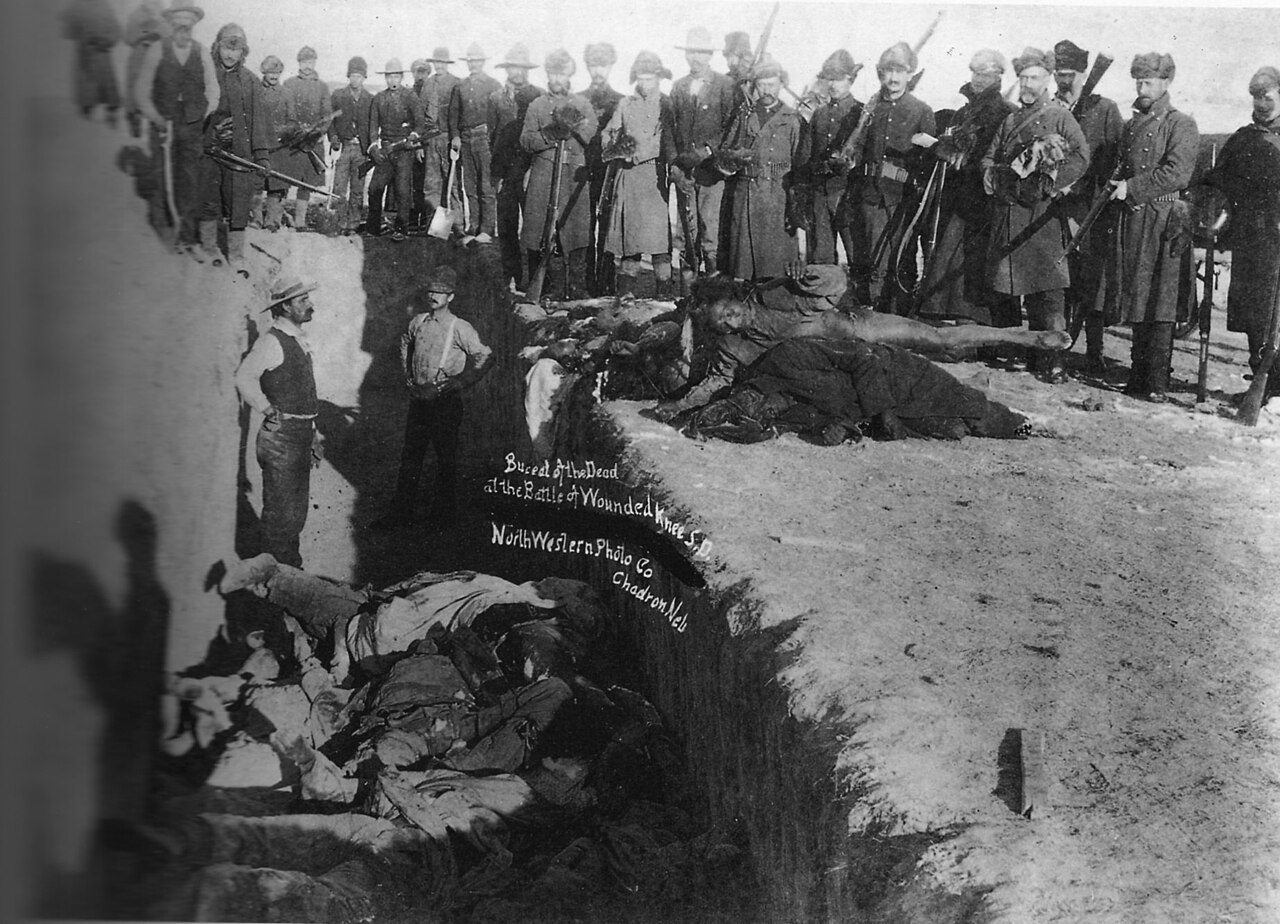
On 29 December 1890, beside Wounded Knee Creek in South Dakota, soldiers of the U.S. 7th Cavalry opened fire on a camp of Miniconjou Lakota they were disarming, killing — modern scholars estimate — between 250 and 300 people, almost half of them women and children: the Wounded Knee Massacre, the last great atrocity of the American Indian Wars. December 29 is also the day Thomas Becket was murdered in Canterbury Cathedral, Texas joined the Union, and Václav Havel became president of Czechoslovakia.
Choose another date: open the On This Day calendar to browse events, births and deaths for any day of the year.
At a Glance
- The setting
- Wounded Knee Creek, Pine Ridge Reservation, South Dakota, on the morning of 29 December 1890
- The band
- Some 350 Miniconjou Lakota led by Chief Big Foot (Spotted Elk), travelling to Pine Ridge after the killing of Sitting Bull
- The troops
- About 500 soldiers of the 7th Cavalry under Colonel James W. Forsyth, with four Hotchkiss rapid-fire guns posted on the hill above the camp
- The spark
- A shot during the disarmament search — accounts differ over whose — followed by volleys into the camp and pursuit of those who fled
- The toll
- Modern scholars estimate 250–300 Lakota killed, almost half women and children; about 25 soldiers also died, several by their own side's fire
- The reckoning
- In 1990, on the centenary, the U.S. Congress formally expressed deep regret for the massacre
Events on this day
- 1170Four knights of Henry II murder Archbishop Thomas Becket in Canterbury Cathedral, an act that shocks Christendom and makes Becket a saint within three years.
- 1778British forces capture Savannah, Georgia, in one of the first moves of the southern campaign of the American Revolutionary War.
- 1835The Treaty of New Echota is signed, by which a minority Cherokee faction cedes all Cherokee lands east of the Mississippi — the legal pretext for the Trail of Tears.
- 1845Texas is admitted to the United States as the 28th state, annexation having helped trigger the war with Mexico that follows.
- 1852Emma Snodgrass is arraigned in Boston for wearing trousers in public, one of a series of arrests that made her a symbol of the dress-reform cause.
- 1860HMS Warrior, the world's first seagoing iron-hulled armoured warship, is launched on the Thames, revolutionising naval power.
- 1890U.S. 7th Cavalry troops kill an estimated 250–300 Lakota at Wounded Knee Creek, South Dakota — the featured story above.
- 1911Mongolia declares its independence from the collapsing Qing dynasty of China, reviving the Mongolian state under the Bogd Khan.
- 1911Sun Yat-sen is elected provisional president of the Republic of China by delegates in Nanjing, weeks before the last emperor abdicates.
- 1937The constitution of Ireland takes effect: the Irish Free State is replaced by a sovereign state called Ireland, with a president as head of state.
- 1940The Luftwaffe's heaviest firebombing of London — the 'Second Great Fire of London' — leaves St Paul's Cathedral standing amid a ring of flames.
- 1989Playwright and former dissident Václav Havel is elected president of Czechoslovakia, days after the Velvet Revolution swept the communists from power.
- 1996A peace accord is signed in Guatemala City, formally ending the country's 36-year civil war.
- 1998Khmer Rouge leaders Khieu Samphan and Nuon Chea publicly apologise for the Cambodian genocide of the 1970s, in which some 1.7 million people died.
Born on this day
- 1766Charles Macintosh — Scottish chemist who invented waterproof fabric and gave his name to the raincoat.
- 1808Andrew Johnson — 17th president of the United States, who succeeded Lincoln and survived impeachment by one vote.
- 1809William Ewart Gladstone — British statesman, four times prime minister and the grand old man of Victorian Liberalism.
- 1876Pablo Casals — Catalan cellist, conductor and composer, the defining cellist of the twentieth century.
- 1972Jude Law — English actor of The Talented Mr. Ripley, Cold Mountain and Sherlock Holmes.
Died on this day
- 1926Rainer Maria Rilke — Austrian poet of the Duino Elegies and Letters to a Young Poet, dead of leukaemia in Switzerland at 51.
- 1986Harold Macmillan — British prime minister from 1957 to 1963, later Earl of Stockton, dead at 92.
- 2022Pelé — Brazilian footballer, three-time World Cup winner and the most famous player of the twentieth century.
- 2024Jimmy Carter — 39th president of the United States and Nobel Peace laureate, dead at 100, the longest-lived president in American history.
The featured story: the Wounded Knee Massacre, 29 December 1890
The killing grew out of fear. Through 1890 the Ghost Dance — a new religious movement promising the return of the buffalo and the disappearance of the settlers — had spread through the Lakota reservations, and officials in Washington read it as preparation for war. Troops poured into South Dakota. On 15 December, Indian police attempting to arrest Sitting Bull at Standing Rock killed him. His followers fled, and many joined the band of Chief Big Foot — also called Spotted Elk — a Miniconjou chief, himself ill with pneumonia, who set out with some 350 people, most of them women and children, towards the Pine Ridge agency, hoping for safety under Red Cloud's protection.
The 7th Cavalry intercepted the band on 28 December and escorted it to a camp beside Wounded Knee Creek, where four Hotchkiss guns — light artillery able to fire explosive shells in rapid succession — were trained on the tipis from the hill above. On the morning of 29 December, Colonel James W. Forsyth ordered the Lakota disarmed. Soldiers searched the camp and the men were gathered in a circle to surrender their rifles. Then a shot rang out. Accounts have never agreed on whose it was: a young man named Black Coyote, said to be deaf, was struggling with soldiers over his rifle when it discharged. The soldiers answered with a volley at point-blank range.
What followed was not a battle but a massacre. The Hotchkiss guns tore into the camp; soldiers pursued fleeing women and children across the frozen prairie, killing some as far as two miles away. When it ended, modern scholars estimate, between 250 and 300 Lakota lay dead — almost half of them women and children — among them Big Foot himself. About 25 soldiers also died, several shot by their own comrades in the crossfire. A blizzard then buried the field; when a burial party returned days later, it found the frozen bodies under the snow and interred them in a mass grave on the hill.
The Army called it a battle and decorated its soldiers; history has settled on the other word. Wounded Knee became the enduring symbol of the destruction of Plains Indian life — so potent that in 1973 members of the American Indian Movement occupied the site for 71 days to protest the treatment of Native peoples. In 1990, a century after the massacre, the United States Congress formally expressed its deep regret. The mass grave on the hill above the creek is still there, fenced and tended, at the centre of the Pine Ridge Reservation.
Why this date matters
December 29 is a day on which violence keeps breaking into sacred or hopeful places: an archbishop cut down at his own altar, a disarmed camp destroyed under guns placed on a hill, bombs setting a cathedral's city alight on the last Sunday of 1940. Yet the same date holds the counterweight — a new constitution in Ireland, a dissident playwright raised to a presidency, a civil war formally ended in Guatemala, even two Khmer Rouge leaders saying the word sorry. The day's character is reckoning: old orders being killed, and, sometimes, accounted for.
Sources
- Encyclopaedia Britannica — On This Day: December 29
- HISTORY — What Happened on December 29
- Encyclopaedia Britannica — Wounded Knee Massacre
- Smithsonian Magazine — On This Day in 1890, the U.S. Army Killed Nearly 300 Lakota People in the Wounded Knee Massacre
The facts on this page were checked against these sources on 19 November 2026. The History Trail's permanent pages are researched and written for this site; the live profiles elsewhere on The History Trail are assembled automatically from Wikipedia and Wikidata.
About the Author
Researched and written by the The History Trail Editorial Team — the accountable editorial function behind this site's permanent story pages. The team works from the published sources cited on each page; it does not invent historians, reviewers or credentials, and it corrects errors openly.
Fact Check
Every load-bearing fact on this page traces to one of the sources listed above, and significant claims link to their source in the text. Our checking method is described on the methodology page; errors can be reported via the corrections page.
Sources & Citations
Cite this page as: The History Trail Editorial Team, The History Trail — this article's title, publication and update dates are shown beneath its headline. The full source list appears under Sources above; the site's source standards are on the sources page.