
Years
1978 in History
1978 is remembered for a birth that changed medicine and a year that changed the papacy. Louise Brown, the first baby conceived by in vitro fertilisation, was born at Oldham on 25 July. The Catholic Church buried two popes and elected a third, the Polish John Paul II; Egypt and Israel framed their first peace at Camp David; and in a Guyana jungle clearing more than 900 members of the Peoples Temple died at Jonestown.
At a Glance
- Defining event
- Louise Brown, the first baby conceived by IVF, is born at Oldham on 25 July 1978
- Peace framework
- Egypt and Israel sign the Camp David Accords, 17 September
- Year of three popes
- Paul VI dies 6 August; John Paul I reigns 33 days; John Paul II elected 16 October
- Mass death
- More than 900 members of the Peoples Temple die at Jonestown, Guyana, 18 November
- Technology first
- Navstar 1, the first operational GPS satellite, is launched, 22 February
- Closed the year
- The United States announces full diplomatic relations with China from 1 January 1979, 15 December
The defining story: the first IVF baby
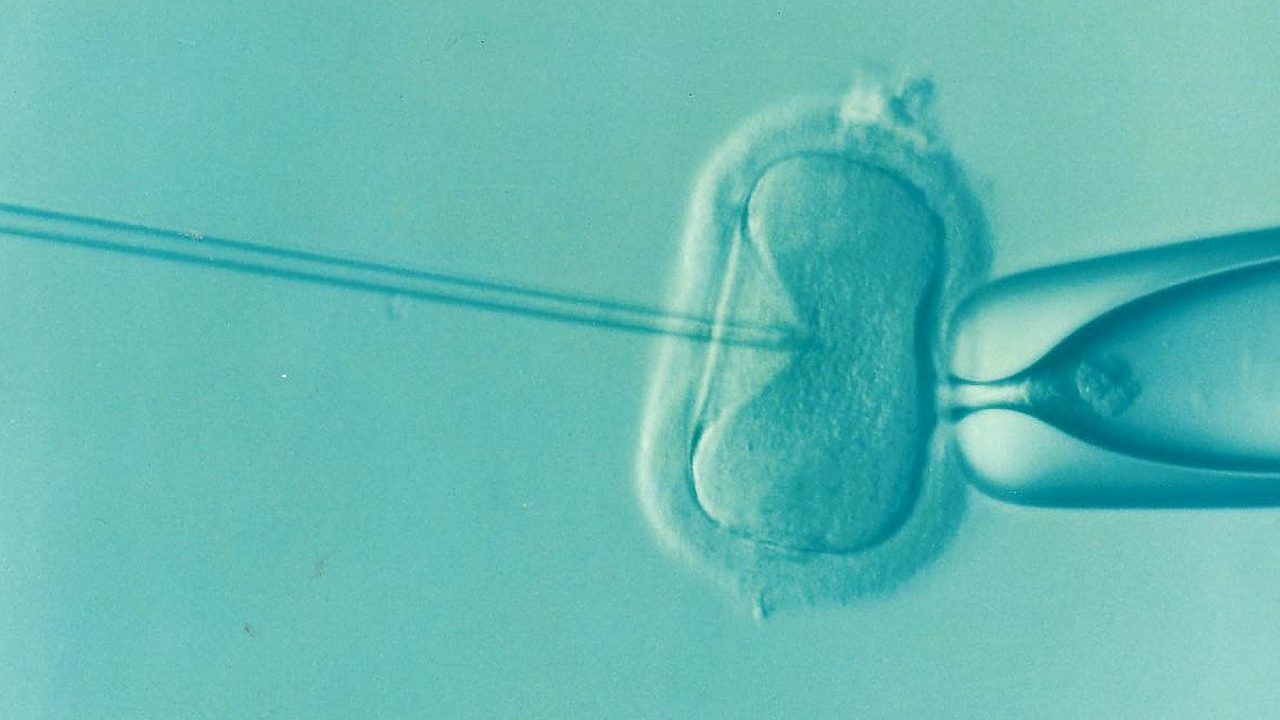
Shortly before midnight on 25 July 1978, at Oldham General Hospital in Lancashire, a healthy girl weighing five pounds twelve ounces was delivered by planned caesarean section. Her name was Louise Joy Brown, and she was the world's first baby to be conceived via in vitro fertilisation. The microscope photograph on this page shows the technique itself — a sperm injected into an egg during IVF treatment — whose first success her birth announced to every continent's headlines.
Her birth was the end of a road that had begun a decade earlier, in a collaboration between a Cambridge physiologist, Robert Edwards, and an Oldham gynaecologist, Patrick Steptoe, working with embryologist Jean Purdy. Louise's parents, Lesley and John Brown, had been trying for a child for nine years; Lesley's fallopian tubes were blocked, and conventional medicine had nothing to offer her. In November 1977 she underwent the then-experimental procedure: an egg was collected at exactly the right moment of a natural cycle, fertilised with her husband's sperm in the laboratory — in a petri dish, despite the test-tube baby label the press attached — and the dividing embryo was returned to her womb. Earlier attempts by the team had produced a pregnancy that lodged in a fallopian tube, and hundreds of women had taken part in the research without success.
The announcement split opinion. Supporters saw the end of a particular, quiet grief for millions of couples; critics warned of Frankenstein science, and the team's funding had repeatedly been refused or withdrawn on ethical grounds. The child herself answered the simplest fear: Louise Brown was an ordinary, healthy baby, and she grew up to have children of her own, conceived naturally. Her younger sister Natalie, also an IVF baby, became in 1999 the first person born by IVF to give birth herself.
The numbers since have settled the argument the year began. Marking 25 years of IVF in 2003, the University of Cambridge counted nearly 70,000 IVF children in the United Kingdom alone, 6,000 of them at Bourn Hall, the clinic Edwards, Steptoe and Purdy founded; worldwide estimates now run to many millions of births. Edwards received the Nobel Prize in Physiology or Medicine in 2010 — Steptoe and Purdy, both dead by then, could not share it. Around that birth, 1978 compressed a second drama into a single autumn: Pope Paul VI died on 6 August, his successor John Paul I reigned only 33 days, and on 16 October Cardinal Karol Wojtyla of Krakow was elected John Paul II, the first non-Italian pope in 455 years.
Timeline of 1978
- 16 January
NASA announces its first class of astronauts to include women — six of them, among them Sally Ride and Judy Resnick.
- 22 February
Navstar 1, the first operational satellite of the Global Positioning System, is launched from California.
- 16 March
The tanker Amoco Cadiz runs aground off Brittany, spilling some 69 million gallons of crude oil, then the largest oil spill in history.
- 3 May
Gary Thuerk sends an advertisement to some 400 ARPANET users — the message now remembered as the first spam email.
- 9 May
Aldo Moro, former Italian prime minister, is found murdered by the Red Brigades after 55 days as a hostage.
- 25 June
The rainbow flag flies for the first time at San Francisco's Gay Freedom Day parade, in Gilbert Baker's original eight-stripe design.
- 25 July
Louise Brown, the first baby conceived by in vitro fertilisation, is born in Oldham, England.
- 26 August
Cardinal Albino Luciani is elected Pope John Paul I; his reign lasts only 33 days.
- 17 September
Egypt's Anwar Sadat and Israel's Menachem Begin sign the Camp David Accords at the White House.
- 16 October
Cardinal Karol Wojtyla of Krakow is elected pope as John Paul II, the first non-Italian pope in 455 years.
- 18 November
More than 900 members of the Peoples Temple die at Jonestown, Guyana, after Congressman Leo Ryan is murdered.
- 27 November
San Francisco mayor George Moscone and supervisor Harvey Milk are assassinated at City Hall.
- 15 December
The United States announces full diplomatic relations with the People's Republic of China from 1 January 1979.
Why 1978 still matters
A technique denounced in 1978 as unnatural is now so routine that 25 July is marked informally as World IVF Day, and the glass jar used in Louise Brown's conception is an exhibit at the Science Museum in London. IVF's first success reframed infertility from a private fate into a treatable condition, and the ethical argument it opened — about where medicine may intervene in reproduction — has accompanied every advance since, on the terms 1978 set.
The year's diplomacy lasted just as long. The Camp David Accords framed the first peace treaty between Israel and an Arab state, and John Paul II's election brought a Polish pope to the Vatican on the eve of the decade in which his homeland's Solidarity movement would challenge the Soviet bloc — a movement whose groundwork the year's December announcement of full United States relations with China also reshaped, ending formal American ties with Taiwan's government.
Against those beginnings stands Jonestown, the year's warning. The serious record corrects the souvenir phrase: the drink was grape Flavor Aid, not Kool-Aid, and the dead were not, in the main, volunteers — the Guyanese coroner's jury treated nearly all the deaths as criminally caused, and more than 300 of the dead were children. In all, 909 people died at Jonestown that day, and with the five murdered at the airstrip and four more in Georgetown the day's total was 918 — the greatest single loss of American civilian life in a deliberate act before 9/11. 1978 holds both: a laboratory birth that gave millions a family, and a jungle clearing that showed how completely belonging could be converted into an instrument of death.
1978 on The History Trail
Louise Brown's birth and the Jonestown massacre carry featured stories on The History Trail.
- July 25 in History — Louise Brown, the first IVF baby, is born at Oldham.
- November 18 in History — More than 900 members of the Peoples Temple die at Jonestown.
- September 17 in History — Egypt and Israel sign the Camp David Accords.
- October 16 in History — Karol Wojtyla is elected Pope John Paul II.
- February 22 in History — Navstar 1, the first operational GPS satellite, is launched.
- June 25 in History — The rainbow flag flies for the first time in San Francisco.
Sources
- HISTORY — World's first 'test tube' baby born (July 25, 1978)
- HISTORY — What Happened on November 18
- Encyclopaedia Britannica — On This Day: September 17
- Encyclopaedia Britannica — On This Day: October 16
- HISTORY — This Day in History: February 22
- Encyclopaedia Britannica — On This Day: August 6
- Encyclopaedia Britannica — On This Day: May 3
- Encyclopaedia Britannica — On This Day: December 15
The facts on this page were checked against these sources on 19 November 2026. The History Trail's permanent pages are researched and written for this site; the live profiles elsewhere on The History Trail are assembled automatically from Wikipedia and Wikidata.
About the Author
Researched and written by the The History Trail Editorial Team — the accountable editorial function behind this site's permanent story pages. The team works from the published sources cited on each page; it does not invent historians, reviewers or credentials, and it corrects errors openly.
Fact Check
Every load-bearing fact on this page traces to one of the sources listed above, and significant claims link to their source in the text. Our checking method is described on the methodology page; errors can be reported via the corrections page.
Sources & Citations
Cite this page as: The History Trail Editorial Team, The History Trail — this article's title, publication and update dates are shown beneath its headline. The full source list appears under Sources above; the site's source standards are on the sources page.