
On This Day
February 22 in History
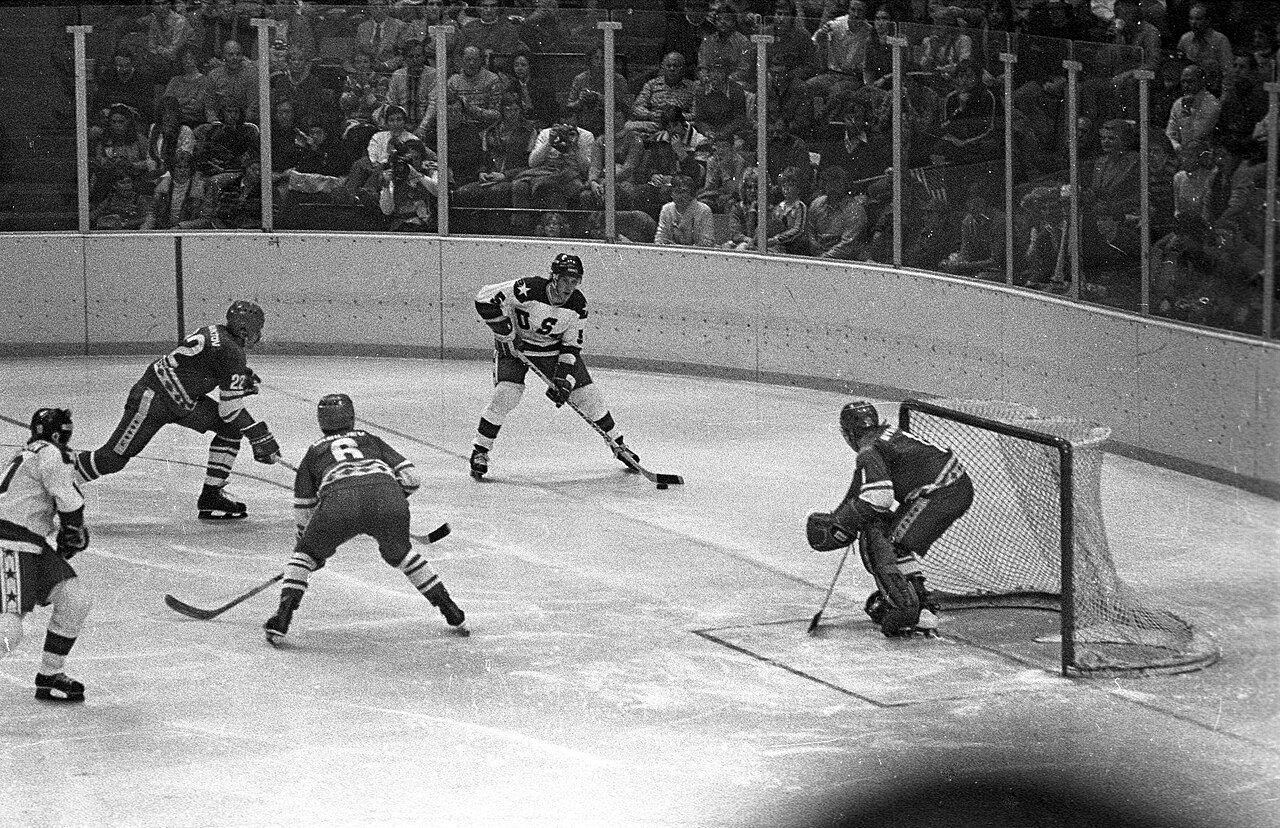
On 22 February 1980, at the Winter Olympics in Lake Placid, a team of American college students defeated the Soviet Union's all-conquering ice hockey team 4–3 in the game remembered as the Miracle on Ice. February 22 is also George Washington's birthday, the day the Long Telegram launched the doctrine of containment, and the day Dolly the sheep was announced to the world.
Choose another date: open the On This Day calendar to browse events, births and deaths for any day of the year.
At a Glance
- The game
- United States 4, Soviet Union 3 — medal round, Lake Placid Winter Olympics, 22 February 1980
- The favourites
- The Soviets had won the previous four Olympic gold medals and had beaten the U.S. team 10–3 in an exhibition weeks earlier
- The winning goal
- Captain Mike Eruzione scored with ten minutes remaining in the third period
- In goal
- Jim Craig made 36 saves for the United States
- Top scorer
- Mark Johnson scored twice for the Americans, including the last-second equaliser in the first period
- The gold
- The U.S. still had to beat Finland two days later to win the Olympic title
Events on this day
- 1819Spain and the United States sign the Adams–Onís Treaty, by which Spain cedes Florida and the two powers settle their North American boundary.
- 1847The Battle of Buena Vista begins in northern Mexico, the hardest-fought battle of the Mexican-American War.
- 1943Hans and Sophie Scholl and Christoph Probst, members of the White Rose resistance group, are executed in Munich for distributing leaflets against the Nazi regime.
- 1946George F. Kennan sends his Long Telegram from Moscow, the analysis of Soviet intentions that shapes the American policy of containment.
- 1959Lee Petty wins the first Daytona 500 stock-car race, a result settled only after officials study a photograph of the finish.
- 1967General Suharto takes full power in Indonesia, beginning more than three decades of authoritarian rule.
- 1978Navstar 1, the first operational satellite of the Global Positioning System, is launched from California.
- 1980A team of American college players defeats the Soviet Union 4–3 at the Lake Placid Olympics in the Miracle on Ice — the featured story above.
- 1997Scientists in Scotland announce Dolly the sheep, the first mammal cloned from an adult cell, born the previous July.
- 2006Raiders steal some £53 million from the Securitas cash depot in Kent, the largest cash robbery in British history.
- 2011A magnitude-6.3 earthquake strikes Christchurch, New Zealand, killing more than 180 people and devastating the city centre.
- 2014Ukraine's president Viktor Yanukovych flees Kyiv and is removed by parliament after months of mass protests.
Born on this day
- 1732George Washington — commander of the Continental Army and first president of the United States.
- 1788Arthur Schopenhauer — German philosopher, author of The World as Will and Representation.
- 1857Robert Baden-Powell — British soldier who founded the worldwide Scout movement.
- 1900Luis Buñuel — Spanish filmmaker, the surrealist director of Un Chien Andalou and The Discreet Charm of the Bourgeoisie.
- 1908John Mills — English actor whose career on screen spanned more than seventy years.
- 1975Drew Barrymore — American actress who became a child star in E.T. and built a long career in film and television.
Died on this day
- 1512Amerigo Vespucci — Italian explorer whose name, in its Latin form, was given to the Americas.
- 1944Kasturba Gandhi — Indian activist and wife of Mahatma Gandhi, who died in British detention at the Aga Khan Palace in Poona.
- 1987Andy Warhol — American artist who made pop art from soup cans and celebrities, dead in New York at 58.
- 2002Chuck Jones — American animator who gave Bugs Bunny, Daffy Duck and the Road Runner their definitive form.
The featured story: the Miracle on Ice, 22 February 1980
No result in Olympic history was less expected than this one. The Soviet Union's ice hockey team arrived at the 1980 Winter Olympics in Lake Placid, New York, as the most dominant side the sport had known: winners of the previous four Olympic gold medals, stocked with seasoned professionals from the Central Red Army club who played together all year. Only weeks before the Games, they had demolished the United States team 10–3 in an exhibition game at Madison Square Garden. The Americans, by contrast, were the youngest team in the tournament — a squad of college students and amateurs assembled by coach Herb Brooks, whose average age was barely twenty-one. When the two sides met again in the medal round on 22 February 1980, almost no one outside the American dressing room believed the rematch would be closer.
The game began as the form book predicted, and then refused to follow it. The Soviets led twice in the first period, but each time the Americans answered, and Mark Johnson scored in the final second of the period to tie the game 2–2 — a goal so unexpected that the great Soviet goaltender Vladislav Tretiak was replaced for the rest of the game. The Soviets dominated the second period yet managed only one goal, taking a 3–2 lead into the final twenty minutes. In the third period the Americans struck twice in quick succession: Johnson scored his second goal to level the game, and then, with exactly ten minutes remaining, team captain Mike Eruzione fired the puck past the replacement goaltender to put the United States ahead 4–3 for the first time.
What followed were the longest ten minutes in American sporting memory. The Soviets, unused to trailing, pressed without their usual calm, while American goaltender Jim Craig turned away shot after shot — he finished the game with 36 saves. The young Americans defended their single-goal lead through a final, frantic minute, and when the clock reached zero the players poured onto the ice in disbelief. The crowd's chant of 'U-S-A' and the stunned celebrations of a team of students who had beaten the unbeatable became, within hours, the defining images of the Games.
The victory did not itself deliver the gold medal — the Americans still had to beat Finland two days later, and did, coming from behind again to win 4–2 and complete the story. But it is the Soviet game that the world remembers. In 1999 Sports Illustrated ranked it the greatest sporting moment of the twentieth century, and its name, the Miracle on Ice, has passed into the language. It landed in an America worn down by inflation, energy shortages and the hostage crisis in Iran, and for one evening a hockey game between students and soldiers became a story an entire country told itself about what was still possible.
Why this date matters
February 22 is George Washington's birthday, and the date has kept his company: it opens with a treaty that handed the United States Florida and closes, in recent decades, with robberies, earthquakes and revolutions. But the day's centre of gravity is a hockey game. In 1980 a team of American students beat the most feared side in world sport, and the result was so far outside expectation that it stopped being a sports story within the hour and became a national one. Around it the date gathers the usual spread of human business — Kennan quietly drafting the doctrine of the Cold War in 1946, the first GPS satellite rising in 1978 — but the ice at Lake Placid is what February 22 is for.
Sources
- Encyclopaedia Britannica — On This Day: February 22
- HISTORY — This Day in History: February 22
- Smithsonian Magazine — 30th Anniversary of the Miracle on Ice
- Encyclopaedia Britannica — Miracle on Ice
The facts on this page were checked against these sources on 19 November 2026. The History Trail's permanent pages are researched and written for this site; the live profiles elsewhere on The History Trail are assembled automatically from Wikipedia and Wikidata.
About the Author
Researched and written by the The History Trail Editorial Team — the accountable editorial function behind this site's permanent story pages. The team works from the published sources cited on each page; it does not invent historians, reviewers or credentials, and it corrects errors openly.
Fact Check
Every load-bearing fact on this page traces to one of the sources listed above, and significant claims link to their source in the text. Our checking method is described on the methodology page; errors can be reported via the corrections page.
Sources & Citations
Cite this page as: The History Trail Editorial Team, The History Trail — this article's title, publication and update dates are shown beneath its headline. The full source list appears under Sources above; the site's source standards are on the sources page.