
On This Day
September 17 in History
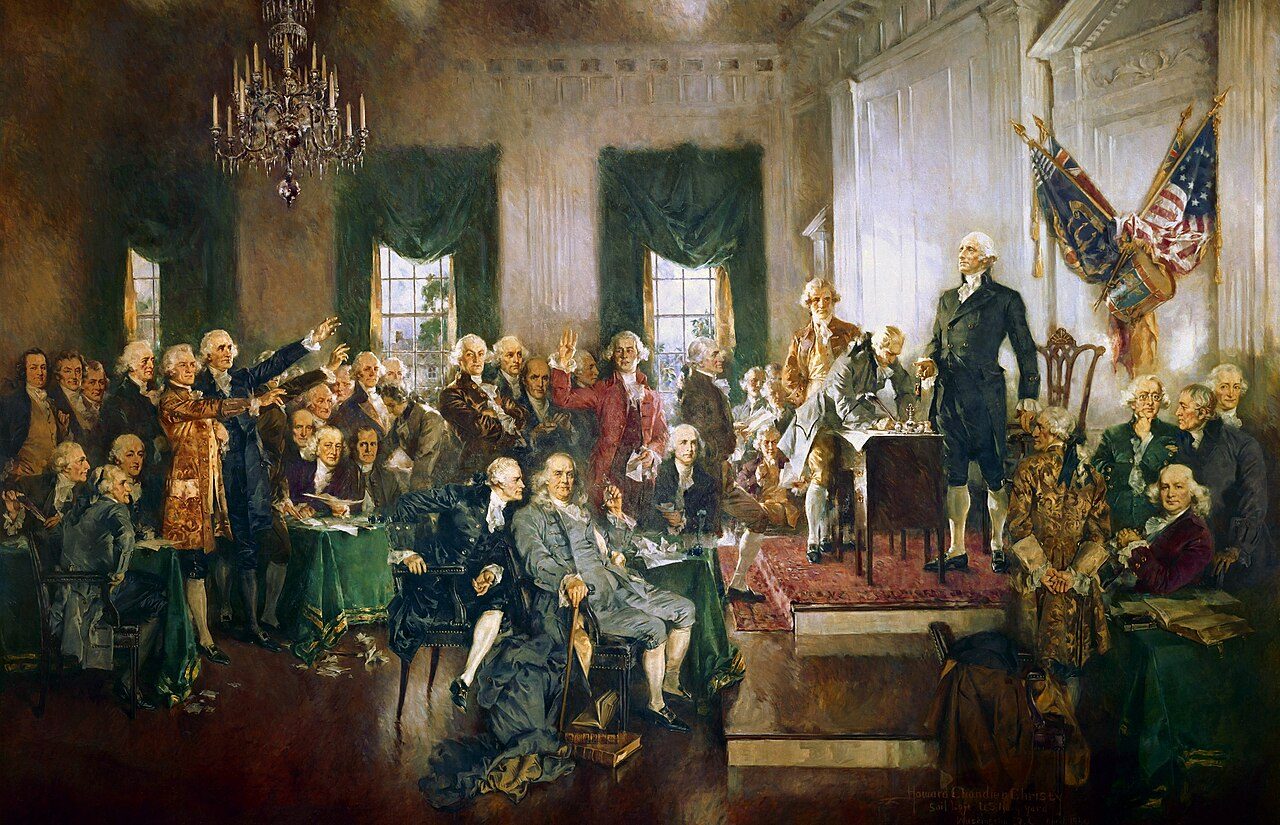
On 17 September 1787, at the Pennsylvania State House in Philadelphia, 39 delegates signed the Constitution of the United States, the oldest written national constitution still in use. September 17 is also, by a striking coincidence, the day of the Battle of Antietam in 1862, the bloodiest single day in American history, and of the signing of the Camp David Accords in 1978.
Choose another date: open the On This Day calendar to browse events, births and deaths for any day of the year.
At a Glance
- The convention
- Fifty-five delegates from 12 states met in Philadelphia from May 1787, ostensibly to revise the Articles of Confederation
- The signing
- Thirty-nine delegates signed the finished Constitution on 17 September 1787; three present — Mason, Randolph and Gerry — refused
- The oldest delegate
- Benjamin Franklin, 81, who urged unanimity in a closing speech read aloud on his behalf
- The bargain
- A federal government of three branches, with a two-chamber Congress balancing population against state equality
- What it lacked
- No bill of rights — the omission nearly sank ratification, and the first ten amendments followed in 1791
- The path ahead
- Ratification by nine states was required; New Hampshire's vote on 21 June 1788 put the Constitution into effect
Events on this day
- 1176At the Battle of Myriokephalon in Anatolia, a Seljuk army ambushes and defeats the Byzantine emperor Manuel I, ending Byzantine hopes of recovering the interior.
- 1683Dutch scientist Antonie van Leeuwenhoek writes to the Royal Society describing 'animalcules' seen under his microscope — the first report of bacteria.
- 1778The Treaty of Fort Pitt is signed between the United States and the Lenape (Delaware), the new republic's first treaty with a Native nation.
- 1787Thirty-nine delegates sign the Constitution of the United States in Philadelphia — the featured story above.
- 1849Harriet Tubman escapes from slavery in Maryland; she will return repeatedly to guide scores of others to freedom on the Underground Railroad.
- 1862The Battle of Antietam is fought in Maryland — with roughly 23,000 casualties, the bloodiest single day in American military history; Lee's invasion of the North is turned back.
- 1920Team owners meet in Canton, Ohio, and found the American Professional Football Association, which becomes the National Football League.
- 1944Operation Market Garden begins: Allied paratroopers drop behind German lines in the Netherlands in a bid to end the war by Christmas; the plan fails at Arnhem.
- 1976NASA rolls out its first space shuttle orbiter, Enterprise, in California; named for the starship after a campaign by Star Trek fans.
- 1978Egypt's Anwar Sadat and Israel's Menachem Begin sign the Camp David Accords at the White House, framing the first peace treaty between Israel and an Arab state.
- 2011Occupy Wall Street protesters camp in New York's Zuccotti Park, launching a global movement against economic inequality.
Born on this day
- 1883William Carlos Williams — American poet and physician, author of Paterson, who wrote the local into modern poetry.
- 1923Hank Williams — American country singer-songwriter whose brief career set the template for modern country music.
- 1931Anne Bancroft — American actress, Oscar winner for The Miracle Worker and Mrs Robinson in The Graduate.
- 1935Ken Kesey — American novelist of One Flew Over the Cuckoo's Nest and counterculture figure of the Merry Pranksters.
- 1945Phil Jackson — American basketball coach who won eleven NBA championships with the Chicago Bulls and Los Angeles Lakers.
Died on this day
- 1179Hildegard of Bingen — German abbess, composer, naturalist and visionary, one of the most remarkable minds of the twelfth century.
- 1951Jimmy Yancey — American boogie-woogie pianist whose rolling bass lines influenced generations of blues and jazz players.
- 1996Spiro Agnew — vice president of the United States under Richard Nixon, who resigned in 1973 amid a bribery scandal.
- 2021Abdelaziz Bouteflika — president of Algeria for twenty years, ousted by mass protests in 2019, dead in retirement.
The featured story: the United States Constitution is signed, 17 September 1787
The Constitutional Convention had been sitting in secrecy, behind shuttered windows, since May. Called to repair the Articles of Confederation — the loose league under which the United States had won its independence but could barely tax, trade or govern — the 55 delegates instead wrote a new frame of government altogether. Through the Philadelphia summer they argued over representation, slavery, the executive and the states, compromising as they went: a House apportioned by population against a Senate of equals, a single president checked by Congress and courts, and the three-fifths clause that counted enslaved people, fractionally, toward southern power while denying them every right the document proclaimed.
On Monday 17 September 1787 the finished text, engrossed on parchment, was read to the convention for the last time. Benjamin Franklin, at 81 too weak to speak, had James Wilson read his closing appeal: he confessed he did not entirely approve of the Constitution, but doubted he would ever think better of his own judgement than he did of the convention's collective work, and he begged every member to sign. Thirty-nine did. Three who were present — George Mason and Edmund Randolph of Virginia and Elbridge Gerry of Massachusetts — refused, Mason objecting above all that the document carried no declaration of rights. Rhode Island had sent no delegates at all.
Signing was not enactment. As Britannica's account sets out, the Constitution was the fundamental law proposed, not yet in force: it required ratification by conventions in nine of the thirteen states. The fight that followed — Federalist essays by Hamilton, Madison and Jay against fierce Anti-Federalist suspicion — produced the political promise that made ratification possible: a bill of rights would be added at once. Delaware ratified first that December; New Hampshire, on 21 June 1788, was the decisive ninth. The new government opened in 1789, and the Bill of Rights followed in 1791.
The document signed that day is, in Britannica's phrase, the oldest written national constitution still in use — amended only 27 times in nearly two and a half centuries, its four parchment pages kept at the National Archives in Washington. The United States marks 17 September as Constitution Day. The date's double life is a historian's gift: exactly 75 years after the signing, on 17 September 1862, the Union the framers built came closer to destruction than on any other single day, at Antietam — the battle that, in turn, gave Lincoln the standing to begin the Constitution's greatest repair, emancipation.
Why this date matters
September 17 is the hinge date of the American experiment. In 1787 the republic was given its operating system — argued over, compromised on, signed by men who admitted its faults in the act of endorsing it. Seventy-five years later to the day, that system nearly crashed at Antietam, and was saved, in part, by the moral amendment the battle made possible. The date also holds a first treaty with a Native nation, Harriet Tubman's first escape to freedom, and a peace signed at Camp David: again and again, the day on which America, and others, wrote down what they intended to be — and then had to live up to it.
Sources
- Encyclopaedia Britannica — On This Day: September 17
- HISTORY — This Day in History: September 17
- Encyclopaedia Britannica — Constitution of the United States of America
- Teaching American History — For Constitution Day: The Road toward the 13th Amendment, begun at Antietam
The facts on this page were checked against these sources on 19 November 2026. The History Trail's permanent pages are researched and written for this site; the live profiles elsewhere on The History Trail are assembled automatically from Wikipedia and Wikidata.
About the Author
Researched and written by the The History Trail Editorial Team — the accountable editorial function behind this site's permanent story pages. The team works from the published sources cited on each page; it does not invent historians, reviewers or credentials, and it corrects errors openly.
Fact Check
Every load-bearing fact on this page traces to one of the sources listed above, and significant claims link to their source in the text. Our checking method is described on the methodology page; errors can be reported via the corrections page.
Sources & Citations
Cite this page as: The History Trail Editorial Team, The History Trail — this article's title, publication and update dates are shown beneath its headline. The full source list appears under Sources above; the site's source standards are on the sources page.