
On This Day
January 27 in History
On 27 January 1945 Soviet soldiers entered Auschwitz, the largest of Nazi Germany's concentration and extermination camps, and found about 7,000 prisoners still alive — the day now kept worldwide as International Holocaust Remembrance Day. January 27 is also Mozart's birthday, the day the Apollo 1 astronauts died, and the day in 1973 the Paris Peace Accords were signed.
Choose another date: open the On This Day calendar to browse events, births and deaths for any day of the year.
At a Glance
- The complex
- Auschwitz I, Auschwitz II–Birkenau and Auschwitz III–Monowitz, near Oświęcim in German-occupied Poland, operating from 1940
- The victims
- An estimated 1.3 million people deported to Auschwitz; at least 1.1 million murdered, most of them Jews (USHMM figures)
- The evacuation
- From 17 January 1945 the SS forced some 60,000 prisoners westward on death marches and destroyed the gas chambers
- Liberation day
- 27 January 1945 — soldiers of the Soviet 60th Army (1st Ukrainian Front) enter the camps and find about 7,000 prisoners alive
- Evidence found
- Warehouses of victims' belongings, including some seven tonnes of human hair, documented by Soviet and Polish investigators
- Remembered
- In 2005 the United Nations designated 27 January as International Holocaust Remembrance Day
Events on this day
- 98Trajan becomes Roman emperor on the death of Nerva, beginning the rule under which the empire reaches its greatest extent.
- 1302The poet Dante Alighieri is exiled from Florence for his political allegiances; he will never return, and writes the Divine Comedy in exile.
- 1862President Abraham Lincoln issues General War Order No. 1, directing all Union land and sea forces to advance against the Confederacy.
- 1880Thomas Edison receives a United States patent for his electric incandescent lamp, the practical light bulb.
- 1888The National Geographic Society is incorporated in Washington, D.C., 'for the increase and diffusion of geographic knowledge'.
- 1944The Siege of Leningrad is finally lifted, 872 days after German forces encircled the city; hundreds of thousands of its people have died, most of starvation.
- 1945Soviet troops liberate the Auschwitz camp complex in Poland, finding about 7,000 surviving prisoners — the featured story above.
- 1967The Outer Space Treaty is signed in London, Moscow and Washington, banning nuclear weapons from orbit and claims of sovereignty over the Moon.
- 1967A fire during a launch rehearsal kills the three astronauts of Apollo 1 — Gus Grissom, Ed White and Roger Chaffee — at Cape Kennedy.
- 1973The Paris Peace Accords are formally signed, ending direct American participation in the Vietnam War.
Born on this day
- 1756Wolfgang Amadeus Mozart — Austrian composer whose 35 years produced over 600 works, from symphonies to The Magic Flute.
- 1775Friedrich Schelling — German philosopher, a central figure of German idealism.
- 1823Édouard Lalo — French composer of the Symphonie espagnole.
- 1832Lewis Carroll — English author and mathematician Charles Dodgson, creator of Alice's Adventures in Wonderland.
- 1859Wilhelm II — the last German emperor and king of Prussia, whose reign ended in the First World War.
Died on this day
- 1901Giuseppe Verdi — Italian composer of Aida, Rigoletto and La traviata, dead in Milan at 87.
- 2009John Updike — American novelist of the Rabbit books, dead at 76.
- 2010J. D. Salinger — American author of The Catcher in the Rye, dead at 91 after half a century of seclusion.
- 2014Pete Seeger — American folk singer and activist whose songs carried movements, dead at 94.
The featured story: Auschwitz is liberated, 27 January 1945
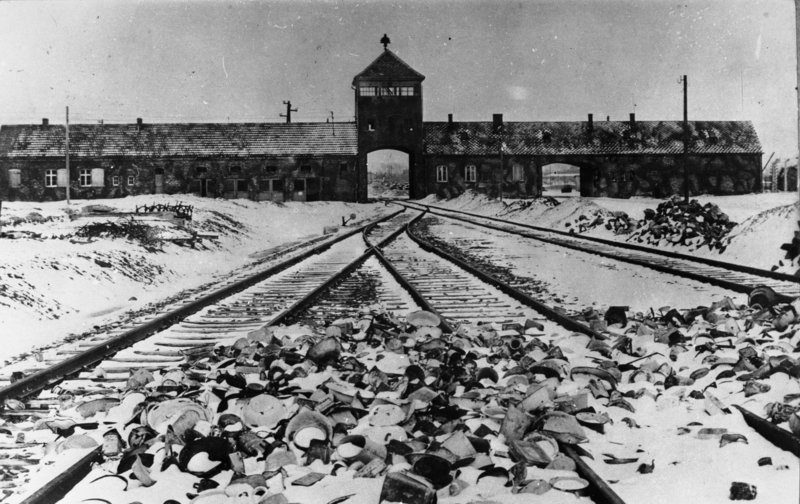
On 27 January 1945, soldiers of the Soviet 60th Army, part of the 1st Ukrainian Front advancing through southern Poland, entered the largest of Nazi Germany's killing centres: Auschwitz. The complex near the town of Oświęcim — Auschwitz I, the extermination camp of Birkenau (Auschwitz II) and the labour camp at Monowitz (Auschwitz III), with dozens of subcamps — had operated since 1940. According to the United States Holocaust Memorial Museum, some 1.3 million people were deported to Auschwitz, and at least 1.1 million of them were murdered, the overwhelming majority Jews, alongside Poles, Roma, Soviet prisoners of war and others.
The soldiers did not find the camp full. As the Red Army approached, the SS had begun destroying the evidence — blowing up the gas chambers and crematoria at Birkenau — and from 17 January had driven some 60,000 prisoners westward on foot in what survivors called the death marches, in which thousands died of cold, hunger and shooting. Those left behind, about 7,000 prisoners in the three main camps, were the ones too sick, too weak or too well hidden to march. It was these — many of them close to death, some of them children — whom Soviet doctors and soldiers began feeding, treating and filming on 27 January, while the front moved on towards Germany.
What the liberators documented in the following days entered the world's conscience: warehouses of confiscated belongings — hundreds of thousands of men's suits, more than 800,000 women's outfits, mountains of shoes, spectacles, prosthetic limbs and some seven tonnes of human hair, packed for shipment to Germany. Soviet and Polish investigators recorded testimony, and Auschwitz became, at Nuremberg and in the trials that followed in Poland, central evidence of the Nazi programme of extermination. Poland established a state museum on the site in 1947, and the camp was later inscribed on UNESCO's World Heritage List as evidence of the genocide.
The date itself was given a second life sixty years later. In 2005 the United Nations General Assembly designated 27 January as International Holocaust Remembrance Day, choosing the anniversary of Auschwitz's liberation to commemorate all the victims of the Holocaust. That is the double character of this date: it marks an ending — the day the killing at the largest death camp stopped — and a beginning, the moment the world started to see, in photographs and testimony it could not unsee, exactly what had been done there. Remembrance, on this date, is not a metaphor. It has an address, and a day.
Why this date matters
No date in January carries more weight of memory than this one. In 1945 it became the day the worst crime of the twentieth century acquired witnesses the world could not dismiss, and in 2005 the United Nations made it the day the world formally remembers. Around that centre the date holds its other patterns: empires at their height, with Trajan's accession in 98; genius arriving, with Mozart in 1756 and Carroll in 1832; and human ambition at its most fragile — three astronauts dead on a launchpad in 1967, on the very day nations agreed to keep weapons out of space. January 27 is where the calendar keeps both its warning and its hope.
Sources
- Encyclopaedia Britannica — On This Day: January 27
- HISTORY — What Happened on January 27
- HISTORY — Auschwitz Is Liberated
- United States Holocaust Memorial Museum — Holocaust Encyclopedia (Auschwitz liberation photograph and caption)
- Smithsonian Magazine — The Liberation of Auschwitz Took Place on This Day in 1945
The facts on this page were checked against these sources on 19 November 2026. The History Trail's permanent pages are researched and written for this site; the live profiles elsewhere on The History Trail are assembled automatically from Wikipedia and Wikidata.
About the Author
Researched and written by the The History Trail Editorial Team — the accountable editorial function behind this site's permanent story pages. The team works from the published sources cited on each page; it does not invent historians, reviewers or credentials, and it corrects errors openly.
Fact Check
Every load-bearing fact on this page traces to one of the sources listed above, and significant claims link to their source in the text. Our checking method is described on the methodology page; errors can be reported via the corrections page.
Sources & Citations
Cite this page as: The History Trail Editorial Team, The History Trail — this article's title, publication and update dates are shown beneath its headline. The full source list appears under Sources above; the site's source standards are on the sources page.