
On This Day
May 16 in History
On 16 May 1966 the Chinese Communist Party issued the May 16 Notification, the document with which Mao Zedong launched the Cultural Revolution — ten years of purges, Red Guard terror and destroyed heritage that the party itself later called its heaviest catastrophe. May 16 is also the day of the first Academy Awards, the first working laser, and Junko Tabei's ascent of Everest.
Choose another date: open the On This Day calendar to browse events, births and deaths for any day of the year.
At a Glance
- The document
- The May 16 Notification, 1966 — a Central Committee circular dissolving a party cultural group and warning of hidden enemies
- The author of the campaign
- Mao Zedong, striking back at party pragmatists who had sidelined him after the Great Leap Forward
- The instrument
- The Red Guards — student mass organisations unleashed against the 'Four Olds' and against authority itself
- The victims
- Officials, teachers and intellectuals persecuted nationwide; head of state Liu Shaoqi dies in detention in 1969
- The toll
- Scholarly estimates range from several hundred thousand to two million deaths; some 17 million youths are later sent to the countryside
- The verdict
- The party's own 1981 resolution calls it the most severe setback since 1949; it ends only with Mao's death in 1976
Events on this day
- 1770Fourteen-year-old Marie Antoinette marries the fifteen-year-old French dauphin, the future Louis XVI, at Versailles.
- 1868The U.S. Senate acquits President Andrew Johnson of impeachment charges by a single vote, 35 to 19.
- 1920Joan of Arc is canonised by Pope Benedict XV, nearly five centuries after her execution.
- 1929The first Academy Awards are presented at a dinner at the Hollywood Roosevelt Hotel; Wings wins best production.
- 1943German forces crush the Warsaw Ghetto Uprising after a month of fighting and blow up the Great Synagogue, ending the revolt.
- 1960Theodore Maiman operates the first working laser, a ruby laser, at Hughes Research Laboratories in Malibu, California.
- 1961Major General Park Chung-hee seizes power in a military coup in South Korea, beginning eighteen years of authoritarian rule.
- 1966The Chinese Communist Party issues the May 16 Notification, launching the Cultural Revolution — the featured story above.
- 1975Junko Tabei of Japan, climbing with Sherpa Ang Tsering, becomes the first woman to reach the summit of Mount Everest.
- 1975Sikkim votes away its monarchy and becomes the twenty-second state of India.
- 1997President Mobutu Sese Seko flees Kinshasa, ending thirty-two years of dictatorship in Zaire as rebel forces advance.
Born on this day
- 1718Maria Gaetana Agnesi — Italian mathematician who wrote the first comprehensive calculus textbook and gave the 'witch of Agnesi' curve its name.
- 1821Pafnuty Chebyshev — Russian mathematician whose work shaped probability theory and number theory.
- 1905Henry Fonda — American actor of The Grapes of Wrath and 12 Angry Men, patriarch of an acting dynasty.
- 1919Liberace — American pianist whose flamboyant showmanship made him television's highest-paid entertainer of his era.
- 1953Pierce Brosnan — Irish actor, the fifth screen James Bond.
- 1955Olga Korbut — Belarusian gymnast whose daring routines at the 1972 Munich Olympics transformed her sport.
- 1966Janet Jackson — American singer who became one of pop's best-selling artists.
- 1986Megan Fox — American actress who rose to fame with the Transformers films.
Died on this day
- 1703Charles Perrault — French writer whose Tales of Mother Goose gave Cinderella and Sleeping Beauty their classic forms.
- 1990Jim Henson — American creator of the Muppets, dead suddenly of pneumonia at 53.
- 1984Andy Kaufman — American comedian and performance artist, dead of lung cancer at 35.
- 1984Irwin Shaw — American novelist and playwright, author of The Young Lions.
- 2010Ronnie James Dio — American heavy-metal singer of Rainbow and Black Sabbath, dead at 67.
The featured story: China launches the Cultural Revolution, 16 May 1966
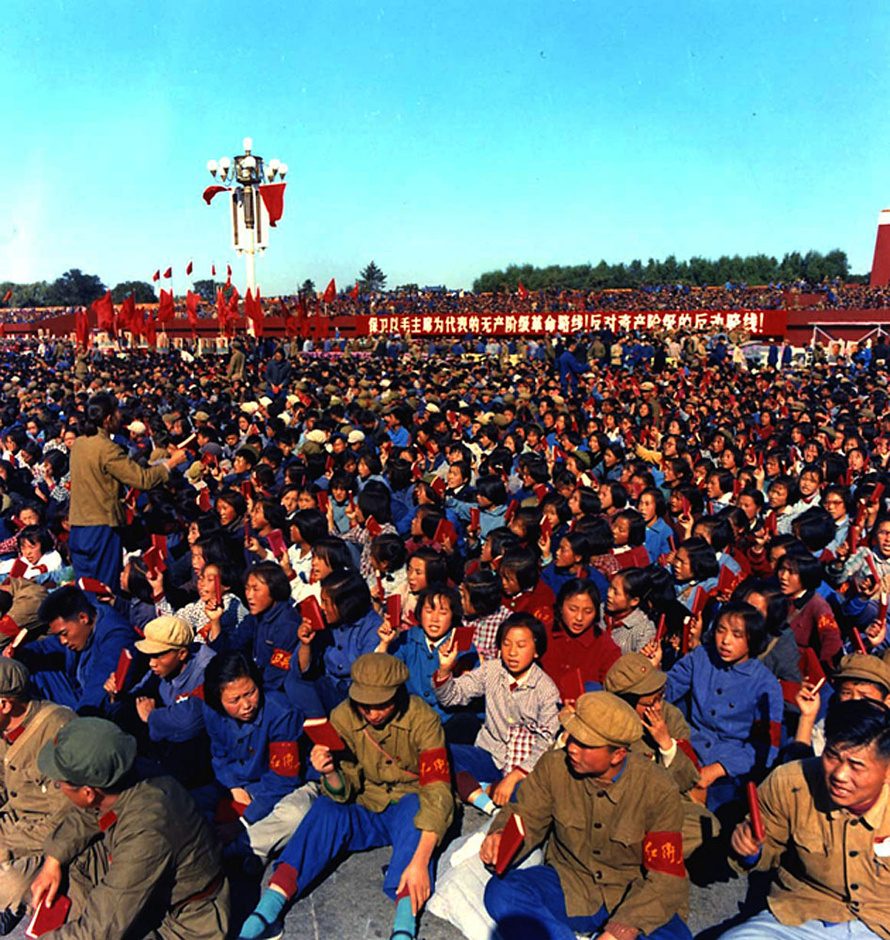
On 16 May 1966 the Central Committee of the Chinese Communist Party issued a short bureaucratic document — the 'May 16 Notification' — that dissolved a party cultural committee, denounced hidden enemies inside the leadership, and warned that 'representatives of the bourgeoisie' had burrowed into the party, the government and the army. With that circular, Mao Zedong formally launched the Great Proletarian Cultural Revolution: a decade of political upheaval that would turn China against itself, close its schools and universities, persecute millions, and leave, by scholarly estimates, between several hundred thousand and two million people dead.
Mao's purposes were layered. A decade after the disasters of the Great Leap Forward, he had been partly sidelined by pragmatists such as Liu Shaoqi and Deng Xiaoping, who had repaired the economy by quietly retreating from his radicalism. The Cultural Revolution was Mao's counter-attack: rather than fight his rivals inside the party apparatus, he appealed over its head to China's youth, calling on them to 'bombard the headquarters' and destroy the 'Four Olds' — old ideas, old culture, old customs and old habits. Students formed Red Guard units, put up big-character posters denouncing their teachers, and within months were ransacking homes, burning books and smashing temples across the country.
The violence escalated beyond anyone's control, including Mao's. In the 'Red August' of 1966, Red Guards terrorised Beijing; officials, intellectuals and ordinary people with the wrong family background were beaten, humiliated at struggle sessions, imprisoned or driven to suicide. Liu Shaoqi, the head of state, was expelled from the party, tortured by neglect in detention, and died in 1969. By 1967 rival Red Guard factions were fighting pitched battles with stolen weapons, and Mao had to send in the army and then exile a generation of urban students to the countryside — some seventeen million 'sent-down youth' — to end the chaos he had started.
The Cultural Revolution formally ended only with Mao's death in 1976 and the arrest of his widow Jiang Qing's 'Gang of Four'. In 1981 the Communist Party itself delivered the verdict: the revolution had been 'responsible for the most severe setback and the heaviest losses suffered by the party, the state and the people since the founding of the People's Republic'. China's universities lost a decade of graduates; its cultural inheritance — temples, manuscripts, artworks, lineages — was destroyed on a scale no invader had managed. The document of 16 May 1966 is a reminder of how much ruin can be set in motion by a single page of party prose.
Why this date matters
May 16 is a study in what crowds can be persuaded to do. In 1966 a single party circular licenses China's students to turn on their teachers, and a civilisation begins eating its own memory; in 1868 the United States Senate, by contrast, resists the crowd's demand and acquits a president by one vote — institutions holding, barely. The day also hands out firsts that built rather than broke: the first laser, the first Academy Awards, the first woman on Everest's summit. May 16 asks what a generation does with its energy, and records both answers.
Sources
- Encyclopaedia Britannica — On This Day: May 16
- HISTORY — What Happened on May 16
- Encyclopaedia Britannica — Cultural Revolution
- Asia for Educators, Columbia University — The Cultural Revolution
The facts on this page were checked against these sources on 19 November 2026. The History Trail's permanent pages are researched and written for this site; the live profiles elsewhere on The History Trail are assembled automatically from Wikipedia and Wikidata.
About the Author
Researched and written by the The History Trail Editorial Team — the accountable editorial function behind this site's permanent story pages. The team works from the published sources cited on each page; it does not invent historians, reviewers or credentials, and it corrects errors openly.
Fact Check
Every load-bearing fact on this page traces to one of the sources listed above, and significant claims link to their source in the text. Our checking method is described on the methodology page; errors can be reported via the corrections page.
Sources & Citations
Cite this page as: The History Trail Editorial Team, The History Trail — this article's title, publication and update dates are shown beneath its headline. The full source list appears under Sources above; the site's source standards are on the sources page.