
Years
1954 in History
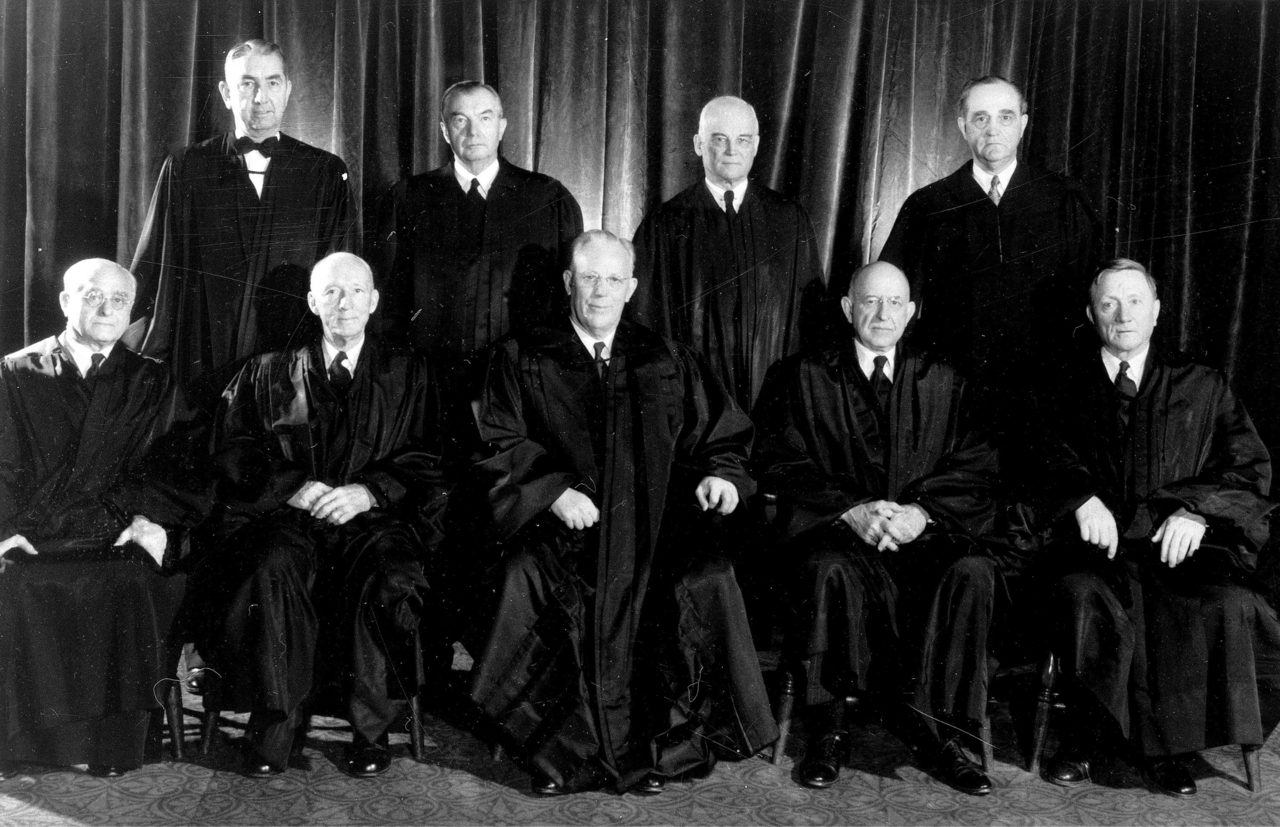
1954 is remembered above all for 17 May, when the U.S. Supreme Court ruled unanimously in Brown v. Board of Education that racial segregation in public schools was unconstitutional. The same spring brought Roger Bannister's first mile in under four minutes, the fall of Dien Bien Phu and the division of Vietnam, the start of Jonas Salk's mass polio vaccine trials, and, in a Memphis studio, Elvis Presley's first great recording session.
At a Glance
- Defining event
- Brown v. Board of Education, 17 May 1954 — school segregation declared unconstitutional, unanimously
- Sporting barrier
- Roger Bannister runs the mile in 3 minutes 59.4 seconds on 6 May
- In Indochina
- Dien Bien Phu surrenders 7 May; Geneva Accords divide Vietnam at the 17th parallel on 21 July
- Public health
- First mass field trials of Salk's polio vaccine begin 26 April
- McCarthy falls
- Senate votes 65–22 to condemn Joseph McCarthy on 2 December
- First volume
- The Fellowship of the Ring is published in London on 29 July
The defining story: separate is inherently unequal
On 17 May 1954 the chief justice of the United States, Earl Warren, read out one of the shortest and most consequential opinions in American law. In Brown v. Board of Education of Topeka, a unanimous Supreme Court held that separating children in public schools solely on the basis of race denied Black children the equal protection of the laws. Separate educational facilities are inherently unequal, the Court concluded, striking down the separate but equal doctrine that had sheltered segregation since 1896.
The case was really five cases, combined from Kansas, South Carolina, Virginia, Delaware and the District of Columbia, and named for Oliver Brown, a welder and assistant pastor in Topeka whose daughter Linda had to travel across town to a Black school although a white school stood blocks from her home. The NAACP's legal team, led by Thurgood Marshall, had spent two decades building toward this argument, presenting social-science evidence, including Kenneth Clark's doll studies, that separation stamped Black children with a sense of inferiority. Marshall would himself join the Court thirteen years later.
Unanimity was the decision's deliberate armour. Warren worked for months to bring all nine justices behind a single opinion written in plain, non-accusatory language newspapers could print and citizens could understand. The Court conspicuously did not order an instant remedy: a second decision, Brown II, followed in 1955, instructing desegregation with all deliberate speed, a phrase whose vagueness Southern officials exploited for a decade of massive resistance, closed schools and token compliance. By 1964 barely one Southern Black child in a hundred attended school with white children.
Brown shared its spring with endings and beginnings elsewhere. On 6 May Roger Bannister ran the first mile in under four minutes, 3 minutes 59.4 seconds, at Oxford. The next day French forces at Dien Bien Phu surrendered to the Viet Minh, ending the First Indochina War and France's empire in Indochina; the Geneva Conference, opened on 26 April, produced Accords on 21 July that divided Vietnam at the 17th parallel. On 26 April the first mass field trials of Salk's polio vaccine began in Virginia, with schoolchildren volunteers known as the Polio Pioneers. On 5 July Elvis Presley recorded That's All Right at Sun Studio in Memphis.
Timeline of 1954
- 21 January
The USS Nautilus, the world's first nuclear-powered submarine, is launched at Groton, Connecticut.
- 23 February
The first children receive Salk's polio vaccine in Pittsburgh, opening the mass vaccination campaign.
- 22 April
The Army–McCarthy hearings open in Washington, televised for weeks.
- 26 April
The first mass field trials of Salk's polio vaccine begin in Virginia.
- 6 May
Roger Bannister runs the first mile in under four minutes at Oxford.
- 7 May
French forces at Dien Bien Phu surrender to the Viet Minh.
- 17 May
Brown v. Board of Education declares school segregation unconstitutional.
- 7 June
Alan Turing, founder of computer science and wartime codebreaker, dies at 41.
- 9 June
At the Army–McCarthy hearings, Joseph Welch confronts McCarthy: Have you no sense of decency, sir, at long last?
- 27 June
The Obninsk power station in the Soviet Union begins supplying electricity, the world's first grid nuclear power plant.
- 5 July
Elvis Presley records That's All Right at Sun Studio in Memphis.
- 21 July
The Geneva Accords end the First Indochina War and divide Vietnam at the 17th parallel.
- 29 July
The Fellowship of the Ring, first volume of The Lord of the Rings, is published in London.
- 2 December
The Senate votes 65–22 to condemn Joseph McCarthy, breaking the power of his crusade.
Why 1954 still matters
Brown changed what the law said America was. It destroyed the constitutional shelter of Jim Crow, gave the young civil rights movement a legal weapon and a moral warrant, and reached far beyond schools: the reasoning that killed separate but equal in education was soon turned on buses, parks, marriage laws and every other statute built on the same fiction. The schoolhouse door Warren opened in 1954 is still being walked through, not least because the remedy lagged the ruling by a generation of court orders, federal money and resistance.
Vietnam's division at Geneva proved the year's most fateful line on a map. Intended as a settlement for Korea and Indochina after years of war, the Accords ended France's Indochina empire and created the two Vietnams whose contest drew in the United States for two decades — the subject of this site's Vietnam War story. In Washington, the televised Army–McCarthy hearings and Joseph Welch's decency question began Senator McCarthy's fall, completed by the Senate's condemnation in December: television had shown the nation the bullying it had previously only read about.
The year's quieter firsts compounded: the Nautilus launched the nuclear navy in January and was commissioned in September, Obninsk supplied the first grid nuclear electricity in June, CERN's convention came into force on 29 September, Texas Instruments announced the first mass-produced transistor radio on 18 October, and Ellis Island, gateway for more than 12 million immigrants, closed on 12 November. Oprah Winfrey, Angela Merkel and James Cameron were all born in 1954.
1954 on The History Trail
Courtroom, running track and Geneva table fill 1954 on The History Trail.
- May 17 in History — Brown v. Board of Education, told in full.
- May 6 in History — Bannister breaks the four-minute mile.
- May 7 in History — Dien Bien Phu surrenders.
- July 21 in History — The Geneva Accords divide Vietnam.
- July 29 in History — The Fellowship of the Ring is published.
- December 2 in History — The Senate condemns McCarthy.
- Vietnam War — The war whose division was drawn at Geneva in 1954.
- The Lord of the Rings — Tolkien's epic, whose first volume appeared in 1954.
Sources
- National Archives — Brown v. Board of Education (1954)
- Encyclopaedia Britannica — On This Day: May 17
- Encyclopaedia Britannica — On This Day: May 6
- Encyclopaedia Britannica — On This Day: May 7
- Encyclopaedia Britannica — On This Day: April 26
- Encyclopaedia Britannica — On This Day: December 2
- Encyclopaedia Britannica — On This Day: July 29
The facts on this page were checked against these sources on 19 November 2026. The History Trail's permanent pages are researched and written for this site; the live profiles elsewhere on The History Trail are assembled automatically from Wikipedia and Wikidata.
About the Author
Researched and written by the The History Trail Editorial Team — the accountable editorial function behind this site's permanent story pages. The team works from the published sources cited on each page; it does not invent historians, reviewers or credentials, and it corrects errors openly.
Fact Check
Every load-bearing fact on this page traces to one of the sources listed above, and significant claims link to their source in the text. Our checking method is described on the methodology page; errors can be reported via the corrections page.
Sources & Citations
Cite this page as: The History Trail Editorial Team, The History Trail — this article's title, publication and update dates are shown beneath its headline. The full source list appears under Sources above; the site's source standards are on the sources page.