
Things
Vietnam War
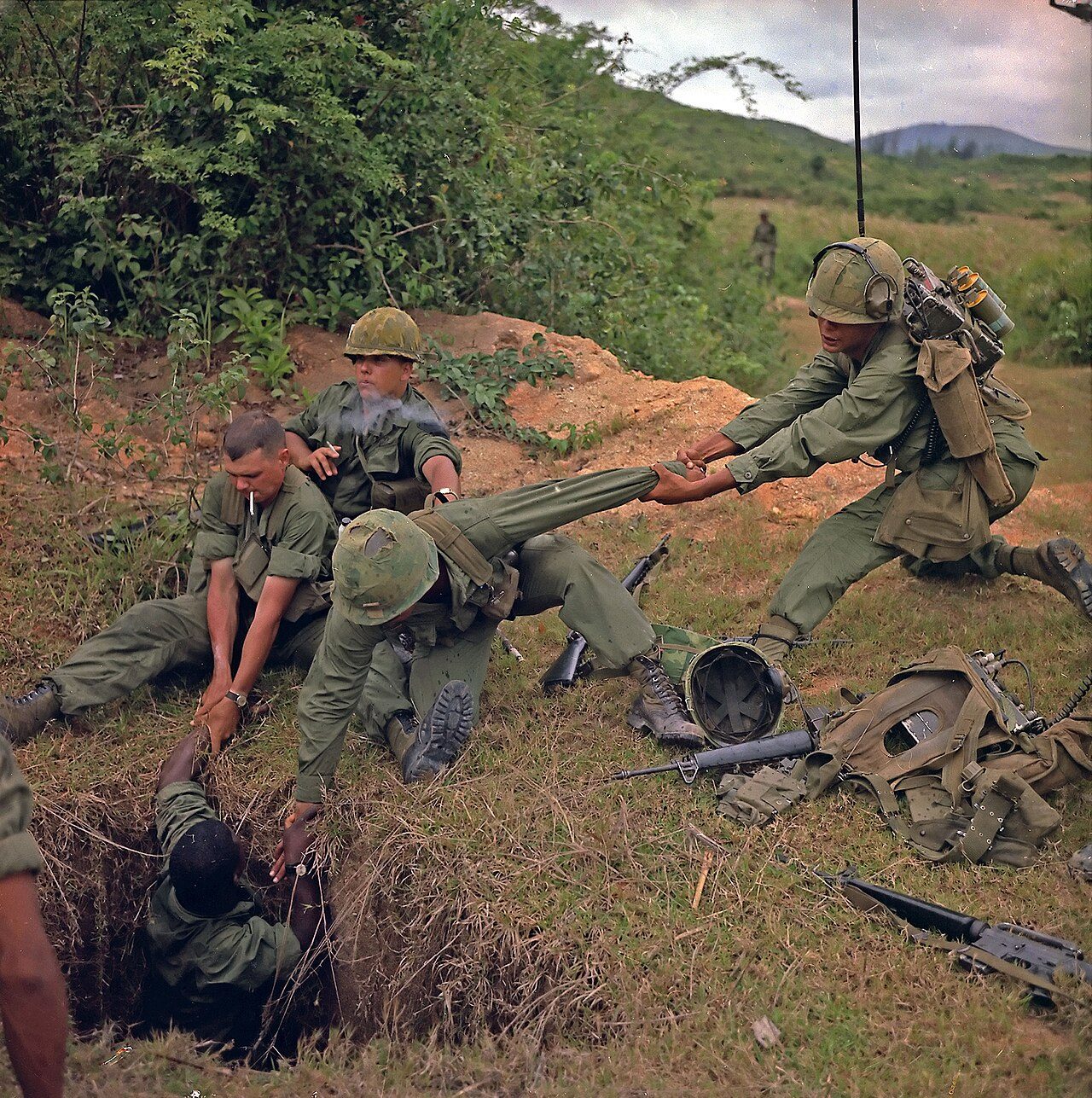
The Vietnam War (1954-1975) was the conflict in which communist North Vietnam and its Viet Cong allies defeated South Vietnam and its principal ally, the United States. It grew out of French colonial rule, became a central Cold War struggle, ended with Saigon's fall on 30 April 1975 and Vietnam's reunification, and is known in Vietnam as the American War.
At a Glance
- Dates
- 1954 to 30 April 1975 in Britannica's dating, from the French defeat and partition of Vietnam to the fall of Saigon
- The sides
- North Vietnam and the Viet Cong, backed by the Soviet Union and China, against South Vietnam, backed principally by the United States
- The partition
- The Geneva Accords of July 1954 divided Vietnam temporarily at the 17th parallel, with nationwide elections planned for 1956 that were never held
- US peak
- More than 500,000 US military personnel were stationed in Vietnam by 1969, according to Britannica; US combat units were withdrawn by 1973
- Deaths
- Vietnam's official estimate, released in 1995: as many as 2 million civilians on both sides and some 1.1 million North Vietnamese and Viet Cong fighters; US deaths passed 58,200
- The end
- The Paris Peace Accords of 27 January 1973 ended direct US involvement; North Vietnamese forces took Saigon on 30 April 1975
- In Vietnam
- The war is called the American War, in full the Resistance War Against America
Introduction
Britannica describes the Vietnam War as a protracted conflict that was also part of a larger regional conflict, the Indochina wars, and a manifestation of the Cold War between the United States and the Soviet Union and their allies. At its heart was North Vietnam's aim, after defeating France in 1954, to unify the country under a single communist regime, set against a South Vietnamese government that fought to preserve a Vietnam aligned with the West.
The fighting spread beyond Vietnam into Laos and Cambodia, drew in hundreds of thousands of American troops, and divided opinion in the United States more deeply than any war of its century. It ended not with an American victory, but with a northern invasion in 1975 and the collapse of the South Vietnamese state.
Origins: French Indochina, Dien Bien Phu and Geneva
Vietnam had been part of French Indochina, and after the Second World War the Viet Minh, the nationalist movement led by Ho Chi Minh, fought to end French rule. The French Indochina War broke out in 1946 and lasted eight years, with France's war effort largely funded and supplied by the United States. It ended in a shattering defeat at Dien Bien Phu, where the French garrison, besieged since March, fell on 7 May 1954.
The defeat prodded negotiators at Geneva to produce the Geneva Accords in July 1954. The accords made the 17th parallel a temporary demarcation line: north of it lay the Democratic Republic of Vietnam, or North Vietnam; south of it, the state that became South Vietnam. Civilians could move between the zones, a demilitarised zone was to separate the two sides, and nationwide elections were to be held in 1956. Those elections were never held, and the temporary line hardened into a frontier between two rival states.
Escalation: Advisers, the Gulf of Tonkin and Combat Troops
American involvement deepened by stages. US advisers, present in small numbers through the 1950s, were introduced on a large scale from 1961, as President Kennedy expanded aid in line with the domino theory: the fear that a communist Vietnam would topple neighbouring states. In the South, a communist insurgency, whose fighters became known as the Viet Cong, fought the Saigon government with northern support, direction and, increasingly, regular troops.
The decisive step came in August 1964. The National Archives records that North Vietnamese torpedo boats attacked the destroyer USS Maddox on 2 August, and that a second attack reported on 4 August was later concluded never to have happened. Congress nevertheless passed the Gulf of Tonkin Resolution on 7 August, authorising the president to take all necessary measures to repel attack and prevent further aggression. It became the legal basis for escalation without a declaration of war: bombing of the North followed, combat units arrived in 1965, and by 1969 more than 500,000 American personnel were in Vietnam.
Tet, Vietnamization and the Paris Accords
On 30 January 1968, at the Tet lunar new year holiday, North Vietnamese and Viet Cong forces launched a coordinated offensive against cities and towns across South Vietnam, including Saigon and Hue. The attackers suffered very heavy losses and were driven back, but the offensive's scale shattered official claims that the war was being won. It deepened American opposition, and President Lyndon B. Johnson halted much of the bombing, opened the way to talks in Paris and announced he would not seek re-election.
His successor, Richard Nixon, pursued Vietnamization from 1969: expanding and re-equipping South Vietnam's forces while American troops were gradually withdrawn, even as US bombing extended into Cambodia and Laos. Negotiations in Paris finally produced the Paris Peace Accords, signed on 27 January 1973 by the United States, North Vietnam, South Vietnam and the Provisional Revolutionary Government. The accords set a ceasefire, required the withdrawal of all US and allied forces within 60 days and provided for the release of prisoners of war. US combat units left in 1973, but the ceasefire did not hold.
Timeline
- 1946-1954
The French Indochina War: the Viet Minh fight French colonial rule, with France's war effort largely funded and supplied by the United States.
- 7 May 1954
The French garrison at Dien Bien Phu falls to the Viet Minh after a siege begun in March, ending French rule in Indochina.
- July 1954
The Geneva Accords divide Vietnam temporarily at the 17th parallel; nationwide elections planned for 1956 are never held.
- 1961
President Kennedy expands US military aid and advisers to South Vietnam on a large scale.
- 2-7 August 1964
The Gulf of Tonkin incidents and Resolution: Congress authorises the president to take all necessary measures in South-East Asia.
- 1965
The United States begins sustained bombing of North Vietnam and introduces active combat units in the South.
- 30 January 1968
The Tet Offensive: coordinated attacks across South Vietnam turn American opinion, though the attackers are driven back.
- 1969
Vietnamization begins under President Nixon: South Vietnamese forces take over the fighting as US troops withdraw.
- 27 January 1973
The Paris Peace Accords are signed; US forces are to withdraw within 60 days and prisoners of war are released.
- 1973
The last US combat units leave Vietnam, but fighting between North and South continues.
- 30 April 1975
Saigon falls to North Vietnamese forces; South Vietnam surrenders and the war ends.
- July 1976
North and South are formally reunified as the Socialist Republic of Vietnam.
Significance
The war's human cost can only be given as attributed estimates, because no exact count exists. Vietnam did not release its official estimate until 1995: as many as 2 million civilians on both sides and some 1.1 million North Vietnamese and Viet Cong fighters killed. The US military has estimated that between 200,000 and 250,000 South Vietnamese soldiers died. American deaths passed 58,200, and smaller numbers of South Korean, Australian, Thai and other allied troops were also killed. Britannica adds that Vietnam emerged a potent military power, but with its industry disrupted, its countryside scarred by bombs and defoliation and laced with land mines, and its towns heavily damaged.
Questions readers ask
Was it technically a war for the United States? In the common sense, yes: America committed some 550,000 troops at the height of the conflict, in Britannica's summary. Constitutionally, however, Congress never declared war; it authorised the deployment, above all through the Gulf of Tonkin Resolution, so the conflict is technically an undeclared war.
Who won? By the war's stated aims, North Vietnam did. The United States entered to prevent a communist takeover of the South; instead the two Vietnams were united under a communist government in July 1976, and Laos and Cambodia also fell to communist movements. That outcome, reached after American withdrawal, is why the war is remembered in the United States as a defeat.
Why is it called the American War? Because that is its name in Vietnam, where it is remembered as a war of resistance against a foreign power, following the earlier war against France. Britannica gives the fuller form as the War Against the Americans to Save the Nation. The two names record two perspectives: an American Cold War intervention, and a Vietnamese struggle for reunification and independence.
Legacy
In Washington, the Vietnam Veterans Memorial, dedicated in 1982 and designed by Maya Lin, carries the names of the American dead and missing in chronological order on two black granite walls. Britannica notes that it was first inscribed with 57,939 names and that additions have brought the total past 58,200. The National Park Service describes visitors' faces reflected in the polished stone among the etched names.
Other legacies are still lived with. The Vietnam Veterans Memorial Fund records that the United States sprayed an estimated 20 million gallons of herbicides between 1962 and 1971, more than half of it Agent Orange, whose dioxin contaminant is linked in the Fund's account to skin diseases and cancers among those exposed and to birth defects in their children, on both sides. The Agent Orange Act of 1991 allows the Department of Veterans Affairs to treat a range of diseases as probable effects of exposure. The war left America, in Britannica's words, with a demoralised military and a deeply divided electorate, and diplomatic relations with Vietnam resumed only in 1995.
Sources
- Encyclopaedia Britannica — Vietnam War
- Encyclopaedia Britannica — Vietnam War: French rule ended, Vietnam divided
- National Archives — Tonkin Gulf Resolution (1964)
- National Park Service — Vietnam Veterans Memorial
- Vietnam Veterans Memorial Fund — Agent Orange
The facts on this page were checked against these sources on 19 November 2026. The History Trail's permanent pages are researched and written for this site; the live profiles elsewhere on The History Trail are assembled automatically from Wikipedia and Wikidata.
About the Author
Researched and written by the The History Trail Editorial Team — the accountable editorial function behind this site's permanent story pages. The team works from the published sources cited on each page; it does not invent historians, reviewers or credentials, and it corrects errors openly.
Fact Check
Every load-bearing fact on this page traces to one of the sources listed above, and significant claims link to their source in the text. Our checking method is described on the methodology page; errors can be reported via the corrections page.
Sources & Citations
Cite this page as: The History Trail Editorial Team, The History Trail — this article's title, publication and update dates are shown beneath its headline. The full source list appears under Sources above; the site's source standards are on the sources page.