
On This Day
July 21 in History
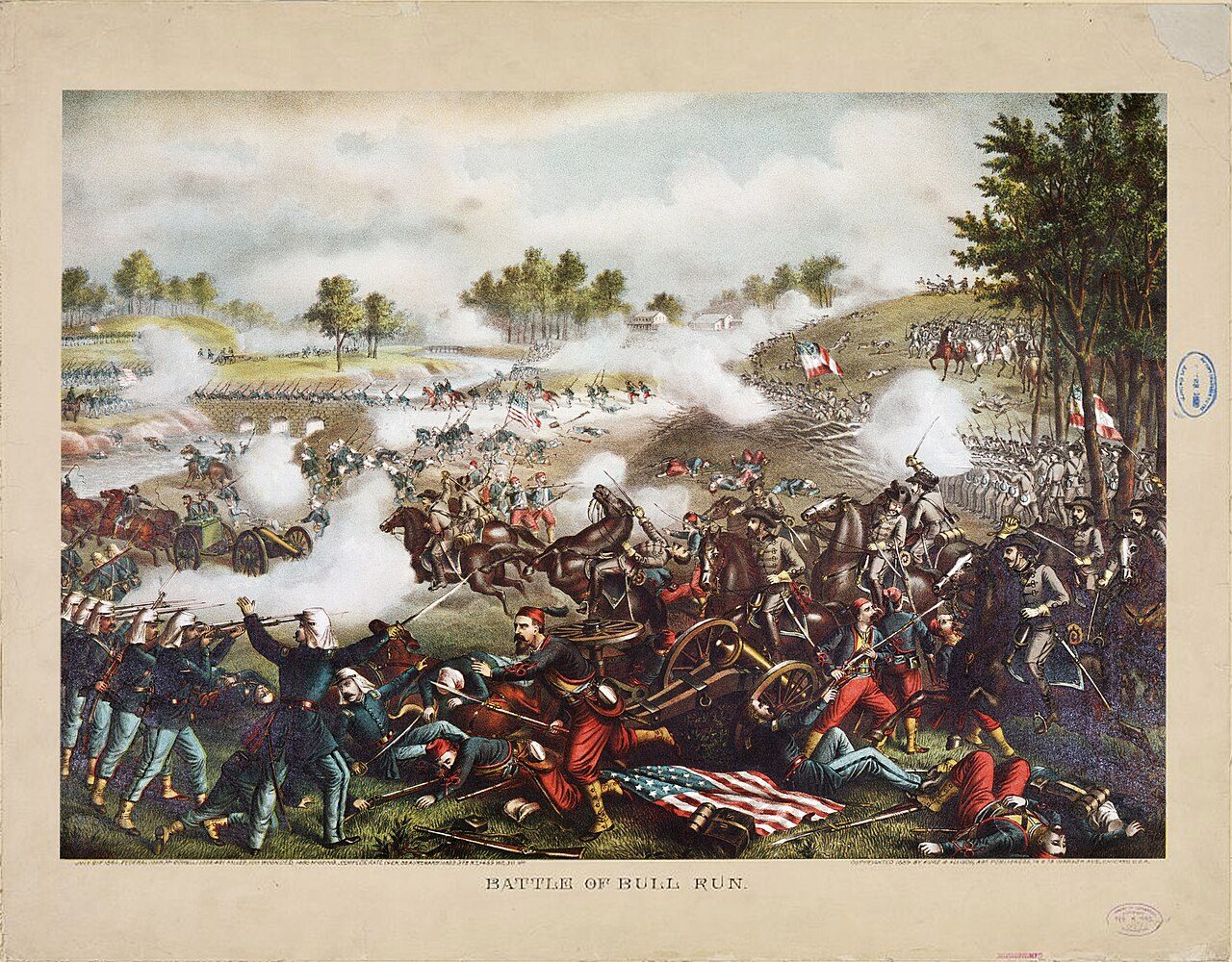
On 21 July 1861, beside a Virginia creek called Bull Run, the Union and Confederate armies fought the first major battle of the American Civil War — and the North's confident advance dissolved into a rout watched by picnicking congressmen. July 21 is also the day of the Scopes trial verdict, the coldest temperature ever recorded on Earth, and Neil Armstrong's first step on the Moon, measured in Universal Time.
Choose another date: open the On This Day calendar to browse events, births and deaths for any day of the year.
At a Glance
- The place
- Along Bull Run creek near Manassas Junction, Virginia, about 30 miles from Washington, D.C.
- The armies
- Some 35,000 Union troops under Irvin McDowell against about 32,000 Confederates under P. G. T. Beauregard and Joseph E. Johnston
- The stakes
- The first major battle of the Civil War, fought three months after Fort Sumter, amid Northern demands to march 'On to Richmond'
- The turning point
- Confederate reinforcements arriving by rail, and Thomas J. Jackson's brigade standing, in the famous phrase, 'like a stone wall' on Henry House Hill
- The cost
- Roughly 4,700 casualties in total — the bloodiest day in American history to that point, and a foretaste of far worse
- The lesson
- Both sides learned the war would be long; within days Lincoln signed up half a million three-year volunteers
Events on this day
- AD 365A great earthquake off Crete sends a tsunami across the eastern Mediterranean, devastating Alexandria and the Nile Delta coast.
- 1403Henry IV defeats the Percy rebellion at the Battle of Shrewsbury; Harry 'Hotspur' Percy is killed.
- 1798Napoleon's army defeats the Mamluks at the Battle of the Pyramids outside Cairo.
- 1831Leopold I is inaugurated as the first king of the Belgians.
- 1861Confederate forces win the First Battle of Bull Run, the first major battle of the American Civil War — the featured story above.
- 1865Wild Bill Hickok shoots Dave Tutt in the public square of Springfield, Missouri, in the first recorded quick-draw duel of the Wild West.
- 1925John T. Scopes is convicted in Dayton, Tennessee, of teaching evolution, in the 'Monkey Trial'; his $100 fine is later overturned on a technicality.
- 1954The Geneva Accords end the First Indochina War and divide Vietnam at the 17th parallel.
- 1961Gus Grissom becomes the second American in space, on the suborbital Mercury-Redstone 4 flight; his capsule sinks after splashdown.
- 1969At 02:56 UTC, Neil Armstrong steps onto the Moon's surface — still 20 July in the Americas, 21 July in Europe and beyond.
- 1970Egypt's Aswan High Dam is completed after eleven years of construction.
- 1983The coldest temperature ever recorded on Earth, −89.2 °C (−128.6 °F), is measured at Vostok Station, Antarctica.
- 2011Space Shuttle Atlantis lands in Florida, ending NASA's thirty-year shuttle programme after 135 missions.
Born on this day
- 1899Ernest Hemingway — American novelist of A Farewell to Arms and The Old Man and the Sea, Nobel laureate in literature.
- 1911Marshall McLuhan — Canadian media theorist who coined 'the medium is the message' and 'the global village'.
- 1924Don Knotts — American comic actor, Barney Fife of The Andy Griffith Show.
- 1948Cat Stevens — English singer-songwriter of 'Wild World' and 'Peace Train', later Yusuf Islam.
- 1951Robin Williams — American actor and comedian of explosive improvisational gifts, from Mork to Good Will Hunting.
Died on this day
- 1796Robert Burns — Scotland's national poet, dead at Dumfries at 37.
- 1944Claus von Stauffenberg — German officer executed in Berlin the day after his bomb failed to kill Hitler in the 20 July plot.
- 1998Alan Shepard — the first American in space and, on Apollo 14, the only Mercury astronaut to walk on the Moon, dead at 74.
- 2023Tony Bennett — American singer whose career ran from the 1950s to duets with Lady Gaga in his nineties, dead at 96.
The featured story: the First Battle of Bull Run, 21 July 1861
Three months into the American Civil War, neither side had yet fought a real battle, and the North was impatient. Union enlistments were running out — many regiments had signed for ninety days — and the newspapers demanded action: 'On to Richmond.' President Lincoln, knowing his army was unready, also knew the Confederates were no readier. 'You are green, it is true,' he told his reluctant general, Irvin McDowell, 'but they are green also; you are all green alike.' McDowell marched some 35,000 men out of Washington toward the Confederate force guarding the railway junction at Manassas, Virginia, where General P. G. T. Beauregard waited behind a muddy creek called Bull Run.
McDowell's plan was sound and too clever for the troops who had to execute it: a feint at the Stone Bridge while the main force looped upstream to fall on the Confederate left. The flanking column lost hours on bad roads, and the attack that should have fallen at dawn began mid-morning. It still nearly worked — by midday the Confederates had been driven from Matthews Hill and McDowell was shouting that the day was won. But two things saved the South. Joseph E. Johnston's army had slipped away from the Shenandoah Valley and arrived by train — the first time in warfare that railways delivered troops directly to a battlefield — and on Henry House Hill, Virginia brigade commander Thomas J. Jackson set his men in line and, in the words that named him for life, stood there 'like a stone wall.'
Through the afternoon the Union attacks broke against that hill, where the battle's most famous civilian, the 85-year-old widow Judith Henry, was killed in her house by artillery fire. When fresh Confederate brigades struck the Union right late in the day, McDowell's exhausted, disorganised army did not retreat so much as dissolve. The road to Washington filled with fleeing soldiers mixed with the carriages of congressmen and sightseers who had ridden out with picnic hampers to watch the battle — the most humiliating spectacle of the Union war. Confederate troops were too disorganised to pursue, and Washington, panicking that night, was never in real danger.
The casualty lists — about 2,900 Union and 1,900 Confederate — shocked both capitals precisely because they were, by the war's later standards, small. Bull Run's real work was educational. The North abandoned the fantasy of a ninety-day war: Lincoln called for 500,000 three-year volunteers and replaced McDowell with George B. McClellan. The South drew the opposite and more dangerous lesson, an early conviction of its own martial superiority. And the battle fixed the war's double naming habit — Bull Run to the North, after the creek; Manassas to the South, after the nearest town — a small, permanent reminder that the two sides could not even agree on what to call the ground they were killing each other on.
Why this date matters
July 21 is a day for the end of illusions. At Bull Run the illusion was a short, gallant war; at Dayton in 1925 it was that a courtroom could settle science; at Geneva in 1954, that a line on a map could settle Vietnam. Even its wonders carry the theme: the coldest air ever measured, a shuttle fleet retiring, and — by the clock that science keeps — a man stepping onto the Moon in the small hours, while half the world still called it yesterday. The date's pattern is reality arriving, on battlefields, in laboratories and once, gently, at the bottom of a ladder in the Sea of Tranquility.
Sources
- Encyclopaedia Britannica — On This Day podcast: July 21
- HISTORY — What Happened on July 21
- Wikimedia Commons — First Battle of Bull Run, Kurz & Allison
- This Week in the Civil War — First Battle of Bull Run, 21 July 1861

The facts on this page were checked against these sources on 19 November 2026. The History Trail's permanent pages are researched and written for this site; the live profiles elsewhere on The History Trail are assembled automatically from Wikipedia and Wikidata.
About the Author
Researched and written by the The History Trail Editorial Team — the accountable editorial function behind this site's permanent story pages. The team works from the published sources cited on each page; it does not invent historians, reviewers or credentials, and it corrects errors openly.
Fact Check
Every load-bearing fact on this page traces to one of the sources listed above, and significant claims link to their source in the text. Our checking method is described on the methodology page; errors can be reported via the corrections page.
Sources & Citations
Cite this page as: The History Trail Editorial Team, The History Trail — this article's title, publication and update dates are shown beneath its headline. The full source list appears under Sources above; the site's source standards are on the sources page.