
On This Day
May 7 in History
On the afternoon of 7 May 1915 the Cunard liner Lusitania, six days out of New York for Liverpool, was torpedoed without warning by the German submarine U-20 off the Old Head of Kinsale, Ireland. She sank in eighteen minutes. Of the 1,960 people aboard, 1,198 died, among them 128 Americans — a loss that turned the United States decisively against Germany. May 7 is also the day Germany first signed its surrender in 1945, at Reims, and Beethoven's Ninth Symphony premiered in 1824.
Choose another date: open the On This Day calendar to browse events, births and deaths for any day of the year.
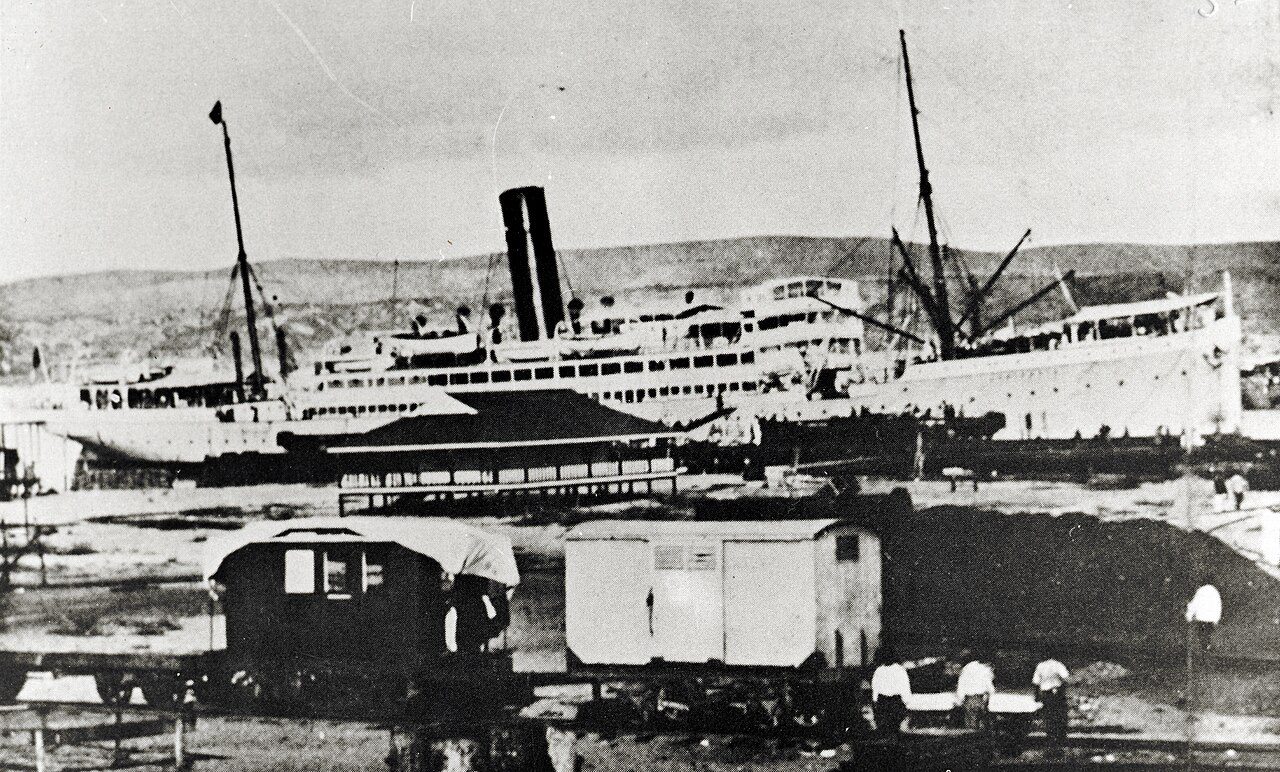
At a Glance
- The ship
- RMS Lusitania of the Cunard Line, on her 202nd Atlantic crossing, New York to Liverpool
- The attacker
- The German submarine U-20, which fired a single torpedo at 2:10 p.m. on 7 May 1915
- The sinking
- A second explosion followed the torpedo hit; the ship sank in about 18 minutes, 11 miles off the Irish coast
- The toll
- 1,198 of the 1,960 people aboard died, including 128 American citizens
- The context
- Germany had declared the seas around Britain a war zone in which Allied ships could be sunk without warning
- The consequence
- American opinion hardened against Germany; the sinking began the two-year road to U.S. entry into the war in 1917
Events on this day
- 1824Beethoven's Ninth Symphony, with its Ode to Joy finale, is premiered in Vienna; the deaf composer is turned around to see the applause.
- 1840The Great Natchez Tornado strikes Natchez, Mississippi, killing 317 people — one of the deadliest tornadoes in American history.
- 1915The Lusitania is sunk by U-20 — the featured story above.
- 1915In the same week, British, French and German forces fight the Second Battle of Ypres, where gas has been used for the first time on the Western Front.
- 1942The Battle of the Coral Sea reaches its climax in the Pacific, the first carrier-versus-carrier battle in history.
- 1945Germany signs its unconditional surrender at Reims, to take effect on 8 May — the first of the two surrenders that end the war in Europe.
- 1946Sony is founded in Tokyo as Tokyo Tsushin Kogyo by Masaru Ibuka and Akio Morita.
- 1954French forces at Dien Bien Phu surrender to the Viet Minh, ending the First Indochina War and France's empire in Indochina.
- 1992The space shuttle Endeavour lifts off on its first mission.
- 2000Vladimir Putin is inaugurated as president of Russia for the first time.
Born on this day
- 1812Robert Browning — English poet of The Ring and the Book and husband of Elizabeth Barrett Browning.
- 1833Johannes Brahms — German composer of four symphonies and the German Requiem.
- 1840Pyotr Ilyich Tchaikovsky — Russian composer of Swan Lake, The Nutcracker and the 1812 Overture.
- 1861Rabindranath Tagore — Bengali poet and thinker, the first non-European to win the Nobel Prize in Literature.
- 1892Josip Broz Tito — Yugoslav partisan leader and president, born in Kumrovec, Croatia.
- 1901Gary Cooper — American film actor, star of High Noon and Sergeant York.
- 1919Eva Peron — Argentine first lady, Evita, whose brief life became a national myth.
Died on this day
- 1825Antonio Salieri — Italian composer and Vienna court Kapellmeister, shadowed by the Mozart legend, dead at 74.
- 1840Caspar David Friedrich — German Romantic painter of Wanderer above the Sea of Fog, dead in Dresden at 65.
- 1941James George Frazer — Scottish anthropologist, author of The Golden Bough, dead at 87.
- 2005George P. Cosmatos — Greek-Italian film director of Rambo: First Blood Part II and Tombstone, dead at 64.
- 2011Seve Ballesteros — Spanish golfer, five-time major champion, dead of a brain tumour at 54.
The featured story: the sinking of the Lusitania, 7 May 1915
Lusitania was a greyhound of the Atlantic: launched in 1906, holder of the Blue Riband for speed, and one of the most famous ships in the world. When war came in 1914 she stayed in passenger service, and the Admiralty listed her as an armed merchant cruiser in its reference books, though she carried no guns. In February 1915 Germany declared the waters around the British Isles a war zone, in which Allied shipping could be sunk without the customary warning and search; the German embassy in Washington took the extraordinary step of publishing newspaper advertisements warning travellers that ships flying the British flag were liable to destruction. On 1 May, Lusitania sailed from New York with 1,960 people aboard, among them millionaires, infants in arms, and a cargo that included millions of rifle cartridges.
On the last afternoon of the crossing, 7 May, she was steaming at reduced speed in fog-lifting weather off the south coast of Ireland, a few hours from Liverpool. At 2:10 p.m. Kapitänleutnant Walther Schwieger of U-20, returning from a patrol, sighted her four funnels and fired one torpedo. It struck under the bridge. Seconds later came a second, larger explosion — its cause argued over for a century: coal dust, a boiler, or the ship's ammunition cargo igniting. Lusitania listed so steeply to starboard that most of her lifeboats could not be launched; only six boats got away cleanly. In eighteen minutes the great liner was gone, taking 1,198 people with her, including 128 Americans and 94 children.
The sinking detonated diplomatically. Britain denounced a crime against civilisation; Germany answered that the ship was a legitimate target — an auxiliary cruiser carrying munitions, warned in advance. President Woodrow Wilson, determined to keep the United States out of the war, chose protest over rupture, sending notes that demanded Germany abandon attacks on passenger ships. Berlin, unwilling to fight America while fighting Britain, France and Russia, conceded in stages: after the Sussex crisis of 1916 it pledged to observe cruiser rules. The concession held only while Germany believed it could win without the U-boats' full licence.
In February 1917, calculating that Britain could be starved before American power could arrive, Germany resumed unrestricted submarine warfare — and the Lusitania argument was settled by events. The United States declared war in April 1917, and two million American soldiers eventually crossed the ocean Lusitania had crossed alone. Her wreck, lying in about 90 metres of water off Kinsale, was depth-charged and salvaged over the decades, and the questions — what exploded second, and what exactly she carried — are still investigated. What is not in question is the eighteen minutes: the moment the Great War's logic reached into a passenger liner's dining saloon, where the stewards had just finished serving lunch.
Why this date matters
Twice in thirty years, May 7 was the eve of endings. In 1915 the Lusitania's sinking began the slow turn that brought America into one world war; in 1945 the signatures at Reims began the peace that ended another, in the same small hours of spring. Between those poles the date holds gentler things — a deaf Beethoven hearing nothing of his own triumph in 1824, a shattered French garrison surrendering at Dien Bien Phu in 1954 as one empire closed and another war opened. It is a hinge date: the day before the celebration, the afternoon before the reckoning.
Sources
- Encyclopaedia Britannica — On This Day: May 7
- HISTORY — What Happened on May 7
- Encyclopaedia Britannica — Lusitania
- Wikipedia — May 7
The facts on this page were checked against these sources on 19 November 2026. The History Trail's permanent pages are researched and written for this site; the live profiles elsewhere on The History Trail are assembled automatically from Wikipedia and Wikidata.
About the Author
Researched and written by the The History Trail Editorial Team — the accountable editorial function behind this site's permanent story pages. The team works from the published sources cited on each page; it does not invent historians, reviewers or credentials, and it corrects errors openly.
Fact Check
Every load-bearing fact on this page traces to one of the sources listed above, and significant claims link to their source in the text. Our checking method is described on the methodology page; errors can be reported via the corrections page.
Sources & Citations
Cite this page as: The History Trail Editorial Team, The History Trail — this article's title, publication and update dates are shown beneath its headline. The full source list appears under Sources above; the site's source standards are on the sources page.