
On This Day
May 6 in History
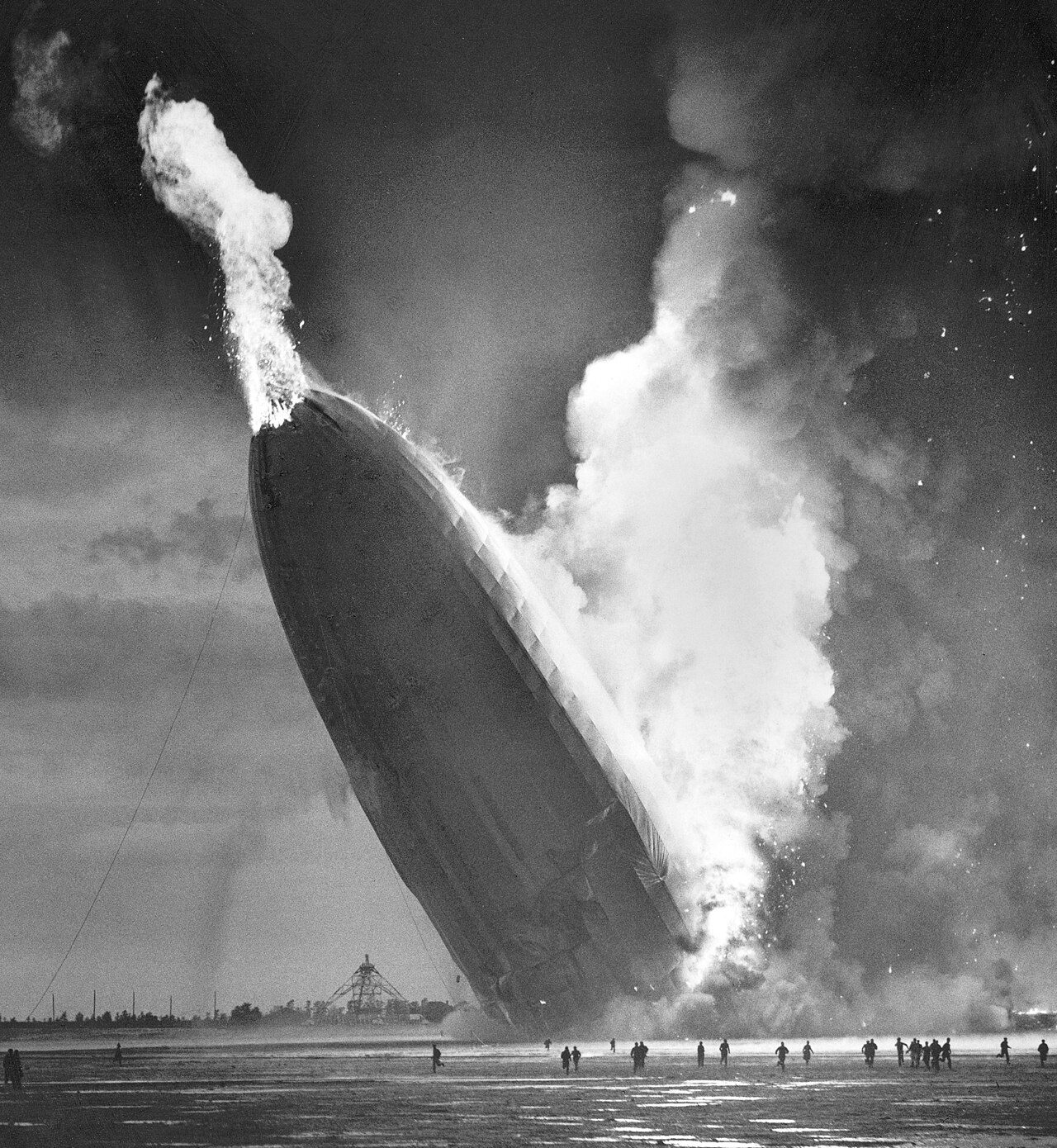
At 7:25 on the evening of 6 May 1937, as the German airship Hindenburg manoeuvred to land at Lakehurst, New Jersey, after crossing the Atlantic, fire broke out at her stern. In little more than half a minute the largest aircraft ever built was a burning wreck on the ground, and 36 people were dead. May 6 is also the day Roger Bannister ran the first four-minute mile in 1954, the Eiffel Tower opened in 1889, and the Channel Tunnel was inaugurated in 1994.
Choose another date: open the On This Day calendar to browse events, births and deaths for any day of the year.
At a Glance
- The ship
- LZ 129 Hindenburg, 245 metres (804 feet) long, the largest rigid airship ever constructed, launched in March 1936
- The service
- In 1936 she carried 1,002 passengers on ten scheduled round trips between Germany and the United States
- The disaster
- Fire during landing at Lakehurst on 6 May 1937, at the start of the 1937 North American season
- The toll
- Of 97 people aboard, 35 died, and one member of the ground crew was also killed — 36 in all
- The official cause
- A discharge of atmospheric electricity near a hydrogen leak, though sabotage was widely speculated about
- The consequence
- The disaster ended the use of rigid airships in commercial passenger transport
Events on this day
- 1889The Eiffel Tower opens to the public in Paris as the entrance arch of the World's Fair marking the centenary of the Revolution.
- 1915Babe Ruth hits his first major-league home run, pitching for the Boston Red Sox against the Yankees.
- 1937The Hindenburg burns at Lakehurst — the featured story above.
- 1941Bob Hope performs the first of his many USO shows for American troops, beginning a wartime institution.
- 1954Roger Bannister runs the first mile in under four minutes — 3 minutes 59.4 seconds — at Oxford.
- 1960Princess Margaret marries photographer Antony Armstrong-Jones at Westminster Abbey.
- 1994Queen Elizabeth II and President Mitterrand open the Channel Tunnel, linking Britain and France by rail beneath the sea.
- 2004The final episode of the sitcom Friends is broadcast in the United States, watched by more than 52 million people.
- 2013Three women held captive for a decade in a Cleveland house escape, leading to the arrest of Ariel Castro.
- 2023Charles III is crowned at Westminster Abbey, the first British coronation in seventy years.
Born on this day
- 1856Sigmund Freud — Austrian neurologist who founded psychoanalysis, born in Freiberg, Moravia.
- 1856Robert Peary — American explorer who claimed, controversially, to have reached the North Pole in 1909.
- 1895Rudolph Valentino — Italian-born silent-film idol, the Latin lover of The Sheik.
- 1915Orson Welles — American director and actor of Citizen Kane and the War of the Worlds broadcast.
- 1953Tony Blair — British prime minister from 1997 to 2007, winner of three general elections.
- 1961George Clooney — American actor and director, star of ER and Ocean's Eleven.
Died on this day
- 1859Alexander von Humboldt — German naturalist and explorer whose Cosmos tried to describe the whole physical world, dead at 89.
- 1862Henry David Thoreau — American essayist, author of Walden, dead of tuberculosis at 44.
- 1910Edward VII — king of the United Kingdom, dead at 68; his son succeeds as George V.
- 1992Marlene Dietrich — German-American actress and singer, star of The Blue Angel, dead in Paris at 90.
- 2021Kentaro Miura — Japanese manga artist, creator of the dark fantasy epic Berserk, dead at 54.
The featured story: the Hindenburg disaster, 6 May 1937
The Hindenburg was the pride of a revived Germany and the queen of a brief, luxurious age of travel. At 245 metres she was as long as an ocean liner, with a dining room, a lounge, a smoking room kept safe by an airlock, and cabins for fifty passengers. In her first season, 1936, she made ten round trips across the North Atlantic between Frankfurt and Lakehurst, carrying a thousand passengers in a style no aeroplane of the day could match: two and a half days of quiet, steady flight above the ocean weather. She was filled with hydrogen — the United States, the only source of safe helium, would not sell it to Nazi Germany — and her operators had handled hydrogen safely for decades of zeppelin flight.
Her first North American crossing of 1937 was troubled by weather. Delayed by headwinds, she arrived over New Jersey hours late on 6 May, then waited out a line of thunderstorms before making her approach to Lakehurst in the early evening, with Captain Max Pruss in command. At 7:21 p.m. the landing lines dropped from her nose to the ground crew below. Four minutes later a small flame was seen at the stern, near the upper fin. Within seconds the tail was ablaze; the ship's stern sank, her nose rose, and the fire ran forward through the hydrogen cells. In about 34 seconds the whole structure had fallen to the ground, still burning.
Of the 97 people aboard, 62 survived — many by jumping as the ship neared the ground or walking out of the wreck's lower decks, since the fire burned upward. Thirty-five aboard died, along with one member of the ground crew. The disaster was the first of its kind to be captured whole by the new media: newsreel cameras filmed it, photographs circled the world within hours, and the radio reporter Herbert Morrison, recording for a Chicago station, broke down on air in the broadcast that made the words 'Oh, the humanity' immortal. No disaster had ever been witnessed so completely by so many who were not there.
The official inquiry blamed a discharge of atmospheric electricity igniting hydrogen leaking from a cell, possibly torn by a snapped bracing wire during the sharp turns of the landing approach; sabotage by an anti-Nazi was suspected at the time and has been argued ever since, without proof. The argument hardly mattered commercially. Public confidence in the airship collapsed overnight; the Hindenburg's sister ship completed a few more flights and was then grounded, and the age of the passenger zeppelin — twenty years of German engineering that had seemed the future of flight — ended on a New Jersey field in half a minute of fire.
Why this date matters
May 6 is a date about records of speed and scale, and what they cost. The largest machine that had ever flown burned on it in 1937; the most famous barrier in running fell on it in 1954, when Bannister's mile lasted barely six weeks before it was broken again; the longest undersea rail tunnel opened on it in 1994. Even its coronation, in 2023, was an exercise in scale managed carefully rather than dared. The day suggests that human beings do not stop building bigger and faster after a disaster — they simply change the machine, and keep the ambition.
Sources
- Encyclopaedia Britannica — On This Day: May 6
- HISTORY — What Happened on May 6
- Encyclopaedia Britannica — Hindenburg
- HISTORY — Hindenburg
The facts on this page were checked against these sources on 19 November 2026. The History Trail's permanent pages are researched and written for this site; the live profiles elsewhere on The History Trail are assembled automatically from Wikipedia and Wikidata.
About the Author
Researched and written by the The History Trail Editorial Team — the accountable editorial function behind this site's permanent story pages. The team works from the published sources cited on each page; it does not invent historians, reviewers or credentials, and it corrects errors openly.
Fact Check
Every load-bearing fact on this page traces to one of the sources listed above, and significant claims link to their source in the text. Our checking method is described on the methodology page; errors can be reported via the corrections page.
Sources & Citations
Cite this page as: The History Trail Editorial Team, The History Trail — this article's title, publication and update dates are shown beneath its headline. The full source list appears under Sources above; the site's source standards are on the sources page.