
Years
1941 in History
1941 is the year the Second World War became truly global. Germany tore up its pact with Moscow and invaded the Soviet Union in June with more than three million troops, and in December Japan's attack on Pearl Harbor brought the United States into the war. By Christmas, every great power on earth was fighting.
At a Glance
- Defining event
- Operation Barbarossa: Germany invades the Soviet Union, 22 June 1941
- Scale
- More than three million Axis troops along a front from the Baltic to the Black Sea
- Pearl Harbor
- Japanese attack kills 2,403 Americans, 7 December; the United States declares war the next day
- War aims set
- Roosevelt and Churchill issue the Atlantic Charter, 14 August
- Leningrad
- German forces complete the city's encirclement, 8 September; the siege lasts until January 1944
- Closed the year
- Churchill addresses a joint meeting of the US Congress, 26 December
The defining story: Barbarossa and Pearl Harbor
In the early hours of 22 June 1941, Nazi Germany launched Operation Barbarossa, the invasion of the Soviet Union and the largest military operation in history. Along a front running from the Baltic to the Black Sea, more than three million German and allied troops crossed the border, supported by some 3,000 tanks and thousands of aircraft. The attack tore up the non-aggression pact the two regimes had signed in 1939 and opened the Eastern Front, the theatre in which the war in Europe would largely be decided. Hitler's aims were ideological as much as strategic: a war of annihilation to seize the Soviet Union's grain, oil and land, destroy the Communist state, and enslave or murder the peoples in the way. Orders issued before the invasion authorised the shooting of captured political commissars and freed German forces from ordinary legal restraint.
Stalin, despite repeated warnings from his own intelligence services and from Britain, refused to believe the attack was coming and had forbidden his frontier armies to take precautions that might provoke Berlin. The result was catastrophe on a continental scale: whole Soviet armies were encircled in the opening weeks at Bialystok, Minsk and Smolensk, and hundreds of thousands of prisoners were taken, most of whom would die in German camps. Yet the invasion failed in its own terms. Barbarossa was planned as a campaign of a few months, won before winter; instead the Red Army kept fighting, industry was dismantled and moved east beyond the Urals, and German spearheads that reached the outskirts of Moscow in December were thrown back in the Soviet winter counteroffensive, the Wehrmacht's first great defeat on land. Leningrad, encircled on 8 September, settled into a siege that lasted until January 1944 and killed an estimated million civilians. The campaign began a four-year war that killed an estimated 27 million Soviet citizens.
While the eastern war consumed itself, the Atlantic war turned on intelligence and paper. In May a boarding party from HMS Bulldog captured the submarine U-110 with an Enigma machine and codebooks, a turning point in the Battle of the Atlantic; the battleship Bismarck sank HMS Hood with the loss of more than 1,400 lives and was herself sunk three days later with more than 2,000 of her crew. In August, Roosevelt and Churchill met aboard warships at Placentia Bay, Newfoundland, and issued the Atlantic Charter, setting out their aims for the postwar world.
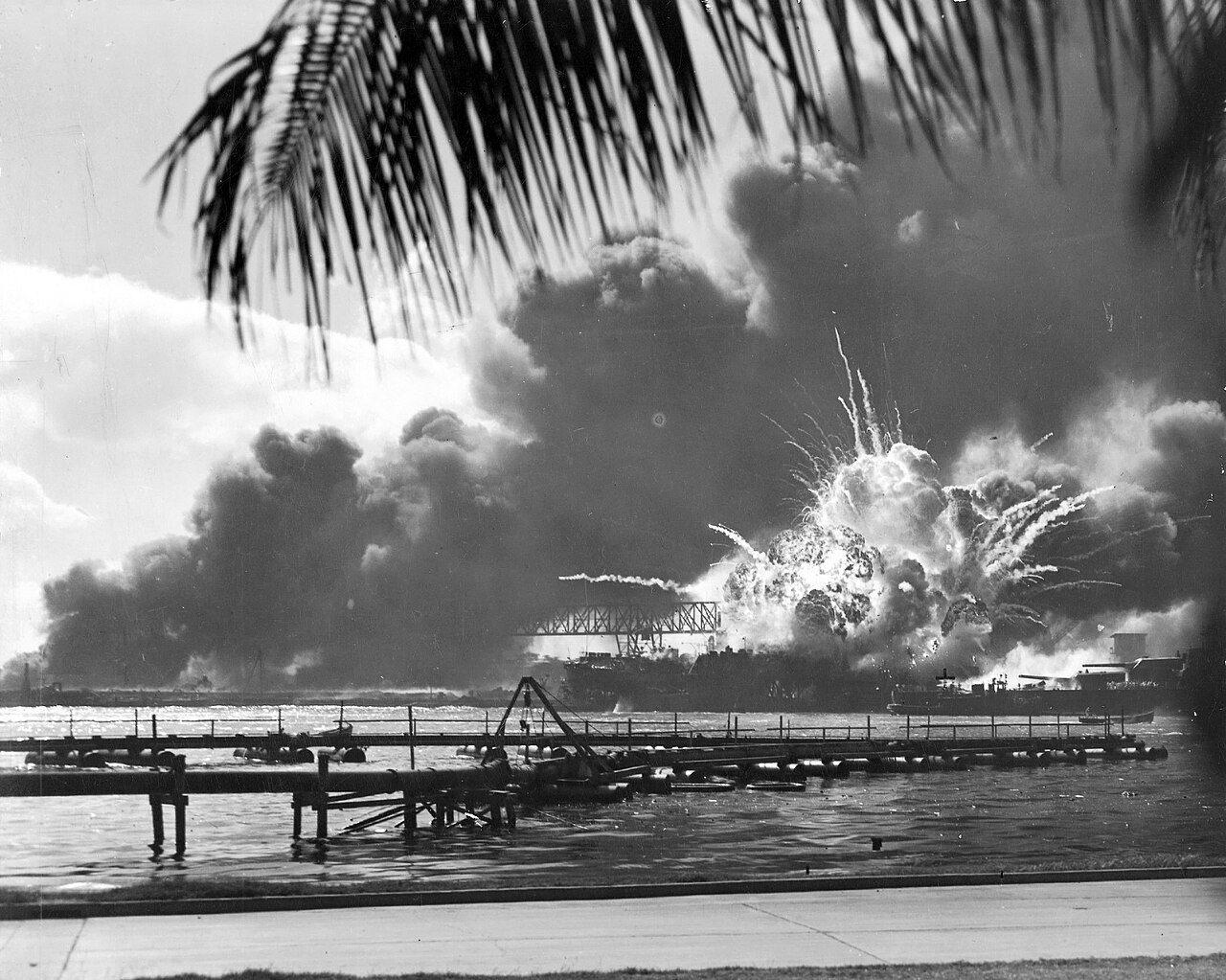
Then, on a Sunday morning, 7 December, Japanese aircraft attacked the United States Pacific Fleet at Pearl Harbor in Hawaii. Warships were bombed and sunk or damaged where they lay, the destroyer USS Shaw blew up in one of the attack's most photographed explosions, and the battleship USS Arizona was destroyed; the counted American toll was 2,403 killed and 1,178 wounded, and the photograph of the Shaw's fireball that illustrates this page became one of the day's defining images. The next day Roosevelt addressed Congress, calling 7 December a date which will live in infamy, and the United States declared war on Japan. On 11 December Germany and Italy declared war on the United States, and by 26 December Churchill was addressing a joint meeting of Congress in Washington. The war now had no outside left.
Timeline of 1941
- 6 January
President Roosevelt sets out the Four Freedoms, of speech, of worship, from want and from fear, in his State of the Union address.
- 6 April
Germany invades Yugoslavia and Greece, bombing Belgrade.
- 9 May
HMS Bulldog's boarding party captures U-110 and recovers an Enigma machine and codebooks.
- 24 May
The German battleship Bismarck sinks HMS Hood in the Denmark Strait, with the loss of more than 1,400 lives.
- 27 May
British warships sink the Bismarck in the North Atlantic, with the loss of more than 2,000 of her crew.
- 22 June
Germany launches Operation Barbarossa, the invasion of the Soviet Union.
- 14 August
Roosevelt and Churchill issue the Atlantic Charter, agreed aboard ship at Placentia Bay.
- 8 September
German forces complete the encirclement of Leningrad, beginning a siege that lasts until January 1944.
- 7 December
Japan launches its surprise attack on Pearl Harbor, killing 2,403 Americans and bringing the United States into the war.
- 8 December
Congress declares war on Japan, the Senate unanimously and the House by 388 votes to 1.
- 11 December
Germany and Italy declare war on the United States.
- 22 December
Churchill arrives in Washington for the Arcadia Conference on joint Anglo-American strategy.
- 26 December
Churchill becomes the first British prime minister to address a joint meeting of the United States Congress.
Why 1941 still matters
The alliances and the battlefields that decided the Second World War were all fixed in 1941. Barbarossa created the Eastern Front, where the German army would be ground down over four years at a cost, on the Soviet side alone, estimated at 27 million lives; after December 1941 Germany was fighting a coalition whose combined industry it could not match. Pearl Harbor supplied the other half of that coalition's power, unifying a divided American public overnight and bringing the world's largest industrial economy fully into the war. Every later turning point, Midway, Stalingrad, D-Day, is a consequence being worked out of decisions taken in 1941.
The year also drafted the peace before the war was won. Roosevelt's Four Freedoms in January and the Atlantic Charter in August set out, in public, the principles on which the postwar order, including the United Nations, would claim to rest. At home in America, Roosevelt's Executive Order 8802 in June banned racial discrimination in the defence industries, an early federal breach in segregation driven by wartime need. Even the year's culture marked the turn: Orson Welles's Citizen Kane premiered in May and was later judged by many critics the greatest film ever made, and Mount Rushmore was completed in October, fourteen years after work began.
1941 on The History Trail
Barbarossa carries a featured story on The History Trail, and Pearl Harbor has a cluster of permanent pages of its own.
- June 22 in History — Germany launches Operation Barbarossa, the invasion of the Soviet Union.
- December 7 in History — Japan attacks Pearl Harbor and the United States enters the Second World War.
- Pearl Harbor: The Attack That Brought America to War — The attack of 7 December 1941, told as a permanent story on The History Trail.
- Why Japan Attacked Pearl Harbor: Oil, Empire and War — The road to Pearl Harbor: oil, empire and the choices that led to the attack.
- USS Arizona: The Battleship That Became a Memorial — The battleship destroyed at Pearl Harbor, whose hull still lies in the harbour.
- World War II — The war that became global in 1941, told as a permanent story on The History Trail.
Sources
- Encyclopaedia Britannica — On This Day: January 6
- Encyclopaedia Britannica — On This Day: April 6
- Encyclopaedia Britannica — On This Day: May 1
- United States Holocaust Memorial Museum — Hitler Comes to Power (Holocaust Encyclopedia)
The facts on this page were checked against these sources on 19 November 2026. The History Trail's permanent pages are researched and written for this site; the live profiles elsewhere on The History Trail are assembled automatically from Wikipedia and Wikidata.
About the Author
Researched and written by the The History Trail Editorial Team — the accountable editorial function behind this site's permanent story pages. The team works from the published sources cited on each page; it does not invent historians, reviewers or credentials, and it corrects errors openly.
Fact Check
Every load-bearing fact on this page traces to one of the sources listed above, and significant claims link to their source in the text. Our checking method is described on the methodology page; errors can be reported via the corrections page.
Sources & Citations
Cite this page as: The History Trail Editorial Team, The History Trail — this article's title, publication and update dates are shown beneath its headline. The full source list appears under Sources above; the site's source standards are on the sources page.