
Vehicles
USS Arizona: The Battleship That Became a Memorial
For twenty-five years USS Arizona was a working battleship of the United States Navy. On 7 December 1941 a single bomb turned her into the single greatest loss of life of the Pearl Harbor attack — 1,177 men — and into a memorial that still spans her wreck, from which oil still rises like black tears.
At a Glance
- Class
- Pennsylvania-class battleship, hull number BB-39; second and last of her class
- Builder
- New York Navy Yard, Brooklyn
- Laid down / launched
- Keel laid 16 March 1914; launched 19 June 1915
- Commissioned
- 17 October 1916
- Size
- 608 feet long, about 31,400 tons
- Lost
- 7 December 1941 — an armour-piercing bomb ignited her forward magazine; she sank in about nine minutes
- Crew lost
- 1,177 officers and men, about half of all American dead in the attack; most remain in the wreck
- Memorial
- USS Arizona Memorial dedicated 30 May 1962; the wreck was declared a National Historic Landmark on 5 May 1989
Introduction
USS Arizona (BB-39) was a Pennsylvania-class battleship built for the United States Navy in the First World War era, launched on 19 June 1915 and named for the 48th state, admitted to the Union only three years earlier. She served for a quarter of a century without ever firing her guns in anger at an enemy fleet. Then, on the morning of 7 December 1941, moored on Battleship Row at Pearl Harbor, she was struck by a Japanese armour-piercing bomb that detonated her forward magazine. The explosion killed 1,177 of the men aboard — the greatest loss of life on any ship that day, and about half of all the Americans killed in the attack.
Unlike almost every other ship sunk that morning, Arizona was never raised. Her wreck still lies where she settled, in the mud off Ford Island, and the white memorial built across her hull in 1962 has become the most visited symbol of Pearl Harbor. She is at once a historic warship, an archaeological site protected by the Navy and the National Park Service, and a war grave: the remains of more than nine hundred of her crew are still inside her.
Background
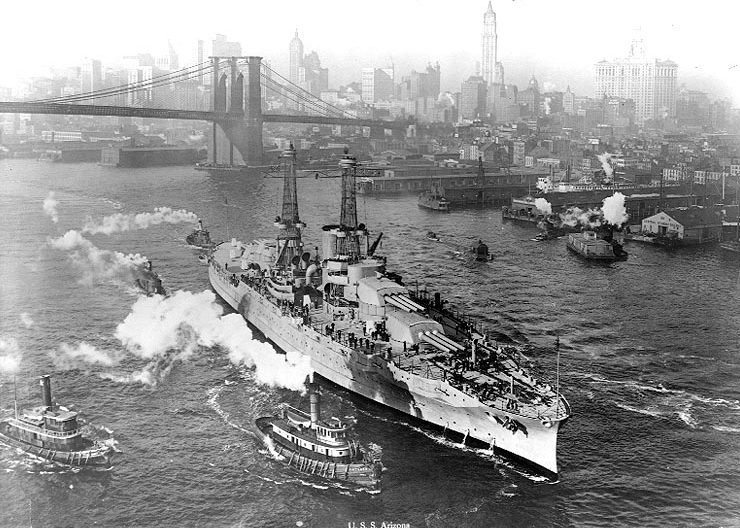
Arizona's keel was laid at the New York Navy Yard on 16 March 1914, with Assistant Secretary of the Navy Franklin D. Roosevelt in attendance — the same Roosevelt who, as President, would ask Congress for war the day after her loss. She was launched on 19 June 1915, sponsored by Esther Ross of Arizona, and commissioned on 17 October 1916. At 608 feet and some 31,400 tons, with twelve 14-inch guns, she was among the most powerful warships afloat, the second and last of the Pennsylvania class.
Her career was respectable rather than glorious. She joined the Atlantic Fleet in 1917 and spent the First World War largely as a gunnery training ship on the American coast, her oil-burning boilers complicating deployment to European waters where coal was the standard fuel. Between the wars she was modernised, exercised with the fleet and showed the flag, before transferring to the Pacific, where the fleet's forward move to Pearl Harbor in 1940 put her on Battleship Row. On the evening of 6 December 1941 she lay moored at berth F-7 beside the repair ship Vestal, having taken on a full load of fuel oil the day before.
Timeline
- 16 March 1914
Keel laid at the New York Navy Yard, Brooklyn, for the second Pennsylvania-class battleship, named for the state of Arizona.
- 19 June 1915
Launched, sponsored by Esther Ross; the hull enters the water fifteen months after keel-laying.
- 17 October 1916
Commissioned under Captain John D. McDonald and assigned to the Atlantic Fleet.
- 1917–1918
Serves mainly as a gunnery training ship on the US East Coast during the First World War.
- 7 December 1941
At about 8:10 a.m. a Japanese armour-piercing bomb penetrates her deck and ignites the forward magazine. The explosion devastates the ship; she sinks in about nine minutes with 1,177 of her crew.
- 1950
Admiral Arthur W. Radford, commander of the Pacific Fleet, orders the national colours raised again over the wreck — the first step toward a permanent memorial.
- 30 May 1962
The USS Arizona Memorial, a white structure spanning the sunken hull without touching it, is formally dedicated on Memorial Day.
- 9 September 1980
Joint administration of the memorial by the US Navy and the National Park Service is established, with the new visitor centre ashore.
- 5 May 1989
Arizona's remains are declared a National Historic Landmark.
Significance
Arizona's loss was the human centre of the Pearl Harbor attack. The magazine explosion was the single deadliest moment of the morning: 1,177 dead from one ship, against 2,403 American dead in total, including her captain, Franklin Van Valkenburgh, and Rear Admiral Isaac C. Kidd, the highest-ranking American officer killed in the attack. The battleship Oklahoma, which capsized with 429 dead, and the other ships on Battleship Row were mostly salvaged and many fought again; Arizona and the old target ship Utah were the harbour's two total losses, and only Arizona became a shrine.
The memorial built over her was designed by Honolulu architect Alfred Preis and is deliberately unlike a museum: a 184-foot white bridge-like structure that sags in the middle and rises at both ends, spanning the wreck without resting on it. Visitors reach it only by boat, stand in silence above the visible outline of the hull, and read the names of the 1,177 carved on a marble wall in the shrine room. More than two million people a year made the crossing in the memorial's busiest years, and the site anchors what is now Pearl Harbor National Memorial.
Legacy
The wreck is not still. Arizona went down with an estimated one and a half million gallons of fuel oil aboard, much of it burned or spilled in 1941, but hundreds of thousands of gallons remain sealed in her bunkers. A slow seep — a few quarts to a couple of gallons a day, by varying estimates — still rises to the surface and spreads in a rainbow sheen above the hull. Visitors call the drops the 'black tears' of the Arizona, and the National Park Service, which monitors the wreck's condition with the Navy, treats the leak as part of the memorial itself while studying the ship's slow corrosion.
That combination — a grave that is also a working historical site, still weeping oil more than eighty years on — is why Arizona, rather than any repaired and recommissioned ship, carries the memory of 7 December 1941. The Navy still owns her; the Park Service still tells her story; and every 7 December the harbour falls quiet over the berth where a 1915 battleship, built for one world war, became the monument of another.
Sources
- National Park Service — USS Arizona National Historic Landmark nomination study
- Naval History and Heritage Command — The Pearl Harbor Attack, 7 December 1941 (FAQ 66-1)
- University of Arizona Libraries — Remembering U.S.S. Arizona at UA
- Pearl Harbor Historic Sites (Pacific Historic Parks) — USS Arizona Memorial
- Wikipedia — USS Arizona Memorial
The facts on this page were checked against these sources on 19 November 2026. The History Trail's permanent pages are researched and written for this site; the live profiles elsewhere on The History Trail are assembled automatically from Wikipedia and Wikidata.
About the Author
Researched and written by the The History Trail Editorial Team — the accountable editorial function behind this site's permanent story pages. The team works from the published sources cited on each page; it does not invent historians, reviewers or credentials, and it corrects errors openly.
Fact Check
Every load-bearing fact on this page traces to one of the sources listed above, and significant claims link to their source in the text. Our checking method is described on the methodology page; errors can be reported via the corrections page.
Sources & Citations
Cite this page as: The History Trail Editorial Team, The History Trail — this article's title, publication and update dates are shown beneath its headline. The full source list appears under Sources above; the site's source standards are on the sources page.