
Years
1940 in History
1940 is the year Britain stood alone. Winston Churchill became prime minister on the day Germany invaded France, an army of 338,226 men was lifted off the beaches at Dunkirk, the RAF held the sky in the Battle of Britain, and London endured the opening of the Blitz. France fell in six weeks; Britain did not.
At a Glance
- Defining event
- The Battle of Britain and the Blitz: Britain holds out alone after the fall of France
- New prime minister
- Winston Churchill takes office, 10 May 1940, the day Germany invades France and the Low Countries
- Dunkirk
- 338,226 Allied troops evacuated between 26 May and 4 June
- France falls
- German troops occupy Paris, 14 June; France signs an armistice at Compiegne, 22 June
- Battle of Britain
- 10 July to 31 October 1940; the RAF's radar-directed defence holds
- The Blitz begins
- 348 German bombers escorted by 617 fighters strike London's docks, 7 September
The defining story: Britain stands alone
The year began with a phoney calm that fooled no one for long. Britain introduced food rationing in January, beginning with bacon, butter and sugar, and in March Finland accepted Soviet peace terms ending the Winter War. In April Germany invaded Norway and Denmark, Denmark surrendering within hours. Then, on the morning of 10 May, Germany invaded France and the Low Countries, and that same day Winston Churchill became prime minister. Three days later, in his first Commons speech in the office, he offered the country only blood, toil, tears and sweat, and a policy of war with all its might; the Commons backed him unanimously.
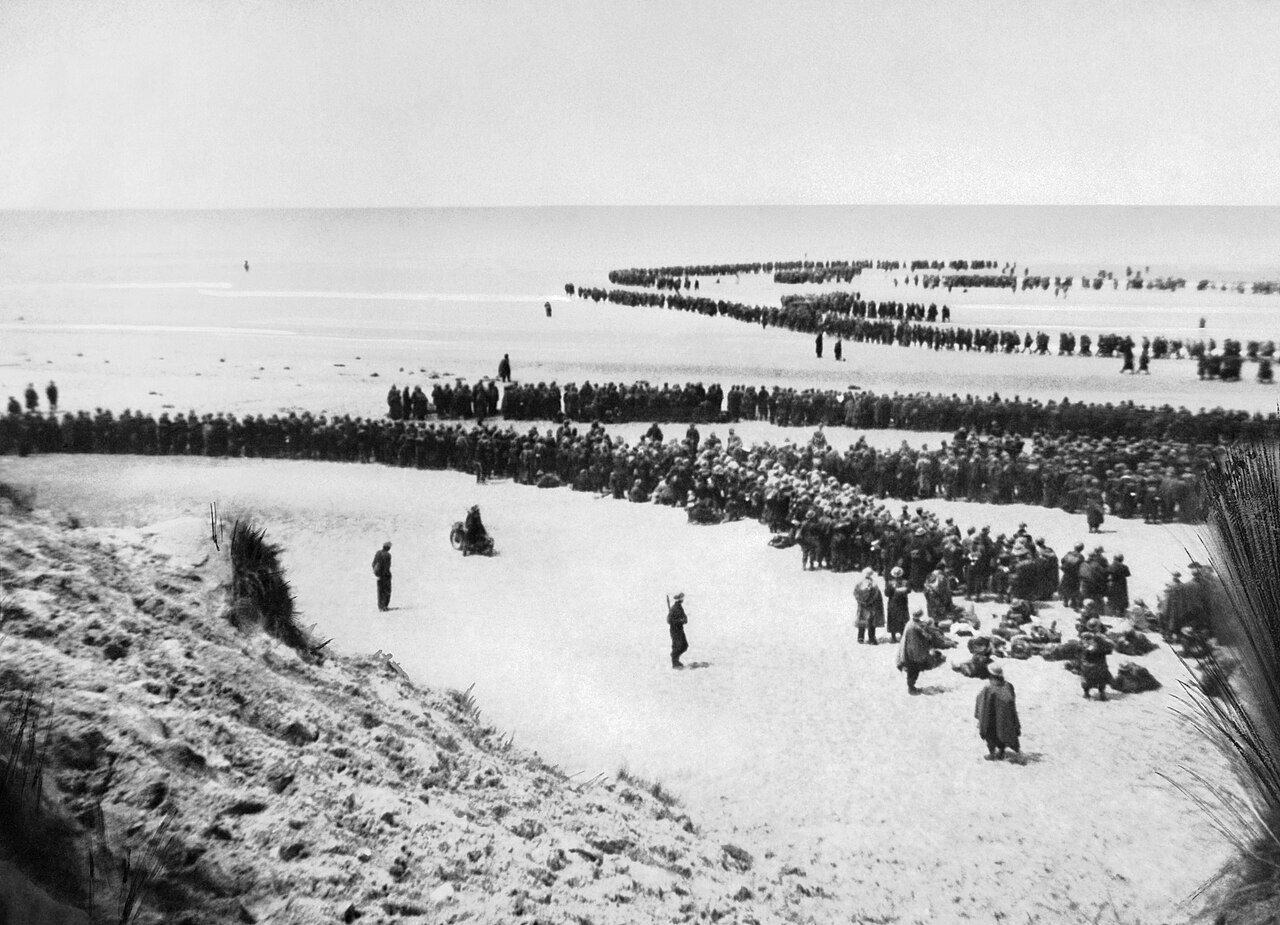
The German advance went with terrifying speed. Armoured columns broke through the Ardennes, raced to the Channel and cut off the British Expeditionary Force and the best French armies in a pocket around Dunkirk. Then, on 24 May, Hitler halted his tanks along a line of canals some fifteen miles from the town, and that pause gave the defenders a window to attempt an evacuation by sea. Operation Dynamo began on 26 May, directed from rooms in the cliffs beneath Dover Castle. The Royal Navy sent destroyers and transports, and alongside them came some 700 civilian craft, fishing boats, yachts, ferries and pleasure steamers, many sailed by their owners. In the first 24 hours nearly 8,000 troops were brought away; by the time the operation ended on 4 June, 338,226 British and Allied soldiers had been ferried to England, though the army's tanks, guns and vehicles were abandoned in France. That same day Churchill told the Commons that Britain would fight on the beaches.
France could not be saved. Italy declared war on France and Britain on 10 June, German troops entered Paris on 14 June, and on 22 June France signed an armistice at Compiegne, in the same railway carriage used for Germany's surrender in 1918. A Vichy government was established under Marshal Pétain, while Charles de Gaulle broadcast his Appeal of 18 June from London and Churchill delivered his Finest Hour speech. Britain now stood alone, and the invasion everyone expected was prepared for from the air. The Battle of Britain began on 10 July with Luftwaffe attacks on Channel shipping and ports, and ran until 31 October; the RAF's radar-directed defence held. On 18 August, the Hardest Day, both sides suffered heavy losses in one of the largest air battles yet seen, and on 15 September, Battle of Britain Day, the Luftwaffe's heaviest daylight attacks on London were beaten off.
On 7 September the air war changed its target: 348 German bombers escorted by 617 fighters struck London's docks, opening the Blitz, the eight-month bombing campaign against British cities. The year closed with the Luftwaffe's heaviest firebombing of London on 29 December, the Second Great Fire of London, which left St Paul's Cathedral standing amid a ring of flames. Britain had survived 1940 unconquered, and that survival, more than any victory, is the year's achievement.
Timeline of 1940
- 8 January
Britain introduces wartime food rationing, beginning with bacon, butter and sugar.
- 12 March
Finland accepts Soviet peace terms ending the Winter War, ceding western Karelia and a naval base at Hanko.
- 9 April
Germany invades Norway and Denmark, opening the Scandinavian campaign; Denmark surrenders within hours.
- 10 May
Winston Churchill becomes prime minister, the day Germany invades France and the Low Countries.
- 26 May
Operation Dynamo, the evacuation of Allied troops from Dunkirk, gets under way.
- 4 June
The Dunkirk evacuation ends, having rescued some 338,000 Allied troops; Churchill delivers his 'we shall fight on the beaches' speech the same day.
- 10 June
Italy declares war on France and Britain.
- 14 June
German troops enter and occupy Paris.
- 22 June
France signs an armistice with Germany at Compiegne, in the same railway carriage used for Germany's surrender in 1918.
- 10 July
The Battle of Britain begins with Luftwaffe attacks on Channel shipping and ports.
- 7 September
The Blitz begins as 348 German bombers escorted by 617 fighters strike London's docks.
- 12 September
Four teenagers discover the painted caves of Lascaux in the Dordogne.
- 15 September
The Luftwaffe launches its heaviest daylight attacks on London and is beaten off, remembered as Battle of Britain Day.
- 29 December
The Luftwaffe's heaviest firebombing of London leaves St Paul's Cathedral standing amid a ring of flames.
Why 1940 still matters
Had Britain made peace or been invaded in 1940, the Second World War's whole shape changes: there would have been no western base from which to bomb Germany, supply the Soviet Union by the Arctic route, or return to France in 1944. The year's three linked events, a change of prime minister at the moment of catastrophe, an army rescued from the beaches, and an air force that could not be beaten in its own sky, together kept a western front in existence when every calculation said it should have vanished. Churchill's speeches of May and June, blood, toil, tears and sweat, the beaches, the finest hour, became the permanent vocabulary of democratic defiance for that reason.
The year also widened the war's map in ways that set up everything after: Italy's entry brought the war to the Mediterranean and North Africa, where Italian forces crossed into Egypt in September and invaded Greece in October, and the first prisoners arrived at the new German camp at Auschwitz in June, 728 Poles in the first transport. In America, Franklin D. Roosevelt was nominated for an unprecedented third term in July, won it in November, and in September signed the first peacetime draft in United States history, steps that moved the still-neutral republic toward the war it would join the following year.
1940 on The History Trail
Six of 1940's days carry featured stories on The History Trail, more than any other year in this batch.
- May 10 in History — Churchill becomes prime minister on the day Germany invades France and the Low Countries.
- May 13 in History — Churchill offers 'blood, toil, tears and sweat' in his first Commons speech as prime minister.
- May 26 in History — Operation Dynamo begins the evacuation of Allied troops from Dunkirk.
- July 10 in History — The Battle of Britain begins with attacks on Channel shipping and ports.
- September 7 in History — The Blitz begins with a mass raid on London's docks.
- September 12 in History — Four teenagers discover the painted caves of Lascaux in the Dordogne.
- London — The city that endured the Blitz, told as a permanent story on The History Trail.
Sources
- Encyclopaedia Britannica — On This Day: January 8
- Encyclopaedia Britannica — On This Day: March 12
- HISTORY — What Happened on April 9
- Encyclopaedia Britannica — On This Day: May 10
- HISTORY — What Happened on May 13
- Encyclopaedia Britannica — Winston Churchill
The facts on this page were checked against these sources on 19 November 2026. The History Trail's permanent pages are researched and written for this site; the live profiles elsewhere on The History Trail are assembled automatically from Wikipedia and Wikidata.
About the Author
Researched and written by the The History Trail Editorial Team — the accountable editorial function behind this site's permanent story pages. The team works from the published sources cited on each page; it does not invent historians, reviewers or credentials, and it corrects errors openly.
Fact Check
Every load-bearing fact on this page traces to one of the sources listed above, and significant claims link to their source in the text. Our checking method is described on the methodology page; errors can be reported via the corrections page.
Sources & Citations
Cite this page as: The History Trail Editorial Team, The History Trail — this article's title, publication and update dates are shown beneath its headline. The full source list appears under Sources above; the site's source standards are on the sources page.