
On This Day
June 22 in History
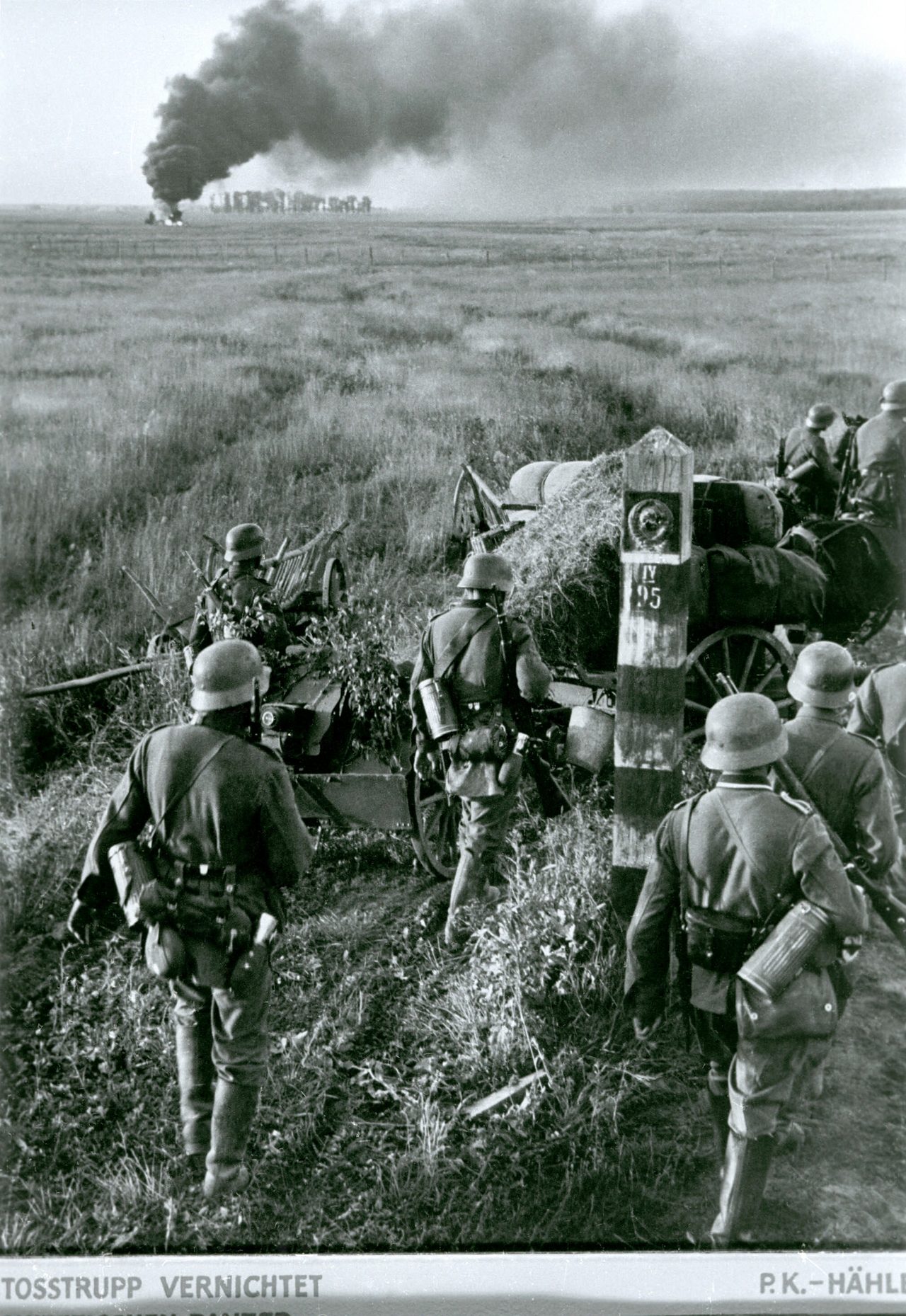
Before dawn on 22 June 1941 more than three million German and allied troops invaded the Soviet Union in Operation Barbarossa, tearing up the Nazi-Soviet pact and opening the Eastern Front — the vast, murderous theatre that decided the Second World War in Europe. June 22 is also the day Galileo recanted, the G.I. Bill was signed and Maradona scored the 'Hand of God'.
Choose another date: open the On This Day calendar to browse events, births and deaths for any day of the year.
At a Glance
- The operation
- Operation Barbarossa, Germany's invasion of the Soviet Union, launched 22 June 1941
- The scale
- More than three million Axis troops, some 3,000 tanks and thousands of aircraft along a front from the Baltic to the Black Sea
- The broken pact
- The invasion tore up the Nazi-Soviet non-aggression pact of 1939
- The first months
- Whole Soviet armies were encircled and captured, but the state did not collapse as German planners had assumed
- The turning point
- German forces were stopped and thrown back before Moscow in December 1941
- The cost
- An estimated 27 million Soviet citizens died in the war the invasion began
Events on this day
- 1611Mutineers set the navigator Henry Hudson, his son and seven loyal men adrift in a small boat in Hudson Bay; they are never seen again.
- 1633Galileo Galilei, tried by the Roman Inquisition, is forced to recant his claim that the Earth moves around the Sun.
- 1775The Continental Congress authorises the issue of $2 million in bills of credit, the first Continental currency.
- 1940France signs an armistice with Germany at Compiegne, in the same railway carriage used for Germany's surrender in 1918.
- 1941Germany launches Operation Barbarossa, the invasion of the Soviet Union — the featured story above.
- 1944President Franklin D. Roosevelt signs the G.I. Bill, offering education, housing and unemployment benefits to returning veterans.
- 1945The Battle of Okinawa ends with an American victory after nearly three months of fighting; the Japanese commander takes his own life.
- 1969The polluted Cuyahoga River in Cleveland, Ohio, catches fire, an image that helps drive the American environmental movement.
- 1978The astronomer James Christy discovers Charon, the largest moon of Pluto.
- 1986Diego Maradona scores both the 'Hand of God' goal and the 'Goal of the Century' as Argentina beat England in the World Cup quarter-final.
- 2011The Boston gangster James 'Whitey' Bulger is arrested in California after 16 years on the run.
Born on this day
- 1887Julian Huxley — English biologist and writer, the first director-general of UNESCO.
- 1898Erich Maria Remarque — German novelist whose All Quiet on the Western Front became the classic account of the First World War trenches.
- 1906Billy Wilder — Austrian-born American film director of Some Like It Hot, Sunset Boulevard and The Apartment.
- 1909Katherine Dunham — American dancer and choreographer who fused modern dance with African and Caribbean traditions.
- 1949Meryl Streep — American actress, winner of three Academy Awards from a record number of nominations.
Died on this day
- 1611Henry Hudson — English navigator, set adrift by his mutinous crew in the bay that bears his name and never seen again.
- 1969Judy Garland — American singer and actress, star of The Wizard of Oz, dead in London at 47.
- 1987Fred Astaire — American dancer and film star whose musicals with Ginger Rogers defined screen dancing, dead at 88.
- 2008George Carlin — American stand-up comedian and social satirist, dead of heart failure at 71.
The featured story: Germany invades the Soviet Union, 22 June 1941
In the early hours of 22 June 1941, Nazi Germany launched Operation Barbarossa, the invasion of the Soviet Union and the largest military operation in history. Along a front running from the Baltic to the Black Sea, more than three million German and allied troops crossed the border, supported by some 3,000 tanks and thousands of aircraft; HISTORY puts the invasion force at nineteen panzer divisions, 3,000 tanks, 2,500 aircraft and 7,000 artillery pieces. The attack tore up the non-aggression pact the two regimes had signed in 1939 and opened the Eastern Front, the theatre in which the Second World War in Europe would largely be decided — and in which it would kill on a scale no other theatre matched.
Hitler's aims were ideological as much as strategic. In his own stated vision, the war in the east was a war of annihilation: to seize the Soviet Union's grain, oil and land as living space, to destroy the Communist state, and to enslave or murder the peoples in the way. Orders issued before the invasion authorised the shooting of captured political commissars and freed German forces from ordinary legal restraint. Stalin, despite receiving repeated warnings from his own intelligence services and from Britain, refused to believe the attack was coming and had forbidden his frontier armies to take precautions that might 'provoke' Berlin. The result was catastrophe on a continental scale: whole Soviet armies were encircled in the opening weeks at Bialystok, Minsk and Smolensk, and hundreds of thousands of prisoners were taken, most of whom would die in German camps.
Yet the invasion failed in its own terms. Barbarossa was planned as a campaign of a few months, won before winter; the planners assumed the Soviet state would collapse under the first blows. Instead the Red Army, mauled and retreating, kept fighting, industry was dismantled and moved east beyond the Urals, and the German advance consumed men, fuel and horses faster than they could be replaced. German spearheads reached the outskirts of Moscow in December 1941 and were thrown back in the Soviet winter counteroffensive — the Wehrmacht's first great defeat on land. Leningrad settled into a siege that lasted nearly 900 days. The blitzkrieg had met a country too large to be swallowed in a single summer.
What followed was four years of war of an extremity Europe had never seen: an estimated 27 million Soviet citizens died, soldiers and civilians together, alongside millions of German and allied troops, in fighting that ran from Stalingrad to Kursk to Berlin itself. Barbarossa also fused the military war with genocide: behind the advancing armies, SS killing squads murdered Jewish communities across the occupied territories, beginning the phase of the Holocaust carried out by mass shooting. When Germany surrendered in May 1945, it was the Red Army that stood in Berlin. The decision taken for 22 June 1941 had destroyed the Soviet Union's western lands — and, in the end, destroyed the regime that ordered it.
Why this date matters
June 22 is dominated by a single morning. Barbarossa was the hinge of the Second World War: after it, Germany was committed to the vast eastern war that consumed it, and the Soviet Union to a struggle for survival that reshaped the century. Around that centre the day gathers its smaller ironies — Galileo recanting the motion of the Earth in 1633, Hudson abandoned on the water he had discovered, France signing its 1940 armistice in the carriage of its 1918 victory, and, exactly five years after Barbarossa began at Okinawa's end, one war closing as another's consequences unfolded. Even its football match, Maradona's two goals in 1986, was played in the shadow of a war between the same two countries four years earlier.
Sources
- Encyclopaedia Britannica — On This Day: June 22
- HISTORY — What Happened on June 22
- Encyclopaedia Britannica — Operation Barbarossa
- HISTORY — Germany launches Operation Barbarossa
The facts on this page were checked against these sources on 19 November 2026. The History Trail's permanent pages are researched and written for this site; the live profiles elsewhere on The History Trail are assembled automatically from Wikipedia and Wikidata.
About the Author
Researched and written by the The History Trail Editorial Team — the accountable editorial function behind this site's permanent story pages. The team works from the published sources cited on each page; it does not invent historians, reviewers or credentials, and it corrects errors openly.
Fact Check
Every load-bearing fact on this page traces to one of the sources listed above, and significant claims link to their source in the text. Our checking method is described on the methodology page; errors can be reported via the corrections page.
Sources & Citations
Cite this page as: The History Trail Editorial Team, The History Trail — this article's title, publication and update dates are shown beneath its headline. The full source list appears under Sources above; the site's source standards are on the sources page.