
On This Day
December 7 in History
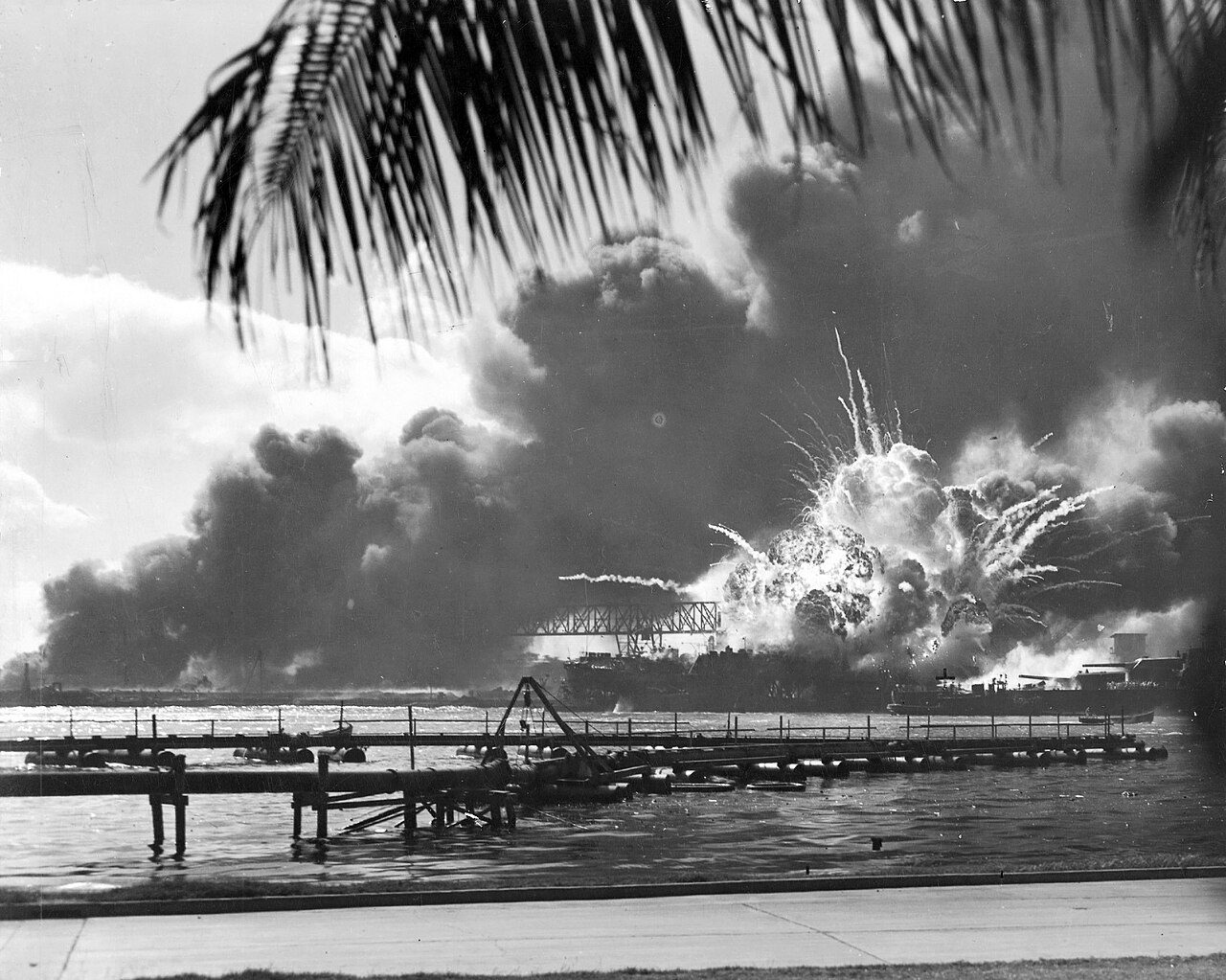
On a Sunday morning, 7 December 1941, Japanese aircraft attacked the United States Pacific Fleet at Pearl Harbor in Hawaii — the shock that brought America into the Second World War.
Choose another date: open the On This Day calendar to browse events, births and deaths for any day of the year.
At a Glance
- Date
- Sunday, 7 December 1941, in the morning, Hawaii time
- Place
- Pearl Harbor naval base, Oahu, Hawaii — home of the US Pacific Fleet
- Attacker
- The Imperial Japanese Navy, in a surprise aerial attack
- American losses
- 2,403 killed and 1,178 wounded; the battleship USS Arizona among the ships destroyed
- Result
- On 8 December the United States declared war on Japan, entering the Second World War
Events on this day
- 1787Delaware becomes the first state to ratify the United States Constitution, earning its nickname 'The First State'.
- 1805Lewis and Clark cross to the south shore of the Columbia River and begin building Fort Clatsop, their winter camp.
- 1862Union forces under James G. Blunt hold off a Confederate attack at the Battle of Prairie Grove, Arkansas.
- 1909Belgian-born chemist Leo Baekeland is granted a US patent for Bakelite, the first synthetic plastic.
- 1941Japan launches its surprise attack on Pearl Harbor, killing 2,403 Americans and bringing the United States into the Second World War.
- 1946Fire sweeps the Winecoff Hotel in Atlanta, Georgia, killing 119 people.
- 1972Apollo 17, the last Apollo mission to the Moon, is launched; on the way out its crew takes the famous 'Blue Marble' photograph of Earth.
- 1975Shortly after East Timor declares independence from Portugal, Indonesian forces invade and occupy it.
- 1982Charles Brooks Jr. is put to death in Texas, the first person in the United States executed by lethal injection.
- 1988An earthquake devastates the Spitak region of Soviet Armenia; official estimates put the death toll at about 25,000.
- 2004Hamid Karzai is sworn in as the first democratically elected president of Afghanistan.
Born on this day
- 1598Gian Lorenzo Bernini — Italian sculptor and architect, the master of the Baroque, creator of The Ecstasy of St Teresa.
- 1863Richard Warren Sears — American businessman, co-founder of the Sears mail-order company.
- 1873Willa Cather — American novelist of frontier life, author of O Pioneers! and My Ántonia.
- 1905Gerard Kuiper — Dutch-American astronomer who discovered moons of Uranus and Neptune.
- 1928Noam Chomsky — American linguist, called the father of modern linguistics.
- 1932Ellen Burstyn — American actress of The Exorcist and Alice Doesn't Live Here Anymore.
- 1956Larry Bird — American basketball player who led the Boston Celtics to three NBA championships.
Died on this day
- 43 BCCicero — Roman orator and statesman, assassinated on the orders of Mark Antony.
- 983Otto II — Holy Roman Emperor, dead at about 28 after a reign of ten years.
- 1817William Bligh — English naval officer, captain of HMS Bounty at the time of its famous mutiny.
- 1902Thomas Nast — German-American political cartoonist whose drawings defined an era of American politics.
- 1970Rube Goldberg — American cartoonist famed for drawings of absurdly complicated machines.
- 1975Thornton Wilder — American novelist and playwright.
- 2020Chuck Yeager — American test pilot, the first person to fly faster than sound, dead at 97.
The featured story: the morning at Pearl Harbor
Pearl Harbor, on the Hawaiian island of Oahu, was the home port of the United States Pacific Fleet — a deep, sheltered harbour the US Navy had spent decades dredging and fortifying, in part because Japan's power in the Pacific was rising. Relations between Washington and Tokyo had been deteriorating for years over Japan's expansion in Asia, and American leaders expected war somewhere, sometime. What they did not expect was that it would begin here, on a quiet Sunday morning, with the fleet at anchor.
On 7 December 1941 Japanese bombers launched a surprise aerial attack on the naval base and on the Army and Marine air forces defending it. Warships in the harbour were bombed and sunk or damaged where they lay; the destroyer USS Shaw blew up in one of the attack's most photographed explosions, and the battleship USS Arizona was destroyed. The National Park Service, which keeps the memorial today, records simply that the harbour's tranquility was shattered, thousands of lives were lost, and the United States was drawn into the Second World War. The counted American toll was 2,403 killed and 1,178 wounded.
The next day, 8 December, President Franklin D. Roosevelt addressed Congress and the United States declared war on Japan. The attack had been intended to cripple the Pacific Fleet so Japan could expand across Asia and the Pacific unopposed; instead it unified a divided American public overnight and brought the world's largest industrial power fully into a war that until that morning had been, for the United States, someone else's. In 1962 the USS Arizona Memorial was dedicated over the sunken battleship's hull, where it still stands — the harbour's quiet surface giving no hint of the morning that changed the century.
Why this date matters
No other December date holds so much of the American story at once. On this day in 1787 Delaware became the first state of the new republic; on this day in 1941 that republic was dragged, burning, into a world war; and on this day in 1972 its last Moon mission lifted off and photographed the whole Earth in a single frame — the Blue Marble. Founding, catastrophe and farewell to the Moon, all on 7 December: the date is a reminder that a nation's turning points do not spread themselves politely across the calendar.
Sources
- Encyclopaedia Britannica — On This Day: December 7
- National Park Service — Pearl Harbor National Memorial
- HISTORY — What Happened on December 7
- Associated Press — Today in History, December 7
The facts on this page were checked against these sources on 18 November 2026. The History Trail's permanent pages are researched and written for this site; the live profiles elsewhere on The History Trail are assembled automatically from Wikipedia and Wikidata.
About the Author
Researched and written by the The History Trail Editorial Team — the accountable editorial function behind this site's permanent story pages. The team works from the published sources cited on each page; it does not invent historians, reviewers or credentials, and it corrects errors openly.
Fact Check
Every load-bearing fact on this page traces to one of the sources listed above, and significant claims link to their source in the text. Our checking method is described on the methodology page; errors can be reported via the corrections page.
Sources & Citations
Cite this page as: The History Trail Editorial Team, The History Trail — this article's title, publication and update dates are shown beneath its headline. The full source list appears under Sources above; the site's source standards are on the sources page.