
On This Day
May 26 in History
May 26 is the day the rescue at Dunkirk began. On this day in 1940, with the British Expeditionary Force and its French allies trapped against the Channel by the German advance, Operation Dynamo got under way: a fleet of naval vessels and hundreds of civilian 'little ships' began ferrying an army home across the sea. Over nine days 338,226 men were evacuated. The date also marks the acquittal of President Andrew Johnson in 1868 and the signing of the SALT agreements in 1972.
Choose another date: open the On This Day calendar to browse events, births and deaths for any day of the year.
At a Glance
- Date begun
- 26 May 1940
- Codename
- Operation Dynamo
- Troops evacuated
- 338,226 Allied soldiers
- First 24 hours
- Nearly 8,000 troops brought off
- Civilian craft
- Some 700 'little ships' joined the naval effort
- Duration
- About nine days, ending 4 June 1940
Events on this day
- 1521The Edict of Worms outlaws Martin Luther and bans his writings across the Holy Roman Empire.
- 1637Puritan forces and their Mohegan allies burn a Pequot village at Mystic, killing some 500 Pequot men, women and children.
- 1868The impeachment trial of President Andrew Johnson ends when the Senate votes to acquit him by a single vote.
- 1896Nicholas II is crowned tsar of Russia in Moscow, the last coronation of the Romanov dynasty.
- 1913The Actors' Equity Association is founded in New York to represent stage performers.
- 1927Henry and Edsel Ford drive the 15 millionth and last Model T out of the Ford factory, ending the car's production run.
- 1938The House Un-American Activities Committee is created in the US Congress under chairman Martin Dies Jr.
- 1940Operation Dynamo, the evacuation of Allied troops from Dunkirk, gets under way — the featured story above.
- 1966Guyana gains independence from Britain.
- 1972President Nixon and Leonid Brezhnev sign the SALT I agreements in Moscow, limiting nuclear missiles.
- 1991A Lauda Air Boeing 767 breaks up over Thailand, killing all 223 people aboard.
- 2014Narendra Modi is sworn in as prime minister of India.
Born on this day
- 1895Dorothea Lange — American photographer whose Migrant Mother became the defining image of the Great Depression
- 1907John Wayne — American actor, born Marion Morrison, who became the archetypal Western film hero
- 1926Miles Davis — American jazz trumpeter who repeatedly reinvented the music across five decades
- 1951Sally Ride — physicist who in 1983 became the first American woman in space
Died on this day
- 1703Samuel Pepys — English diarist whose vivid diary is a primary record of Restoration London, the plague and the Great Fire
- 1976Martin Heidegger — German philosopher, author of Being and Time (1927), one of the most influential and controversial thinkers of the twentieth century.
- 2008Sydney Pollack — American film director of Tootsie and Out of Africa and a respected actor
The featured story: The miracle of Dunkirk begins, 26 May 1940
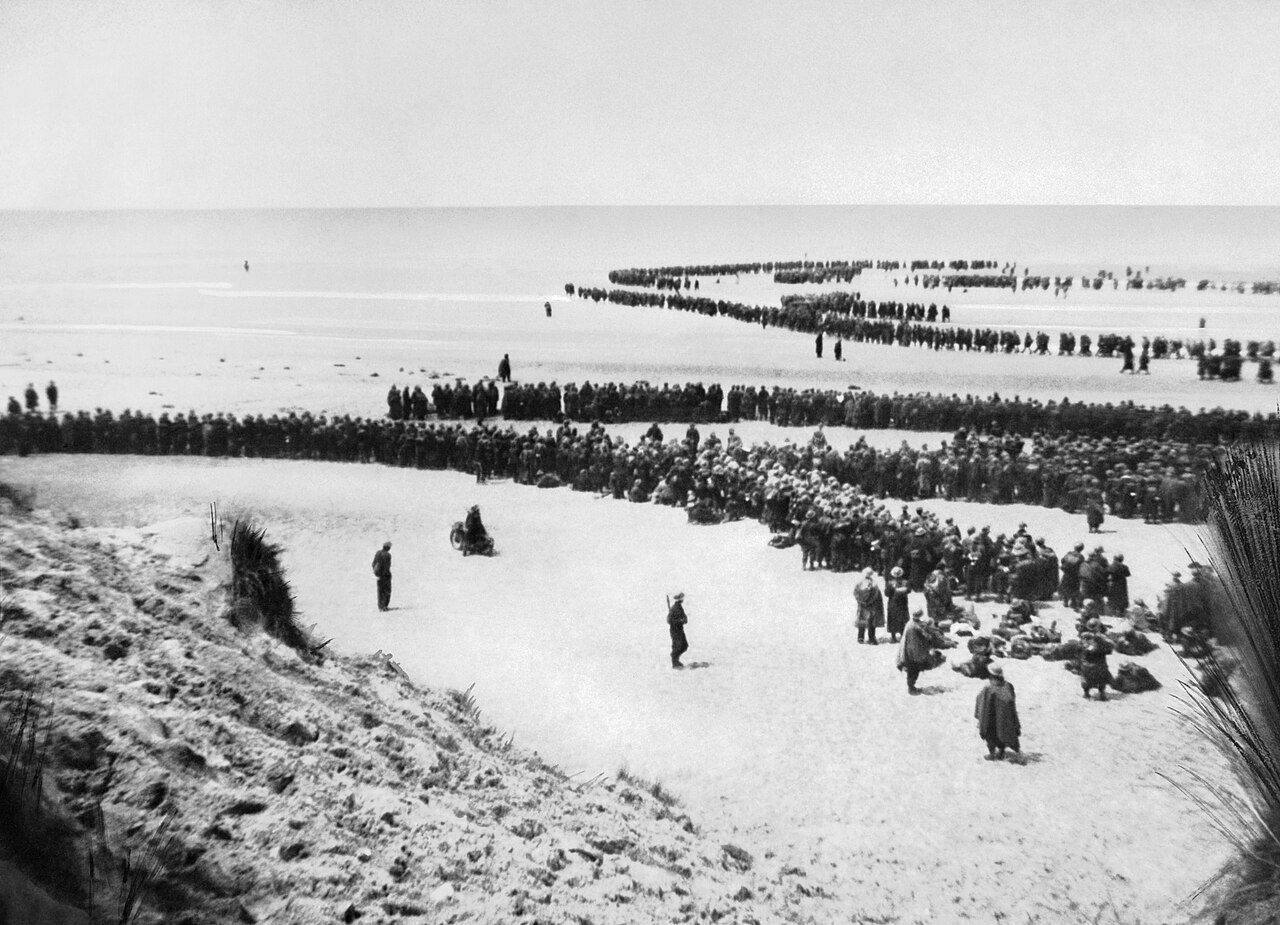
In May 1940 the German invasion of France went with terrifying speed. German armoured columns broke through the Ardennes, raced to the Channel and cut off the British Expeditionary Force and the best French armies in a pocket around the port of Dunkirk. The Allied position looked hopeless. Then, on 24 May, Hitler halted his tanks along a line of canals some 15 miles from the town. That pause, whether ordered from caution or overconfidence, gave the defenders a narrow window in which to organise a perimeter and attempt the impossible: an evacuation by sea. The men waiting on the beaches and in the dunes had little cover from the air attacks that came in waves, and the wreckage of ships sunk in the harbour approaches marked the channels through which the rescuers had to feel their way, in darkness and under fire, night after night.
Operation Dynamo began on 26 May, directed from rooms in the cliffs beneath Dover Castle. The Royal Navy sent destroyers and transports, and alongside them came one of the most famous improvised fleets in history: some 700 civilian craft, fishing boats, yachts, ferries and pleasure steamers, many sailed by their owners, crossed the Channel to lift men from the beaches and the harbour mole. The Royal Air Force fought the Luftwaffe above them. In the first 24 hours nearly 8,000 troops were brought away, a trickle that planners feared might be all that could be saved.
Instead the trickle became a flood. Day after day the armada returned, under bombing and shellfire, while the perimeter held and French troops fought a stubborn rearguard. By the time the operation ended on 4 June, 338,226 British and Allied soldiers had been ferried to England, a deliverance so far beyond expectation that it entered British memory as the miracle of Dunkirk. The cost was real: the army's tanks, guns and vehicles were abandoned in France, and many of the French soldiers lifted off chose or were obliged to return to the fight and to captivity. On the beaches, soldiers waded out shoulder-deep and waited in lines in the water for the boats, while others were lifted from the long harbour mole straight onto the decks of destroyers, the mole in the end accounting for the greater share of the men brought home.
Dunkirk was a defeat, and Winston Churchill warned the country not to mistake evacuation for victory. But the rescued army formed the experienced core around which Britain rebuilt its forces, and the 'Dunkirk spirit' became a byword for endurance under bombardment. The war had almost six years still to run, yet the men saved in those nine days made it possible for Britain to run it at all.
Why this date matters
May 26 is a date of narrow escapes and last stands. An army is lifted off a beach under fire; a president survives impeachment by one vote; an outlawed reformer defies an empire's edict. Its quieter entries carry the same charge of things ending and beginning: the last Model T rolls out of the factory as one industrial age closes, and SALT's signatures in Moscow try to cap the weapons of another. Even the day's art is about endurance, from Pepys's diary of plague and fire to Dorothea Lange's photographs of a nation in depression. May 26 keeps asking what can be saved when the worst arrives. What the date finally commemorates is not victory but salvage: armies, presidencies and reputations pulled back from the edge by the narrowest of margins.
Sources
- Encyclopaedia Britannica — On This Day: May 26
- HISTORY — This Day in History: May 26
- Wikimedia Commons — Dunkirk 26-29 May 1940 file page
- Wikipedia — May 26

The facts on this page were checked against these sources on 19 November 2026. The History Trail's permanent pages are researched and written for this site; the live profiles elsewhere on The History Trail are assembled automatically from Wikipedia and Wikidata.
About the Author
Researched and written by the The History Trail Editorial Team — the accountable editorial function behind this site's permanent story pages. The team works from the published sources cited on each page; it does not invent historians, reviewers or credentials, and it corrects errors openly.
Fact Check
Every load-bearing fact on this page traces to one of the sources listed above, and significant claims link to their source in the text. Our checking method is described on the methodology page; errors can be reported via the corrections page.
Sources & Citations
Cite this page as: The History Trail Editorial Team, The History Trail — this article's title, publication and update dates are shown beneath its headline. The full source list appears under Sources above; the site's source standards are on the sources page.