
On This Day
September 12 in History
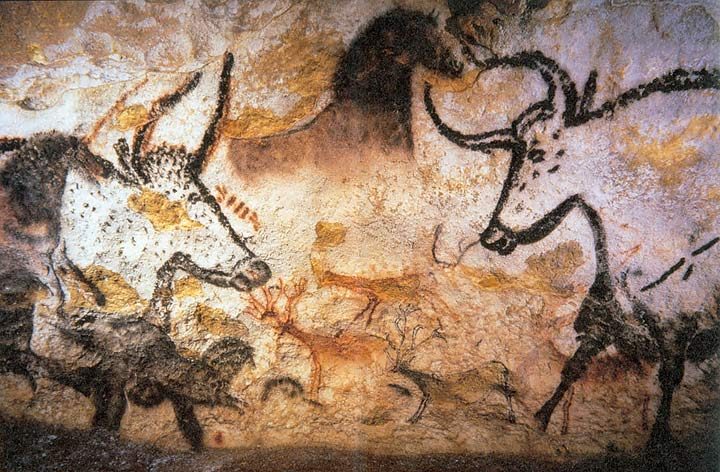
On 12 September 1940 four teenage boys exploring the hillside above Montignac in south-western France followed their dog down a hole and found the Lascaux caves, whose walls carry one of the greatest collections of prehistoric art on Earth. September 12 is also the day Jesse Owens was born, Steve Biko died in police custody and Mae Jemison became the first Black woman in space.
Choose another date: open the On This Day calendar to browse events, births and deaths for any day of the year.
At a Glance
- The discoverers
- Four teenagers — among them Marcel Ravidat — exploring near Montignac, Dordogne, in September 1940
- What they found
- Cave walls covered with paintings and engravings of animals, more than 600 figures in the main chambers
- The subjects
- Horses, bison, deer, aurochs and other animals, with a single human figure — among the most concentrated displays of cave art known
- The age
- The paintings date to the Upper Palaeolithic, roughly 17,000 years ago
- The sequel
- Public visits damaged the art with mould and algae, and the original cave was closed to visitors in 1963; replicas now receive the crowds
Events on this day
- 1683An army under John III Sobieski of Poland and Charles of Lorraine relieves the Ottoman siege of Vienna, turning the tide of Ottoman expansion into Europe.
- 1846The poets Elizabeth Barrett and Robert Browning marry secretly and elope to Italy, defying her father's ban on his children's marriages.
- 1940Four teenagers discover the painted caves of Lascaux in the Dordogne — the featured story above.
- 1942A German U-boat sinks the British liner Laconia in the Atlantic; its commander, learning Italian prisoners are aboard, attempts a rescue that draws Allied attack.
- 1953Senator John F. Kennedy marries Jacqueline Bouvier at Newport, Rhode Island, seven years before he becomes president of the United States.
- 1953Nikita Khrushchev is announced as first secretary of the Soviet Communist Party, succeeding Stalin at the head of the USSR.
- 1959The Soviet Union launches Luna 2; two days later it becomes the first human-made object to reach the surface of the Moon.
- 1966The Monkees, a television sitcom about a pop group modelled on the Beatles, debuts in the United States and becomes an unlikely chart success.
- 1974Emperor Haile Selassie of Ethiopia is deposed by a military committee, the Derg, ending a reign and an empire of long standing.
- 1992Mae Jemison flies aboard the space shuttle Endeavour, becoming the first Black woman to travel into space.
- 2000The Dutch parliament passes legislation to legalise same-sex marriage; it takes effect in 2001, making the Netherlands the first country to do so.
Born on this day
- 1494Francis I — king of France from 1515, Renaissance patron and lifelong rival of Henry VIII and Charles V.
- 1888Maurice Chevalier — French singer and actor, the straw-hatted star of Gigi and a symbol of Parisian charm.
- 1897Irène Joliot-Curie — French physicist who shared a Nobel Prize for discovering artificial radioactivity.
- 1913Jesse Owens — American track-and-field athlete who won four gold medals at the 1936 Berlin Olympics.
- 1944Barry White — American singer and songwriter, the deep-voiced 'Maestro' of 1970s soul and disco.
Died on this day
- 1764Jean-Philippe Rameau — French composer and theorist, a master of Baroque opera whose works include Castor et Pollux.
- 1977Steve Biko — South African anti-apartheid activist and Black Consciousness leader, who died of injuries suffered in police custody.
- 1992Anthony Perkins — American actor, indelible as Norman Bates in Alfred Hitchcock's Psycho.
- 2003Johnny Cash — American singer-songwriter, the 'Man in Black' whose baritone remade country music.
- 2014Ian Paisley — Northern Irish Protestant leader and founder of the Democratic Unionist Party, later first minister of Northern Ireland.
The featured story: the discovery of the Lascaux caves, 12 September 1940
The discovery was an accident of wartime boyhood. In September 1940, with France defeated and occupied, four teenagers from Montignac in the Dordogne were exploring the hill of Lascaux above the town when their dog vanished into a hole left by an uprooted tree. Following it down, Marcel Ravidat and his companions slid into a cavern — and their lamp picked out animals covering the walls and ceiling: horses, bulls, stags, painted in earth pigments on a scale none of them had imagined. They had found, as Britannica puts it, one of the most concentrated showcases of cave art in existence, with more than 600 creatures pictured in the chambers.
The boys told their schoolteacher, and within days the prehistorian Henri Breuil had come to see and authenticate the paintings. The art belonged to the Upper Palaeolithic, created roughly 17,000 years earlier by hunter-gatherers of the last Ice Age. Its most famous chamber, the Hall of the Bulls, carries great aurochs four metres long; elsewhere are horses, ibex, bison, a wounded man — the cave's single human figure — and abstract signs whose meaning is still debated. Nothing in the caves was a rough sketch: the artists had used scaffolding, lamps and sophisticated shading to give the animals movement and bulk.
Lascaux opened to the public in 1948 and drew crowds of more than a thousand visitors a day. Their breath, and the lights installed for them, began to feed algae and mould that threatened the paintings, and in 1963 the French government closed the original cave altogether. A meticulous replica, Lascaux II, opened nearby in 1983, and later generations of facsimiles — including a complete copy at the International Centre for Cave Art in Montignac — now take the visitors the real cave cannot. The original survives under guard, monitored like a patient, its air filtered and its walls watched for the white and black moulds that still appear.
The find changed the standing of prehistoric art. Before Lascaux, and the earlier discovery of Altamira in Spain, scholars had doubted that Ice Age people could produce work of such ambition; afterwards it was impossible to treat cave painting as crude decoration. Four boys and a lost dog had opened a gallery older than agriculture, older than writing — the work of artists whose names, language and beliefs are gone, but whose horses still run across the stone.
Why this date matters
September 12 joins the deepest past to the newest frontiers. On one day in 1940 teenagers uncovered art made some 17,000 years earlier; on the same date in 1959 a Soviet probe set off to strike the Moon, and in 1992 Mae Jemison carried the day's reach into orbit. Between those poles sit the relief of Vienna, a poets' elopement, a presidential wedding and the death of Steve Biko, which helped turn world opinion against apartheid. It is a date that keeps demonstrating how much of history is found by accident — and how much of it is made by people refusing to accept the world as it was handed to them.
Sources
- Encyclopaedia Britannica — On This Day: September 12
- HISTORY — This Day in History: September 12
- Encyclopaedia Britannica — Jesse Owens
- Encyclopaedia Britannica — Lascaux
The facts on this page were checked against these sources on 19 November 2026. The History Trail's permanent pages are researched and written for this site; the live profiles elsewhere on The History Trail are assembled automatically from Wikipedia and Wikidata.
About the Author
Researched and written by the The History Trail Editorial Team — the accountable editorial function behind this site's permanent story pages. The team works from the published sources cited on each page; it does not invent historians, reviewers or credentials, and it corrects errors openly.
Fact Check
Every load-bearing fact on this page traces to one of the sources listed above, and significant claims link to their source in the text. Our checking method is described on the methodology page; errors can be reported via the corrections page.
Sources & Citations
Cite this page as: The History Trail Editorial Team, The History Trail — this article's title, publication and update dates are shown beneath its headline. The full source list appears under Sources above; the site's source standards are on the sources page.