
On This Day
January 30 in History
On 30 January 1933 Adolf Hitler was appointed chancellor of Germany by President Paul von Hindenburg — not by coup or electoral majority, but by conservative politicians who believed they could control him. Within eighteen months the Weimar Republic was gone. January 30 is also the day Charles I was executed, Gandhi was assassinated, the Tet Offensive began, and the Beatles played their last live show.
Choose another date: open the On This Day calendar to browse events, births and deaths for any day of the year.
At a Glance
- The appointment
- President Paul von Hindenburg appoints Adolf Hitler chancellor of Germany on 30 January 1933, after weeks of intrigue led by Franz von Papen
- The party's position
- The Nazis were Germany's largest party but had never won a majority in a free election; their vote had fallen in November 1932
- The cabinet
- Only 3 of the 12 ministers in Hitler's first cabinet were Nazis — but they held the Reich and Prussian interior ministries, and with them the police
- The evening
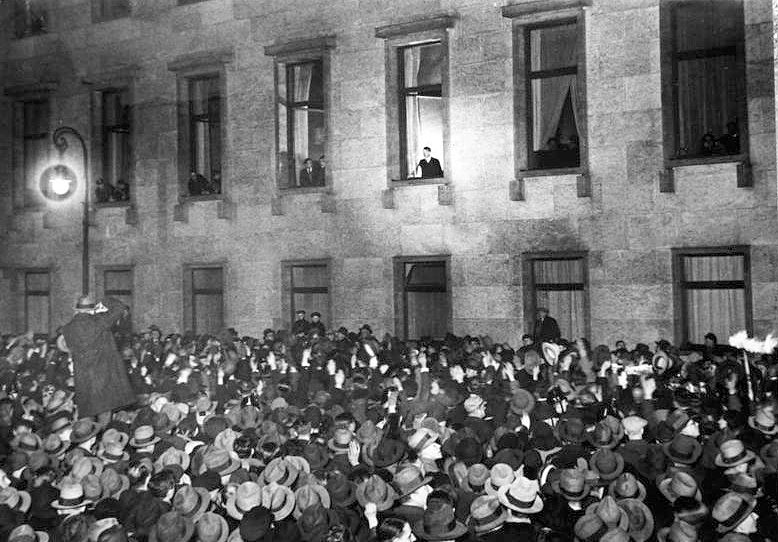
- Thousands of SA men celebrate with a torchlight parade through the Brandenburg Gate and past the Chancellery in Berlin
- What followed
- The Reichstag Fire Decree (February 1933) suspends civil liberties; the Enabling Act (March 1933) frees Hitler from parliament; on Hindenburg's death in August 1934 Hitler becomes Führer
- The verdict of historians
- Hitler did not seize power — it was handed to him constitutionally by conservative elites who believed they could control him
Events on this day
- 1649Charles I of England is executed outside the Banqueting House in Whitehall, London, after his trial for high treason — the first European king publicly tried and beheaded by his own subjects.
- 1835A would-be assassin fires two pistols at President Andrew Jackson outside the U.S. Capitol; both misfire, and Jackson beats the man with his cane — the first assassination attempt on a U.S. president.
- 1902Britain and Japan sign the Anglo-Japanese Alliance, the first alliance between a European power and an Asian nation on equal terms.
- 1933Adolf Hitler is appointed chancellor of Germany by President Hindenburg — the featured story above.
- 1945The Soviet submarine S-13 sinks the German liner Wilhelm Gustloff in the Baltic; an estimated 9,000 people die, the deadliest sinking in maritime history.
- 1948Mahatma Gandhi is assassinated in New Delhi, shot by the Hindu nationalist Nathuram Godse as he walks to evening prayers.
- 1968The Tet Offensive begins in Vietnam, as North Vietnamese and Viet Cong forces attack more than a hundred cities and bases across the South, including the U.S. Embassy in Saigon.
- 1969The Beatles perform in public together for the last time, playing an unannounced concert on the roof of their Apple Corps headquarters in London.
- 1972On Bloody Sunday in Derry, Northern Ireland, British paratroopers shoot 26 unarmed civil-rights marchers, killing 14.
- 2020The World Health Organization declares the new coronavirus outbreak a public health emergency of international concern.
Born on this day
- 1882Franklin D. Roosevelt — 32nd president of the United States, who led the country through the Great Depression and most of the Second World War.
- 1930Gene Hackman — American actor of The French Connection and Unforgiven.
- 1937Boris Spassky — Russian chess grandmaster, world champion and Bobby Fischer's opponent in the 1972 'Match of the Century'.
- 1941Dick Cheney — American politician, vice president under George W. Bush.
- 1951Phil Collins — English drummer and singer, of Genesis and a solo career of stadium scale.
- 1974Christian Bale — Welsh actor known for total physical transformations between roles.
Died on this day
- 1649Charles I — king of England, Scotland and Ireland, executed in London at 48.
- 1948Mahatma Gandhi — leader of India's independence movement, assassinated in Delhi at 78, weeks after partition.
- 1948Orville Wright — co-inventor of the aeroplane with his brother Wilbur, dead in Ohio at 76, on the same day as Gandhi.
- 2006Coretta Scott King — American civil-rights leader and widow of Martin Luther King Jr., dead at 78.
- 2007Sidney Sheldon — American novelist and screenwriter whose thrillers sold in the hundreds of millions, dead at 89.
The featured story: Hitler is appointed chancellor of Germany, 30 January 1933
On 30 January 1933, Adolf Hitler was sworn in as chancellor of Germany. There had been no coup, no march on the capital, no election that made him head of government. The leader of the Nazi Party was appointed, in full constitutional form, by the 85-year-old President Paul von Hindenburg, in a ceremony at the presidential palace in Berlin — the outcome of weeks of backstairs intrigue among conservative politicians who believed they could use Hitler's mass movement while controlling the man at its head. Franz von Papen, the intriguer-in-chief who took the vice-chancellorship, boasted that they had 'hired' Hitler and would push him so far into a corner that he would squeak.
The arithmetic seemed to support their complacency. The Nazis had peaked at 37.3 per cent of the vote in July 1932 and had actually fallen back in the November election; in Hitler's first cabinet only three of the twelve ministers — Hitler himself, Wilhelm Frick at the Interior Ministry and Hermann Göring — were Nazis. What the conservatives had discounted was what those posts commanded: Frick controlled the police apparatus of the Reich, and Göring, as minister without portfolio and interior minister of Prussia, controlled the police of Germany's largest state. Within weeks, that machinery was being turned on the regime's opponents.
That evening, thousands of SA stormtroopers marched in a torchlight parade through the Brandenburg Gate and down the Wilhelmstrasse, past the Chancellery window where Hitler stood acknowledging the cheers, and past the window from which Hindenburg watched. The spectacle was staged as the dawn of a national rebirth. It was, in reality, the beginning of the end of the Weimar Republic. A month later the Reichstag fire gave the regime its pretext for the decree that suspended civil liberties; in March the Enabling Act let Hitler legislate without parliament; by the summer every other party had been dissolved or had dissolved itself, and when Hindenburg died in August 1934 Hitler merged the presidency into his own person as Führer.
The United States Holocaust Memorial Museum's account of these months stresses the point that posterity most needs: Hitler did not seize power, and German voters never gave his party a majority in a free election. Power was handed to him, legally, by men who thought institutions and their own cunning would contain him. Twelve years later the regime they enabled had murdered six million Jews and millions of others and left Europe in ruins. January 30, 1933 is the standing proof that democracies can be dismantled from inside the constitution, by appointment, in a morning.
Why this date matters
No single date holds both the birth certificate and the death certificate of modern democracy the way January 30 does. It is the day a king was beheaded by a republic in 1649 — and the day, in 1933, that a republic handed itself to a tyrant by legal appointment. Around those poles it gathers Gandhi's assassination, the first attempt on an American president's life, the Tet Offensive, Bloody Sunday in Derry, and the Beatles' last performance together on a London rooftop. January 30 keeps teaching the same lesson from both directions: who holds power, and how they got it, decides everything that follows.
Sources
- Encyclopaedia Britannica — On This Day: January 30
- HISTORY — What Happened on January 30
- United States Holocaust Memorial Museum — Hitler Comes to Power (Holocaust Encyclopedia)
The facts on this page were checked against these sources on 19 November 2026. The History Trail's permanent pages are researched and written for this site; the live profiles elsewhere on The History Trail are assembled automatically from Wikipedia and Wikidata.
About the Author
Researched and written by the The History Trail Editorial Team — the accountable editorial function behind this site's permanent story pages. The team works from the published sources cited on each page; it does not invent historians, reviewers or credentials, and it corrects errors openly.
Fact Check
Every load-bearing fact on this page traces to one of the sources listed above, and significant claims link to their source in the text. Our checking method is described on the methodology page; errors can be reported via the corrections page.
Sources & Citations
Cite this page as: The History Trail Editorial Team, The History Trail — this article's title, publication and update dates are shown beneath its headline. The full source list appears under Sources above; the site's source standards are on the sources page.