
Years
1920 in History
1920 is remembered for the summer American women won the constitutional right to vote: Tennessee's ratification on 18 August made the Nineteenth Amendment the law of the land, certified on 26 August after a seventy-year campaign. The year also opened the League of Nations — which the United States, its chief architect, never joined — saw the Senate reject the Treaty of Versailles for the final time, and heard the first commercial radio broadcast in the United States.
At a Glance
- Defining event
- Nineteenth Amendment certified, 26 August 1920 — women win the vote across the US
- The deciding state
- Tennessee ratifies on 18 August, the 36th state, after Harry Burn switches his vote
- The League begins
- League of Nations comes into being, 10 January — the United States never joins
- Treaty rejected
- US Senate rejects the Treaty of Versailles for the second and final time, 19 March
- Radio begins
- KDKA Pittsburgh makes the first US commercial radio broadcast, 2 November
- Football founded
- Owners meet at Canton, Ohio, and found the association that becomes the NFL
The defining story: one vote in Tennessee
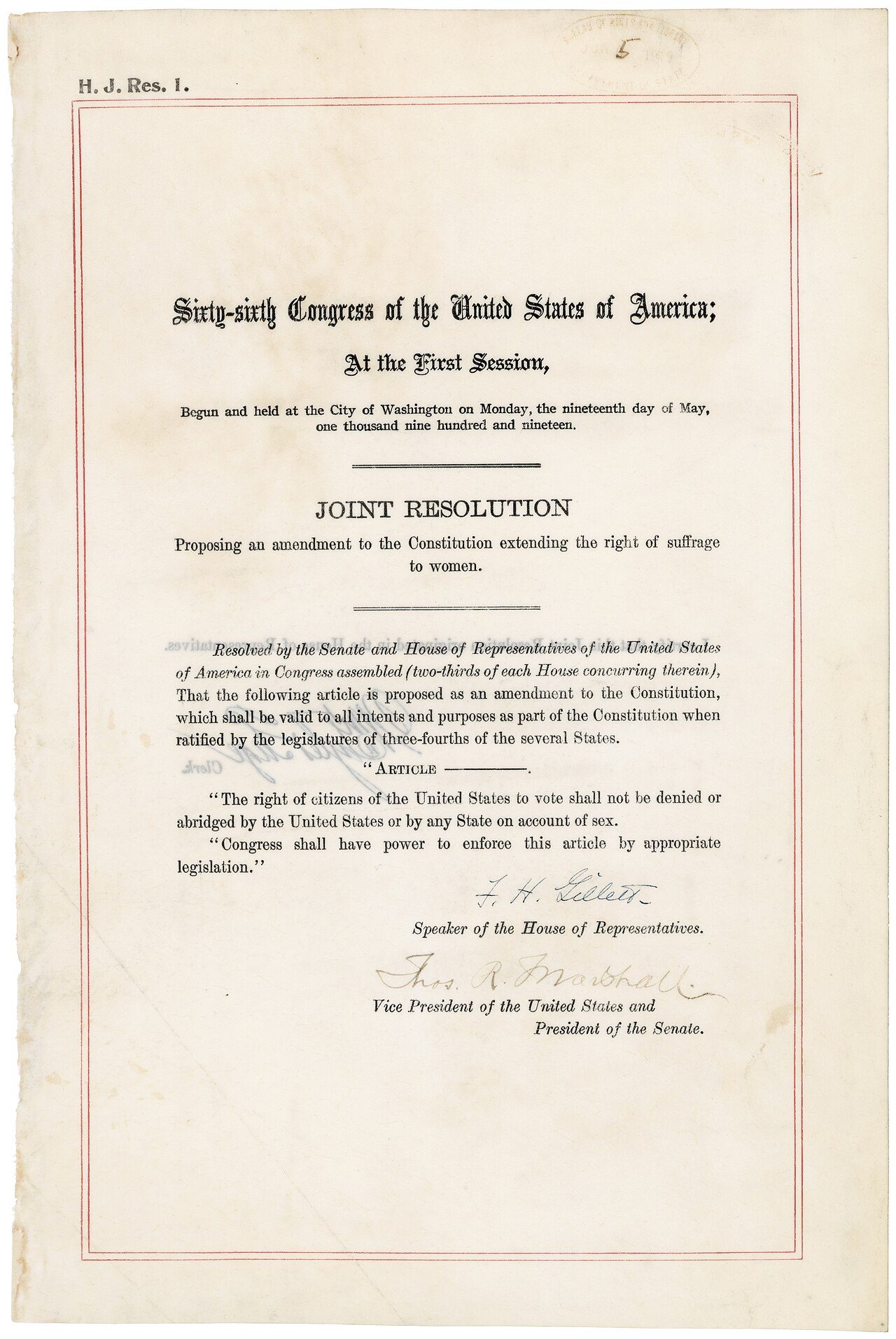
The Nineteenth Amendment is one sentence long: the right of citizens of the United States to vote shall not be denied or abridged on account of sex. It had been introduced in Congress in 1878, and for four decades it went nowhere while the suffrage movement fought state by state, winning the vote in much of the West and being beaten back in the South and East. Only after women had worked, marched and been imprisoned through the First World War years did Congress pass it — the House in May 1919 and the Senate on 4 June 1919 — and send it to the states. Ratification needed 36 of the 48.
Through the winter and spring the total climbed — Wisconsin and Michigan first, then state after state — until by the summer of 1920 it stood at 35, one short, with the remaining legislatures either adjourned or hostile. Tennessee, which had not been expected to settle the question, was called into special session. Both sides poured into Nashville, suffragists wearing yellow roses and opponents red, and lobbied the state House member by member, because everyone could count, and the count was tied. On 18 August 1920 the House voted. The deciding vote belonged to its youngest member, 24-year-old Harry Burn, counted with the opponents and wearing the red rose — but carrying in his pocket a letter from his mother urging him to vote for suffrage. He switched, and ratification carried.
Eight days later, on the morning of 26 August, Secretary of State Bainbridge Colby signed the certification at his home in Washington, without ceremony and without inviting the women who had fought for it — fearing a court challenge from Tennessee opponents, he signed early, and the suffragists learned they had won from the newspapers. Some 26 million women were eligible to vote in a presidential election for the first time that November. The campaign's organisations adapted at once: the League of Women Voters had already been founded in Chicago on 14 February, with Carrie Chapman Catt as its driving force.
The amendment's promise was real but incomplete — Black women in the Jim Crow South faced the same poll taxes and literacy tests that disenfranchised Black men. And 1920's other great settlement was incomplete in the opposite direction: the League of Nations came into being on 10 January, as the Treaty of Versailles took effect, but on 19 March the United States Senate rejected the treaty for the second and final time, keeping America out of the League its own president had designed. The new world order began the decade with its architect absent.
Timeline of 1920
- 10 January
The League of Nations comes into being as the Treaty of Versailles takes effect; the United States never joins.
- 14 February
The League of Women Voters is founded in Chicago, months before women win the vote nationwide.
- 19 March
The US Senate rejects the Treaty of Versailles for the second and final time.
- 2 May
The Negro National League plays its first game — the first successful professional baseball league for Black Americans.
- 16 May
Joan of Arc is canonised, nearly five centuries after her execution.
- 12 July
Soviet Russia signs a peace treaty recognising the independence of Lithuania.
- 18 August
Tennessee becomes the 36th state to ratify the Nineteenth Amendment, securing women's right to vote.
- 26 August
The Nineteenth Amendment is certified into the US Constitution after a seventy-year campaign.
- 17 September
Team owners meet in Canton, Ohio, and found the American Professional Football Association — the future NFL.
- 2 November
KDKA Pittsburgh makes the first commercial radio broadcast in the United States.
- 11 November
The Cenotaph is unveiled in London and the Unknown Warrior is buried in Westminster Abbey.
- 21 November
Bloody Sunday in Dublin: the IRA kills 14 intelligence officers; British forces kill 14 civilians at Croke Park.
Why 1920 still matters
The Nineteenth Amendment doubled the American electorate with a single sentence, and its route to law remains the model of how constitutional change actually happens in the United States: seventy-two years from the demand written at Seneca Falls in 1848, four decades of failed introductions, a state-by-state map changed first, and a final decision that came down to one young legislator's pocket and his mother's letter. Its incompleteness matters just as much: the amendment forbade denial of the vote on account of sex, but the machinery of disenfranchisement in the South kept many Black women from the ballot for another forty-five years — a gap between constitutional text and lived right that later movements had to close.
The League of Nations began the same year with the opposite defect: a fine text and a missing member. The Senate's final rejection of Versailles on 19 March meant the organisation designed by an American president opened without America, and the separate peace the United States concluded with Germany in 1921 underlined the absence. The League's failure to prevent a second world war is usually told as a story about the 1930s, but its structural weakness was set in 1920, in the gap between the world Wilson imagined at Paris and the one his own Senate would accept.
The year's foundings, meanwhile, built the century's popular culture. The owners who met in Canton in September created the association that became the National Football League; Rube Foster's Negro National League, playing its first game on 2 May, was the first successful professional baseball league for Black Americans; and KDKA's election-night broadcast on 2 November began commercial radio, the first electronic mass medium. In London on 11 November, the Cenotaph and the Unknown Warrior fixed the forms in which the war just ended would be remembered.
1920 on The History Trail
This year's featured days are the ratification and the certification of the Nineteenth Amendment, eight days apart.
- August 18 in History — Tennessee ratifies the Nineteenth Amendment, the 36th state, after Harry Burn switches his vote.
- August 26 in History — The Nineteenth Amendment is certified into the United States Constitution.
- Treaty of Versailles — The 1919 peace whose rejection by the US Senate kept America out of the League in 1920.
- January 10 in History — The League of Nations comes into being as the Treaty of Versailles takes effect.
- November 2 in History — KDKA Pittsburgh makes the first commercial radio broadcast in the United States.
- November 21 in History — Bloody Sunday in Dublin, in the Irish War of Independence.
Sources
- Encyclopaedia Britannica — On This Day: August 18
- Encyclopaedia Britannica — On This Day: August 26
- HISTORY — League of Nations instituted
- Encyclopaedia Britannica — On This Day: November 2
- Encyclopaedia Britannica — On This Day: November 21
- Encyclopaedia Britannica — On This Day: March 19
The facts on this page were checked against these sources on 19 November 2026. The History Trail's permanent pages are researched and written for this site; the live profiles elsewhere on The History Trail are assembled automatically from Wikipedia and Wikidata.
About the Author
Researched and written by the The History Trail Editorial Team — the accountable editorial function behind this site's permanent story pages. The team works from the published sources cited on each page; it does not invent historians, reviewers or credentials, and it corrects errors openly.
Fact Check
Every load-bearing fact on this page traces to one of the sources listed above, and significant claims link to their source in the text. Our checking method is described on the methodology page; errors can be reported via the corrections page.
Sources & Citations
Cite this page as: The History Trail Editorial Team, The History Trail — this article's title, publication and update dates are shown beneath its headline. The full source list appears under Sources above; the site's source standards are on the sources page.