
Years
1919 in History
1919 is remembered for the peace that ended the First World War in law: on 28 June, exactly five years after the Sarajevo assassination, Germany and the Allies signed the Treaty of Versailles in the Hall of Mirrors. The year also brought the Paris Peace Conference and the League of Nations it created, Ireland's declaration of a republic, the eclipse of 29 May that confirmed Einstein's general relativity, and Congress's passage of the Nineteenth Amendment.
At a Glance
- Defining event
- Treaty of Versailles signed, 28 June 1919, in the Hall of Mirrors
- The conference
- Paris Peace Conference opens 18 January, dominated by the 'Big Four'
- The League
- League of Nations approved at Paris, 25 January — written into the treaty as its Part I
- Science confirmed
- Solar eclipse of 29 May confirms Einstein's general relativity; he becomes world-famous
- Germany's terms
- Army capped at 100,000; about 13 percent of European territory lost; Article 231 grounds reparations
- America votes
- Congress passes the Nineteenth Amendment, 4 June; ratification follows in 1920
The defining story: the peace signed in the Hall of Mirrors
The fighting of the First World War had stopped on 11 November 1918, but an armistice is only a ceasefire: the state of war ended with a treaty. The Paris Peace Conference opened on 18 January 1919 and was dominated by the 'Big Four' — Woodrow Wilson of the United States, Georges Clemenceau of France, David Lloyd George of Britain and Vittorio Orlando of Italy — who had first met together on 12 January. Germany, which had asked Wilson to broker a ceasefire on the basis of his Fourteen Points, was not at the table. On 25 January the delegates approved a commission to create the League of Nations, with Wilson as its chairman, and the League's Covenant became Part I of the treaty itself.
The terms were presented to a German delegation on 7 May 1919; Germany could object only in writing. The result departed radically from the Fourteen Points. Germany lost about 13 percent of its European territory and a tenth of its population: Alsace-Lorraine returned to France, Posen and West Prussia went to a restored Poland, Danzig became a free city, the Saar passed under League administration for fifteen years, and all Germany's overseas colonies were taken away as League mandates. The army was capped at 100,000 men, conscription abolished, and tanks, military aircraft and submarines forbidden; the Rhineland was demilitarised. Article 231 affirmed that Germany accepted responsibility for the Allies' loss and damage — the legal basis for reparations, whose total the treaty itself left unspecified.
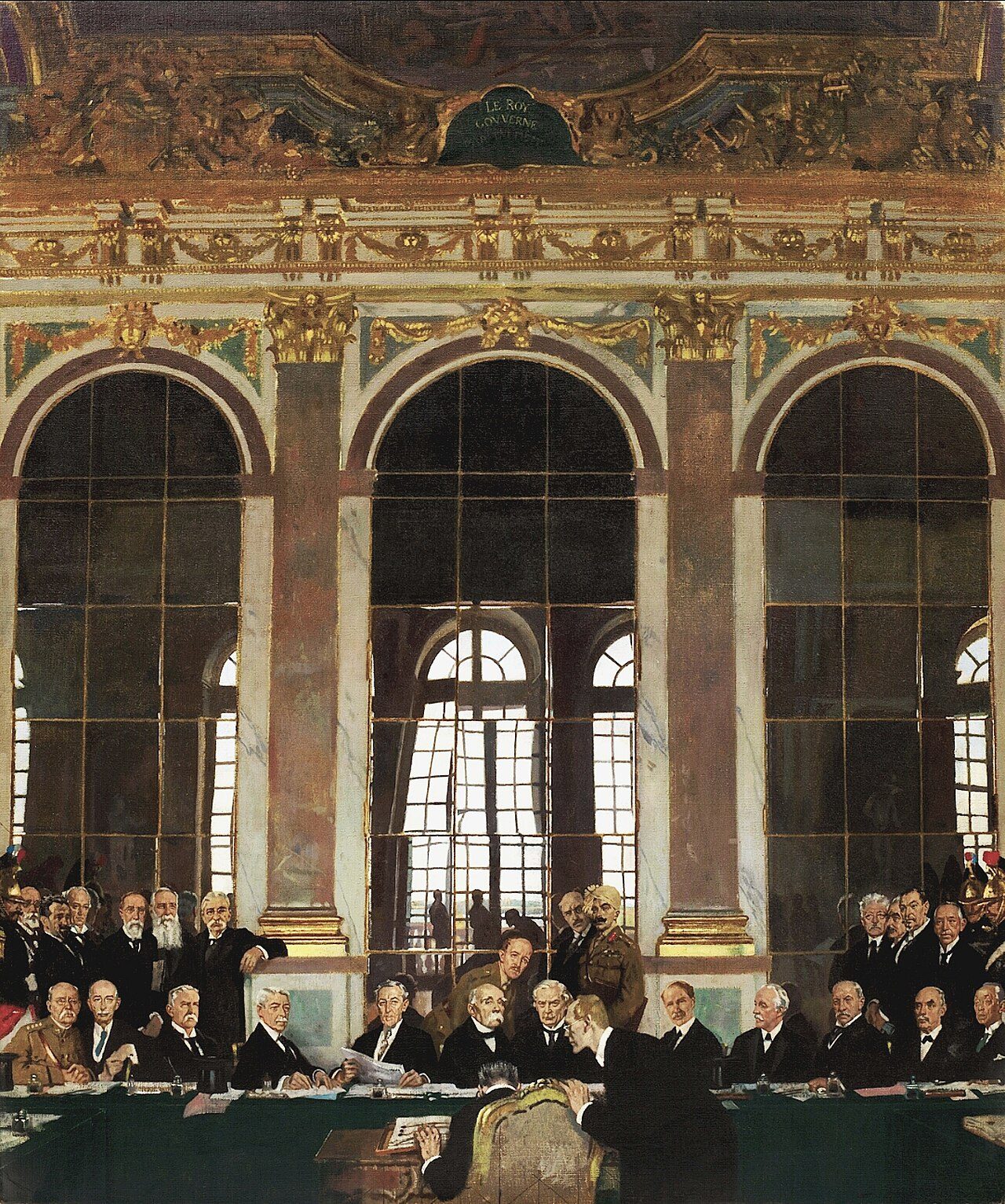
The signing was staged for symbolism. On 28 June 1919, exactly five years after the assassination of Archduke Franz Ferdinand at Sarajevo, German delegates signed in the Hall of Mirrors at Versailles — the same room in which the German Empire had been proclaimed in 1871. William Orpen's official painting shows the statesmen dwarfed by the hall around them. The document ran to 440 articles in fifteen parts, and in Germany the settlement was read from the first day as a dictated peace.
The conference's world was wider than Versailles. On 21 January Ireland's Sinn Féin deputies met in Dublin as the first Dáil and declared an Irish republic, opening the War of Independence. On 4 May students in Beijing marched in the May Fourth Movement, protesting the settlement's transfer of German rights in Shandong to Japan. And on 29 May, far from the negotiating tables, observations of a total solar eclipse — expeditions to Principe and to Sobral in Brazil — confirmed Einstein's general theory of relativity and made him world-famous almost overnight when the results were announced in November.
Timeline of 1919
- 18 January
The Paris Peace Conference opens at Versailles to remake the world after the First World War.
- 21 January
Ireland's Sinn Féin deputies meet in Dublin as the first Dáil and declare an Irish republic.
- 25 January
Delegates at Paris formally approve a commission to create the League of Nations, chaired by Wilson.
- 5 February
Chaplin, Pickford, Fairbanks and Griffith found United Artists, the first studio owned by its stars.
- 4 May
Beijing students march in the May Fourth Movement against the Versailles transfer of Shandong to Japan.
- 29 May
Observations of a solar eclipse confirm Einstein's general theory of relativity, making him world-famous.
- 4 June
The US Congress passes the Nineteenth Amendment, guaranteeing women the vote; it goes to the states.
- 14 June
Alcock and Brown take off from Newfoundland on the first nonstop transatlantic flight.
- 28 June
Germany and the Allies sign the Treaty of Versailles, formally ending the state of war.
- 27 July
The Chicago race riot erupts; a week of violence leaves 38 dead.
- 11 August
The Weimar Constitution is promulgated, formally establishing Germany as a democratic republic.
- 2 October
President Woodrow Wilson suffers a severe stroke, leaving him largely incapacitated for the rest of his term.
- 28 November
Nancy Astor wins the Plymouth Sutton by-election, the first woman elected to take her seat in the Commons.
Why 1919 still matters
Versailles was the centrepiece of a settlement that redrew Europe: new or restored states from Poland to Czechoslovakia and Yugoslavia took shape in its order, four empires — German, Austro-Hungarian, Ottoman and Russian — were gone, and the League of Nations, the first international organisation charged with keeping the peace, began work in January 1920. The idea inside Part I of the treaty returned in 1945 as the United Nations, designed with the League's failures in mind; Part XIII also created the International Labour Organization, which survives as a UN agency. Germany's reparations, fixed only in 1921 at 132 billion gold marks, were finally closed out in 2010 — ninety-one years after the signing.
The treaty's weakness lay as much in its enforcement as in its text. The United States never ratified it — Wilson, incapacitated by his October stroke, could not carry the Senate — never joined the League it created, and concluded a separate peace with Germany in 1921. In Germany, Article 231 was read as a verdict of sole moral guilt, though the word guilt does not appear in it, and resentment of the 'war guilt clause' proved a significant factor in the growing popularity of Hitler's Nazi Party in the 1920s and early 1930s. Whether Versailles caused the Second World War is disputed; what is certain is that the treaty defined the unhappy life of the Weimar Republic proclaimed the same year.
The year's other legacies were gentler and longer. The 1919 eclipse gave general relativity its first famous public test — a checkable prediction measured on two continents — and its data have been argued over ever since, though later eclipses and modern techniques have confirmed the prediction independently. Alcock and Brown's sixteen-hour flight across the Atlantic in June pointed to the connected century ahead, and Congress's passage of the Nineteenth Amendment on 4 June sent women's suffrage to the states, where Tennessee would settle it the following summer.
1919 on The History Trail
This year has no single featured day on The History Trail, but its two great stories — the peace and the eclipse — are told in full.
- Treaty of Versailles — The 1919 peace that reshaped Germany and Europe, signed in the Hall of Mirrors on 28 June.
- Solar eclipse — Ancient records and the eclipse of 29 May 1919 that tested Einstein's theory.
- January 18 in History — The Paris Peace Conference opens at Versailles.
- June 28 in History — The Treaty of Versailles is signed, five years after Sarajevo.
- May 29 in History — Eclipse observations confirm Einstein's general theory of relativity.
- June 4 in History — Congress passes the Nineteenth Amendment, sending women's suffrage to the states.
Sources
- Encyclopaedia Britannica — On This Day: June 28
- HISTORY — This Day in History: May 29
- HISTORY — What Happened on January 18
- Encyclopaedia Britannica — On This Day: June 4
- Encyclopaedia Britannica — On This Day: August 11
- Encyclopaedia Britannica — On This Day: October 2
The facts on this page were checked against these sources on 19 November 2026. The History Trail's permanent pages are researched and written for this site; the live profiles elsewhere on The History Trail are assembled automatically from Wikipedia and Wikidata.
About the Author
Researched and written by the The History Trail Editorial Team — the accountable editorial function behind this site's permanent story pages. The team works from the published sources cited on each page; it does not invent historians, reviewers or credentials, and it corrects errors openly.
Fact Check
Every load-bearing fact on this page traces to one of the sources listed above, and significant claims link to their source in the text. Our checking method is described on the methodology page; errors can be reported via the corrections page.
Sources & Citations
Cite this page as: The History Trail Editorial Team, The History Trail — this article's title, publication and update dates are shown beneath its headline. The full source list appears under Sources above; the site's source standards are on the sources page.