
On This Day
January 10 in History
On 10 January 49 BC Julius Caesar led his army across the Rubicon, the small river marking the boundary of Italy, in open defiance of the Senate — the step that began the civil war which destroyed the Roman Republic and made him master of Rome. January 10 is also the day the League of Nations came into being in 1920 and the first United Nations General Assembly opened in 1946.
Choose another date: open the On This Day calendar to browse events, births and deaths for any day of the year.
At a Glance
- The act
- Caesar crossed the Rubicon, the boundary between his province of Cisalpine Gaul and Italy, with the Thirteenth Legion — bringing an army into Italy was treason under Roman law
- The trigger
- On 7 January 49 BC the Senate passed its emergency decree against Caesar and ordered him to give up his command or be declared an enemy of the state
- The saying
- Later writers report Caesar quoting the gambler's phrase 'let the die be cast' — in Greek, in Plutarch and Appian; Suetonius gives it in Latin, iacta alea est
- The date itself
- No ancient source gives the exact day; tradition and modern scholarship place the crossing on the night of 10–11 January
- The result
- Pompey and the Senate fled Italy; within four years Caesar had won the civil war and become dictator, and the Republic never recovered
Events on this day
- 49 BCJulius Caesar crosses the Rubicon and marches on Rome — the featured story above.
- 1072Robert Guiscard and his Normans take Palermo from its Muslim rulers, a decisive step in the Norman conquest of Sicily.
- 1475Stephen III of Moldavia crushes a much larger Ottoman army at the Battle of Vaslui, one of the great victories of medieval Europe.
- 1645Archbishop William Laud, Charles I's religious enforcer, is beheaded on Tower Hill as England's civil war turns against the king's party.
- 1776Thomas Paine publishes Common Sense, the pamphlet that makes the case for American independence; it sells hundreds of thousands of copies.
- 1863The Metropolitan Railway opens between Paddington and Farringdon — the first underground railway in the world, and the start of the London Underground.
- 1870John D. Rockefeller and his partners incorporate the Standard Oil Company in Ohio.
- 1901The Spindletop gusher blows in near Beaumont, Texas, beginning the Texas oil boom and the age of cheap petroleum.
- 1920The League of Nations comes into being as the Treaty of Versailles takes effect; the United States, its chief architect, never joins.
- 1946The first session of the United Nations General Assembly opens in London, with 51 nations represented.
- 1984The United States and the Vatican establish full diplomatic relations, ending a break of 117 years.
Born on this day
- 1738Ethan Allen — American frontiersman who captured Fort Ticonderoga and led Vermont's Green Mountain Boys.
- 1769Michel Ney — Napoleon's bravest marshal, 'the bravest of the brave', shot by a firing squad in 1815.
- 1903Barbara Hepworth — English sculptor whose pierced, organic forms reshaped modern art.
- 1938Donald Knuth — American computer scientist, author of The Art of Computer Programming and creator of TeX.
- 1945Rod Stewart — British singer who moved from blues clubs to become one of the best-selling solo artists in history.
- 1949George Foreman — American boxer, twice world heavyweight champion, twenty years apart.
Died on this day
- 1862Samuel Colt — American inventor of the practical revolver, whose company armed the American West.
- 1917William 'Buffalo Bill' Cody — American scout and showman whose Wild West show mythologised the frontier.
- 1951Sinclair Lewis — American novelist of Main Street and Babbitt, the first American to win the Nobel Prize in Literature.
- 1961Dashiell Hammett — American author of The Maltese Falcon, who defined hard-boiled detective fiction.
- 1971Coco Chanel — French designer who liberated women's fashion, dead in Paris at 87.
- 2016David Bowie — English musician and actor, dead of cancer two days after his sixty-ninth birthday and the release of his final album.
The featured story: Caesar crosses the Rubicon, 10 January 49 BC
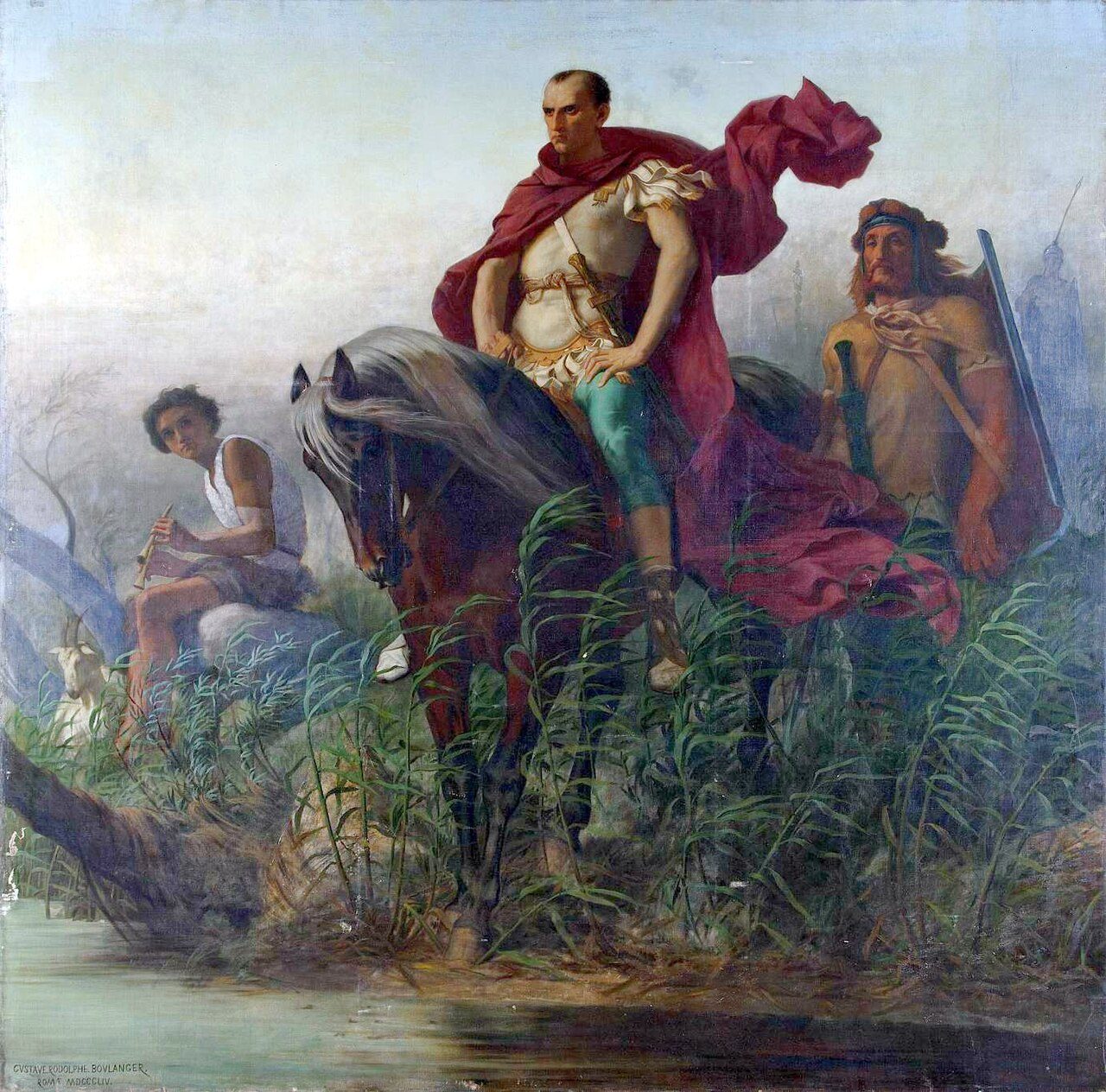
The Rubicon was not much of a river — a modest stream flowing to the Adriatic in northern Italy — but in law it was a wall. It marked the southern boundary of Cisalpine Gaul, the province Julius Caesar had governed and conquered from for a decade, and Roman law was absolute: a general who brought his army across it into Italy without the Senate's authority committed treason and made war on the state. In January 49 BC Caesar stood on its bank with a single legion, the Thirteenth, and a decision that his enemies in Rome had spent two years engineering: surrender his command, return as a private citizen, and face prosecution and ruin — or cross.
The Senate forced the moment. On 7 January it passed its 'ultimate decree', the emergency measure used against threats to the republic, and Caesar's allies the tribunes fled Rome to join him. Tradition places the crossing on the night of 10–11 January — no ancient account gives the precise date, and Caesar's own memoir of the civil war never mentions the river at all. The famous words are later embroidery: Suetonius has Caesar say, in Latin, iacta alea est, 'the die is cast'; Plutarch and Appian give the phrase in Greek and trace it to the playwright Menander. What is certain is the act. Caesar crossed, occupied Ariminum, and the Roman Republic's last civil war had begun.
It was over faster than anyone expected. Pompey the Great, the Senate's champion, judged Italy indefensible and evacuated his forces across the Adriatic, abandoning Rome itself; Caesar entered a capital emptied of its government. The war then widened to the whole Roman world — Spain, Greece, Egypt, Africa — and lasted, in its phases, for years: Pharsalus in 48 BC, where Pompey was beaten; Pompey's murder in Egypt; Caesar's dictatorship and reforms; and, in March 44 BC, his assassination by men who claimed to be saving the republic he had already destroyed. The crossing's logic proved irreversible: after Caesar, armies, not assemblies, decided who ruled Rome, and within a generation his heir Augustus had converted the republic into an empire in all but name.
That is why a small river still lends its name to every point of no return. 'Crossing the Rubicon' survives as the phrase for the step that cannot be taken back, and the date traditionally given to it — 10 January — is a fitting hinge for the day: the same date later opened the League of Nations and the United Nations General Assembly, two attempts to build a world in which disputes are settled by votes rather than by the man with the legion. Caesar's crossing is the standing warning those institutions were built against: a republic's rules hold only while its soldiers agree to stop at the river.
Why this date matters
January 10 is the calendar's day of irrevocable first steps. Caesar crossed a river and a republic fell; Paine published a pamphlet and a revolution found its argument; Londoners descended into the first underground railway and cities were never arranged the same way again; oil burst out of a Texas salt dome and the petroleum age began. Twice in the twentieth century the date was chosen to begin again from Caesar's lesson — the League of Nations in 1920 and the UN General Assembly in 1946 both opened on 10 January, attempts to make the world's Rubicon-crossings unnecessary. The day keeps posing the same question: what happens the morning after the step that cannot be undone?
Sources
- Encyclopaedia Britannica — On This Day: January 10
- HISTORY — What Happened on January 10
- HISTORY — League of Nations instituted
- National Geographic — How Julius Caesar Crossing the Rubicon Shattered the Roman Republic
The facts on this page were checked against these sources on 19 November 2026. The History Trail's permanent pages are researched and written for this site; the live profiles elsewhere on The History Trail are assembled automatically from Wikipedia and Wikidata.
About the Author
Researched and written by the The History Trail Editorial Team — the accountable editorial function behind this site's permanent story pages. The team works from the published sources cited on each page; it does not invent historians, reviewers or credentials, and it corrects errors openly.
Fact Check
Every load-bearing fact on this page traces to one of the sources listed above, and significant claims link to their source in the text. Our checking method is described on the methodology page; errors can be reported via the corrections page.
Sources & Citations
Cite this page as: The History Trail Editorial Team, The History Trail — this article's title, publication and update dates are shown beneath its headline. The full source list appears under Sources above; the site's source standards are on the sources page.