
On This Day
August 18 in History
On 18 August 1920 Tennessee's legislature voted to ratify the Nineteenth Amendment, becoming the 36th state to do so — and with that one state's decision, women across the United States won the constitutional right to vote, in time for the presidential election that November. August 18 is also the day the lost colony of Roanoke was found deserted, and the day Genghis Khan died on campaign.
Choose another date: open the On This Day calendar to browse events, births and deaths for any day of the year.
At a Glance
- The amendment
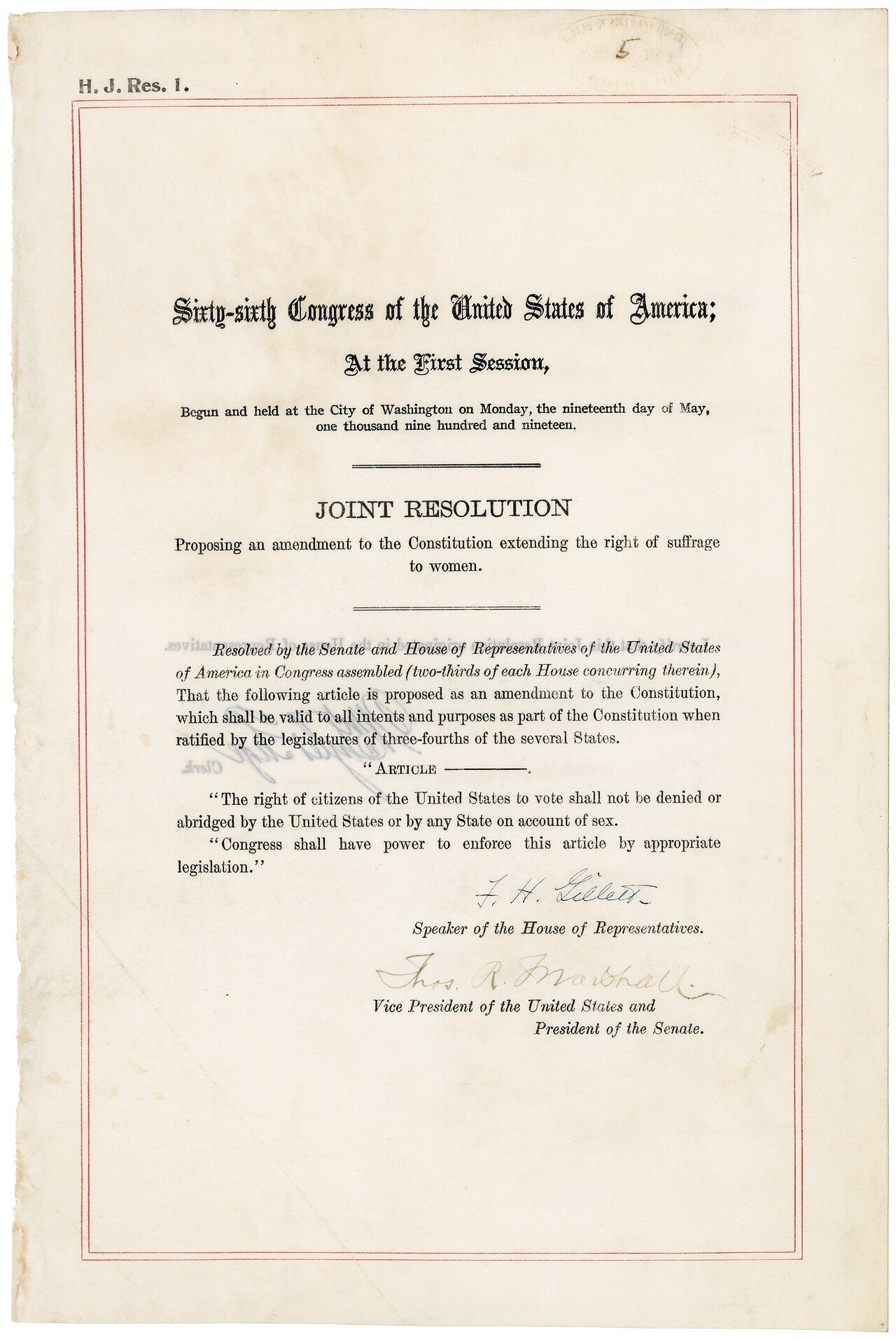
- Bars the United States and the states from denying the right to vote 'on account of sex'
- Passed by Congress
- 4 June 1919 — the House on 21 May by 304–89, then the Senate on 4 June
- The deciding state
- Tennessee, the 36th state to ratify, on 18 August 1920 — the three-fourths majority the Constitution requires
- Certified
- 26 August 1920, by Secretary of State Bainbridge Colby
- The electorate
- Some 26 million women became eligible to vote in time for the 1920 presidential election
- The turning point
- The Tennessee House vote turned on 24-year-old representative Harry Burn, who switched sides after a note from his mother
Events on this day
- 1590Governor John White returns to Roanoke Island to find the English colony deserted: more than a hundred settlers have vanished, with no sign of violence, and the word 'Croatoan' carved on a post.
- 1868Watching a total solar eclipse in India, French astronomer Pierre Janssen observes the spectral line of a new element — helium, found in the Sun before it is found on Earth.
- 1877American astronomer Asaph Hall discovers Phobos, the larger of the two moons of Mars.
- 1920Tennessee becomes the 36th state to ratify the Nineteenth Amendment, securing women's right to vote across the United States — the featured story above.
- 1940In 'the Hardest Day' of the Battle of Britain, the Luftwaffe and the RAF fight one of the largest air battles yet seen, with heavy losses on both sides.
- 1958Vladimir Nabokov's novel Lolita is published in the United States, two years after its first appearance in Paris.
- 1976North Korean soldiers kill two American officers with axes in the demilitarised zone at Panmunjom, in the 'axe murder incident' that nearly restarts the Korean War.
- 1992Larry Bird, one of basketball's defining players, announces his retirement after 13 seasons with the Boston Celtics.
- 2008Pervez Musharraf resigns as president of Pakistan, facing impeachment after nine years in power.
- 2017The wreck of the cruiser USS Indianapolis, sunk in 1945 with heavy loss of life, is found 5.5 kilometres down in the Pacific by a team funded by Paul Allen.
Born on this day
- 1587Virginia Dare — the first English child born in the Americas, at the Roanoke colony; she vanished with it.
- 1830Franz Joseph I — emperor of Austria for 68 years, one of the longest-reigning monarchs in European history.
- 1900Vijaya Lakshmi Pandit — Indian diplomat, the first woman president of the UN General Assembly.
- 1933Roman Polanski — Polish-French film director of Rosemary's Baby and The Pianist.
- 1934Roberto Clemente — Puerto Rican baseball star of the Pittsburgh Pirates, killed in a plane crash on a relief mission.
- 1936Robert Redford — American actor and director, founder of the Sundance Film Festival.
- 1952Patrick Swayze — American actor, star of Dirty Dancing and Ghost.
- 1969Christian Slater — American actor, star of Heathers and True Romance.
Died on this day
- 1227Genghis Khan — founder of the Mongol Empire, dead on campaign against the Xi Xia kingdom, his burial place kept secret to this day.
- 1850Honoré de Balzac — French novelist, author of the vast novel sequence La Comédie humaine.
- 1990B. F. Skinner — American psychologist, the leading figure of behaviourism.
- 2009Kim Dae-jung — president of South Korea and Nobel Peace Prize laureate for his 'Sunshine Policy' toward the North.
- 2018Kofi Annan — Ghanaian diplomat, secretary-general of the United Nations from 1997 to 2006, dead in Bern at 80.
The featured story: the Nineteenth Amendment is ratified, 18 August 1920
The Nineteenth Amendment is one sentence long: 'The right of citizens of the United States to vote shall not be denied or abridged by the United States or by any State on account of sex.' It had been introduced in Congress as long ago as 1878, and for four decades it went nowhere while the women's suffrage movement fought the battle state by state, winning the vote in much of the West and being beaten back in the South and East. Only after women had worked, marched and been imprisoned through the First World War years did Congress finally pass the amendment — the House on 21 May 1919 and the Senate on 4 June 1919, the House vote being 304 to 89 — and send it to the states for ratification.
Ratification needed 36 of the 48 states. Through the winter and spring the total climbed: Wisconsin and Michigan first, then state after state, until by the summer of 1920 it stood at 35, one short, with the remaining legislatures either adjourned or hostile. Tennessee, which had not been expected to settle the question, was called into special session by its governor. Both sides poured into Nashville — suffragists wearing yellow roses, opponents wearing red — and lobbied the state House of Representatives member by member, because everyone could count, and the count was tied.
On 18 August 1920 the Tennessee House voted. The deciding vote is remembered as belonging to the chamber's youngest member, 24-year-old Harry Burn, who had been counted with the opponents but carried in his pocket a letter from his mother urging him to vote for suffrage; he switched, and ratification carried. Tennessee was the 36th state, and the amendment was secured. Eight days later, on 26 August 1920, Secretary of State Bainbridge Colby certified the ratification, and the Nineteenth Amendment became part of the Constitution of the United States.
The effect was immediate and vast: some 26 million women became eligible to vote in time for the presidential election of November 1920, roughly doubling the American electorate at a stroke. The victory was incomplete — in the segregated South, poll taxes, literacy tests and intimidation still kept many Black women, like Black men, from the ballot for decades more — and the movement's own organisations soon split over what to fight for next. But 18 August 1920 is the day the United States wrote into its founding document that sex could no longer be a legal reason to refuse a citizen the vote.
Why this date matters
August 18 has an uncanny pairing at its heart: the first English child born in America, Virginia Dare in 1587, and the deserted colony her grandfather found on her third birthday in 1590 — a beginning and a vanishing on the same date. Against that stands 1920, the day the American electorate doubled by a single state's vote in Nashville. It is a date of thresholds crossed and mysteries left open, from helium glimpsed in the Sun to a lost warship found in the deep Pacific: things long sought, finally located — or never found at all.
Sources
- Encyclopaedia Britannica — On This Day: August 18
- HISTORY — This Day in History: August 18
- US House of Representatives — The 19th Amendment
- National Archives — 19th Amendment to the U.S. Constitution: Women's Right to Vote (1920)
- Encyclopaedia Britannica — Nineteenth Amendment
The facts on this page were checked against these sources on 19 November 2026. The History Trail's permanent pages are researched and written for this site; the live profiles elsewhere on The History Trail are assembled automatically from Wikipedia and Wikidata.
About the Author
Researched and written by the The History Trail Editorial Team — the accountable editorial function behind this site's permanent story pages. The team works from the published sources cited on each page; it does not invent historians, reviewers or credentials, and it corrects errors openly.
Fact Check
Every load-bearing fact on this page traces to one of the sources listed above, and significant claims link to their source in the text. Our checking method is described on the methodology page; errors can be reported via the corrections page.
Sources & Citations
Cite this page as: The History Trail Editorial Team, The History Trail — this article's title, publication and update dates are shown beneath its headline. The full source list appears under Sources above; the site's source standards are on the sources page.