
Things
Influenza
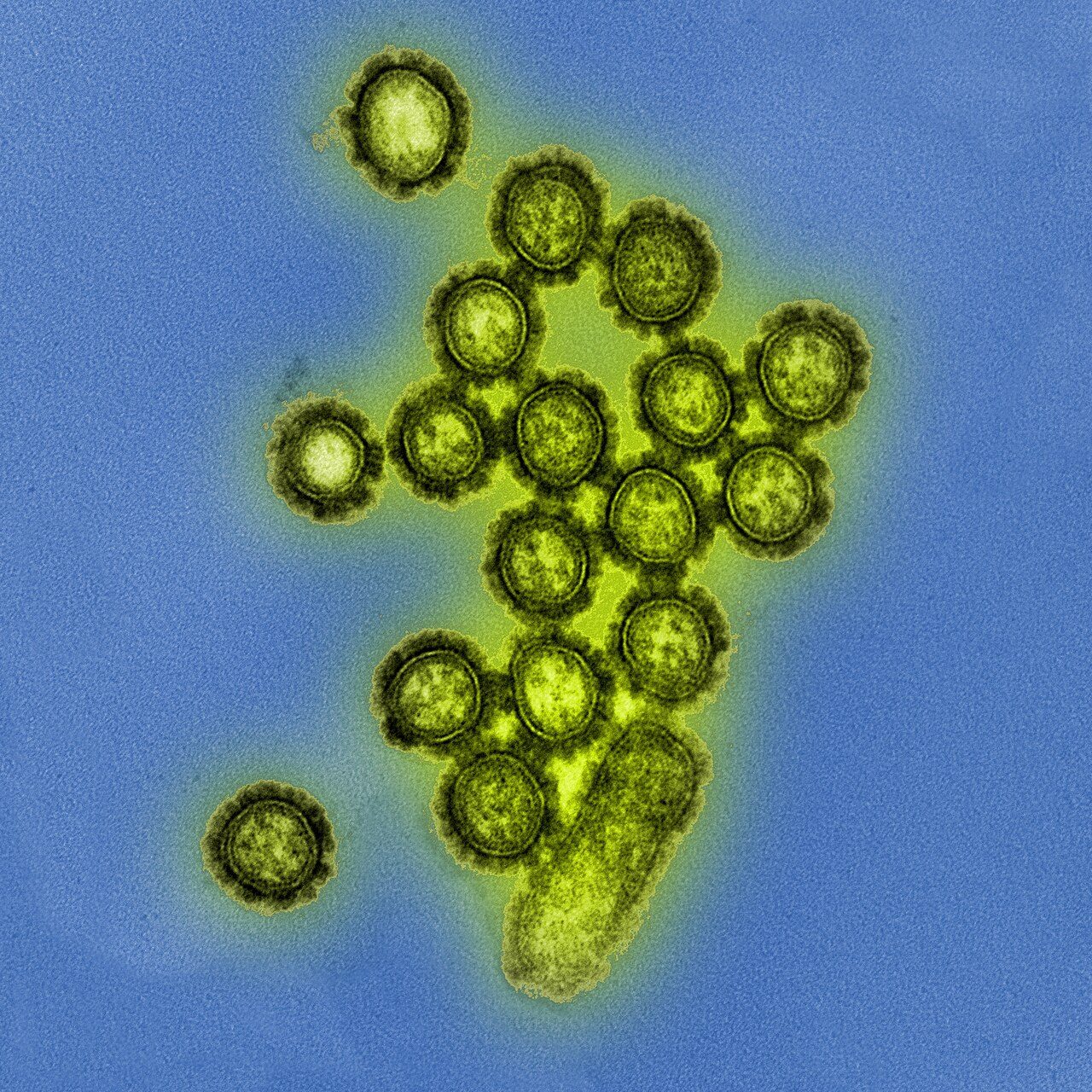
Influenza was named for a supposed influence of the stars, blamed for decades on a bacterium, and in 1918 produced the deadliest pandemic of the modern era — all before anyone had seen its virus. When the virus was finally isolated in 1933, science had twelve years to reach a vaccine, and a permanent race began.
At a Glance
- Wrong suspect
- Pfeiffer's bacillus influenzae, isolated 1892 — a bacterium, not the cause
- 1918 pandemic toll
- An estimated 500 million infected; between 20 and 50 million deaths
- Virus isolated
- Wilson Smith, C. H. Andrewes and P. P. Laidlaw, London, 1933
- Influenza B identified
- Thomas Francis, 1936; virus shown growable in hens' eggs the same era
- First vaccine licensed for civilians
- 1945, developed by Francis and Jonas Salk with US Army support
- Global surveillance system
- WHO Worldwide Influenza Centre, 1948; GISRS, 1952
- Later pandemics
- 1957–58, 1968–69 and 2009–10, after the 1918–19 pandemic
Introduction
For years influenza was thought to be a bacterial infection. In 1892 the German scientist Richard Pfeiffer isolated a small bacterium from the noses of flu patients and named it bacillus influenzae — a confident identification of the wrong organism. The error mattered in 1918, when a particularly virulent new strain of influenza A swept the world and vaccine efforts, in the United States and Europe, produced hundreds of thousands of doses aimed at a bacterium that did not cause the disease.
The 1918–19 pandemic, sometimes called the mother of all pandemics, began with a mild first wave in early 1918 and returned in a far deadlier second wave later that year. It is estimated to have infected 500 million people worldwide and killed between 20 and 50 million — more, it is thought, than died over the whole course of the First World War. Death rates were so high that life expectancy dropped by several years in country after country. Medicine faced the deadliest respiratory pandemic of the modern age without knowing what caused it.
Background
The correction came from London in 1933. At the National Institute for Medical Research, Wilson Smith, C. H. Andrewes and P. P. Laidlaw took throat washings from influenza patients, found no bacteria in them, and showed the disease could be passed to ferrets by the filtered material — influenza was caused by a virus. They isolated and identified influenza A. During the following years researchers established that a second type existed: Thomas Francis isolated influenza B in 1936, and Frank Macfarlane Burnet showed the virus could be grown in embryonated hens' eggs, the production method that still underlies most flu vaccine manufacture.
With the agent known, a vaccine became an engineering problem. Supported by the US Army, Thomas Francis and Jonas Salk at the University of Michigan developed the first inactivated flu vaccine, tested it on the military, and saw it licensed for wider use in 1945. A bivalent vaccine protecting against both influenza A and B strains had already been produced in 1942. The tools of 1918's failure — wrong target, no virus, no production system — had all been replaced within a single generation.
Timeline
- 1892
Richard Pfeiffer isolates a bacterium from flu patients and names it bacillus influenzae, misidentifying the cause for four decades.
- 1918–1919
The H1N1 pandemic infects an estimated 500 million people and kills between 20 and 50 million worldwide.
- 1933
Smith, Andrewes and Laidlaw isolate influenza A virus in London, proving flu is viral, not bacterial.
- 1936
Francis isolates influenza B virus; Burnet shows influenza virus can be grown in hens' eggs.
- 1942
A bivalent vaccine offering protection against both influenza A and influenza B viruses is produced.
- 1945
The inactivated influenza vaccine developed by Francis and Salk is licensed for civilian use.
- 1947
Circulating viruses prove different from vaccine strains, exposing the problem of viral change.
- 1948
WHO establishes the Worldwide Influenza Centre to track the viruses in circulation.
- 1952
WHO's Global Influenza Surveillance and Response System, GISRS, is established.
- 1957
A new H2N2 influenza virus emerges and triggers the second pandemic of the vaccine era.
- 2005
Scientists complete the genome sequence of the reconstructed 1918 H1N1 pandemic virus.
Significance
Influenza taught public health a new kind of permanence. The 1947 season, when existing vaccines proved ineffective against the viruses then circulating, demonstrated that this enemy changes its coat: immunity to one strain does not necessarily protect against the next. The institutional answer was surveillance without end — the WHO centre of 1948 and the global system of 1952 — and an annual cycle in which the world's laboratories monitor circulating strains and WHO recommends the composition of each hemisphere's vaccine. No earlier disease had required a standing global watch of this kind.
The pandemic record frames the stakes. At least three influenza pandemics are documented before 1918, and three more followed it, in 1957–58, 1968–69 and 2009–10. Seasonal influenza still kills up to 650,000 people a year globally, according to WHO. The 1918 catastrophe thus produced both a science — virology's first great human success — and a doctrine: that the next pandemic is a matter of when, and that preparation is a permanent duty rather than a response.
Legacy
Influenza's legacy is written into the architecture of global health: the GISRS network still coordinates the strain selection on which seasonal vaccines depend, and the egg-based production method Burnet pioneered in the 1930s still makes most of the world's flu vaccine, now joined by a live attenuated nasal spray vaccine licensed in 2003 and a recombinant vaccine approved in 2013. The reconstruction and sequencing of the 1918 virus's genome in 2005 closed a historical circle, letting science interrogate directly the pathogen that had outrun it eighty-seven years earlier.
The disease remains, in WHO's assessment, a constantly evolving threat that experience says will produce another pandemic. Influenza's history is therefore less a completed story than a standing arrangement between a mutating virus and the institutions built to watch it — the first disease for which humanity organised a permanent, planetary early-warning system.
Sources
- World Health Organization — History of influenza vaccination
- US Centers for Disease Control and Prevention — Influenza Historic Timeline
- PubMed Central — One Hundred Years of Influenza Since the 1918 Pandemic (CDC authors)
The facts on this page were checked against these sources on 19 November 2026. The History Trail's permanent pages are researched and written for this site; the live profiles elsewhere on The History Trail are assembled automatically from Wikipedia and Wikidata.
About the Author
Researched and written by the The History Trail Editorial Team — the accountable editorial function behind this site's permanent story pages. The team works from the published sources cited on each page; it does not invent historians, reviewers or credentials, and it corrects errors openly.
Fact Check
Every load-bearing fact on this page traces to one of the sources listed above, and significant claims link to their source in the text. Our checking method is described on the methodology page; errors can be reported via the corrections page.
Sources & Citations
Cite this page as: The History Trail Editorial Team, The History Trail — this article's title, publication and update dates are shown beneath its headline. The full source list appears under Sources above; the site's source standards are on the sources page.