
Things
Theory of relativity
In 1905 a patent clerk published the theory that made simultaneity relative and mass a form of energy; in 1915 he rebuilt gravity as curved space-time. Relativity is the framework modern physics, astronomy and cosmology still live inside.
At a Glance
- Author
- Albert Einstein
- Special relativity
- 1905 — uniform motion; constant speed of light; simultaneity is relative
- Mass–energy equivalence
- E = mc², published as a follow-up in 1905
- General relativity
- Completed November 1915 — gravity as curvature of space-time
- First famous test
- 1919 eclipse expeditions measure starlight bending near the Sun
- Explained anomaly
- The precession of Mercury's orbit, unexplained by Newton's theory
- Nobel note
- Einstein's 1921 Nobel Prize was for the photoelectric effect, not relativity
Introduction
Relativity is the pair of physical theories formed by Albert Einstein — special relativity in 1905 and general relativity in 1915 — which between them overthrew many assumptions of earlier physics and redefined the fundamental concepts of space, time, matter, energy and gravity. Special relativity concerns objects moving in uniform motion relative to one another; general relativity concerns gravity, and describes large-scale phenomena such as planetary dynamics, the birth and death of stars, black holes and the evolution of the universe.
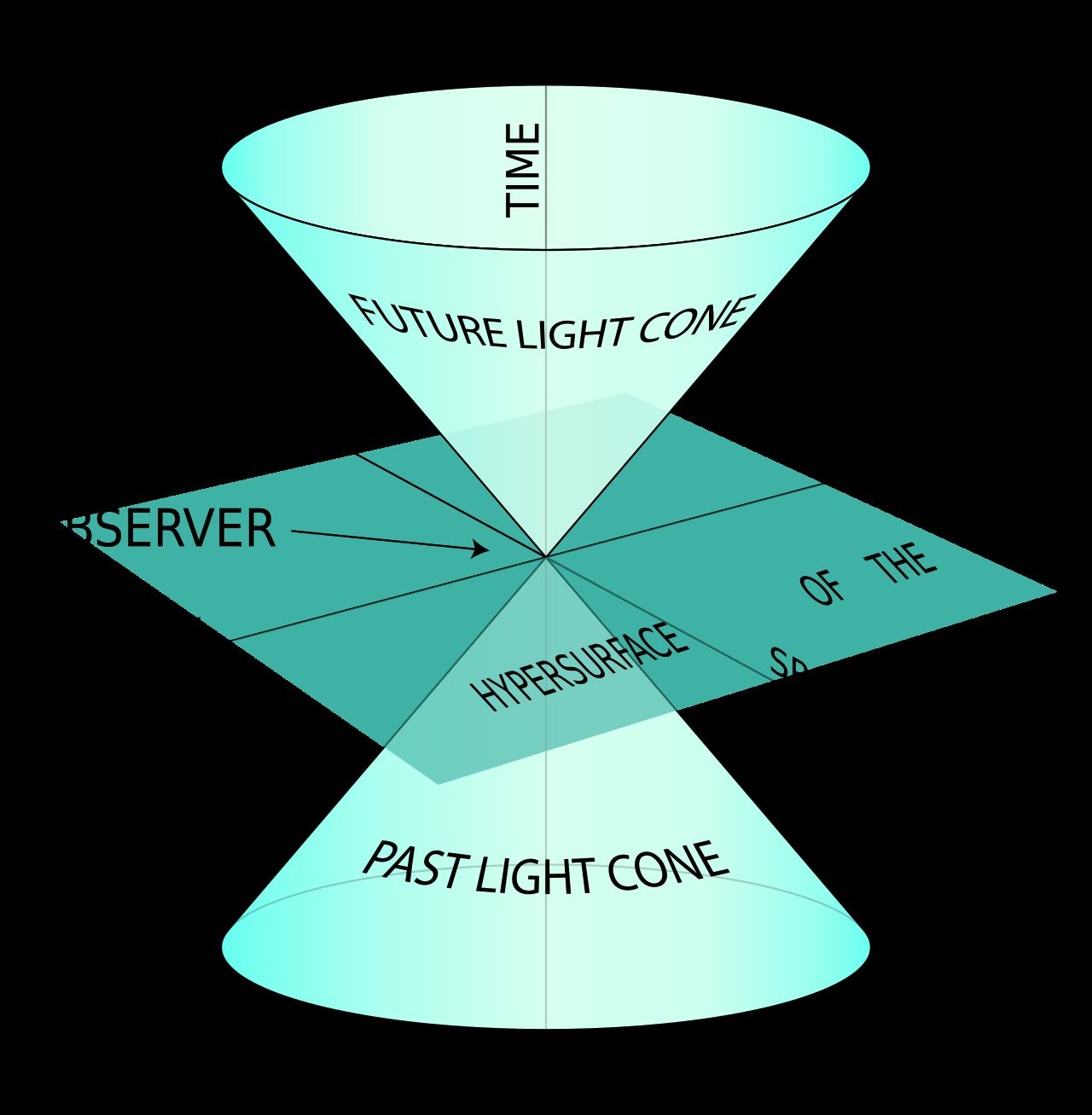
The core shock is that space and time are not a fixed stage. In special relativity, built on the constancy of the speed of light and the sameness of physical laws for all observers in uniform motion, whether two distant events happen 'at the same time' depends on the observer — simultaneity itself is relative. In general relativity, mass and energy curve space-time, and gravity is that curvature: bodies do not get pulled across space, they follow the straightest paths available through a bent geometry.
Background
The mechanical universe relativity replaced began with Galileo, who moved beyond Aristotle to a quantitative study of bodies moving in space and time, and culminated in Newton, whose laws of motion framed physics for two centuries. Newton defined space and time as absolutes, unaffected by anything external, and his law of gravity — perhaps prompted by a falling apple, then tested against the orbiting Moon — explained falling bodies and planetary motion in one system. Its success was total, and its assumptions went unquestioned because nothing in everyday experience contradicted them.
The cracks were in the extremes: light, electricity and very precise astronomy. Einstein, a patent clerk in Bern, approached them with thought experiments — imagining, for instance, a man falling freely who would not feel his own weight, an insight he later called the happiest thought of his life and the seed of general relativity. If a freely falling person feels no gravity, then gravity and acceleration must be locally indistinguishable: the principle of equivalence, on which the general theory rests.
Timeline
- 1905
Einstein publishes special relativity: the laws of physics are the same for all observers in uniform motion, and the speed of light is constant — so simultaneity, lengths and clock rates are relative.
- 1905
A short follow-up paper draws out mass–energy equivalence, expressed in the equation E = mc².
- 1907
Einstein's equivalence insight: a person in free fall feels no weight, so gravity and acceleration are locally indistinguishable — the starting point of general relativity.
- 1908
Hermann Minkowski reformulates special relativity as a single four-dimensional continuum, space-time.
- November 1915
Einstein completes general relativity: gravity is the curvature of space-time by mass and energy. The theory accounts for the anomalous precession of Mercury's orbit, which Newton's law could not explain.
- 1919
British eclipse expeditions, one led by Arthur Eddington to Príncipe and another to Sobral in Brazil, measure starlight bending near the Sun by about the amount Einstein predicted; the announcement makes him world-famous.
- 1921
Einstein receives the Nobel Prize in Physics — pointedly, for his explanation of the photoelectric effect, not for relativity.
- 1993
A Nobel Prize is awarded for work on gravitational waves, an effect predicted by Einstein's theory — one of several prizes his work has won for later physicists.
Significance
Special relativity changed kinematics into geometry: moving clocks run slow, moving objects contract along their motion, and no signal outruns light. Mass–energy equivalence, its most famous corollary, recast matter as frozen energy and eventually underwrote both nuclear physics and the understanding of how stars shine. None of this was ornament — the theory has been confirmed wherever it can be tested, and high-energy physics is built inside its frame.
General relativity did for gravity what special relativity did for motion. It explained Mercury's perihelion, a discrepancy Newtonian theory had carried unexplained for decades, and predicted light-bending, black holes, the expansion of the universe and gravitational waves. Satellites continue to verify Einstein's cosmology, black holes are now counted in the thousands, and generations of physicists still work at completing his dream of a unified theory of everything.
Legacy
Relativity's legacy is a universe stranger and more unified than the one it replaced: time that runs at different rates in different places, space that bends, mass that is energy, and a cosmos with a history that physics can narrate. It also set a standard for what a theory should do — deduce surprising, testable predictions from a few principles and survive every measurement thrown at it for over a century.
Its unfinished business is equally famous. General relativity and quantum theory, the two pillars of modern physics, still do not fit together, and Einstein spent his later decades hunting a unified field theory that eluded him — in some respects, as Britannica suggests, he may have been too far ahead of his time, since the strong force at the heart of any such theory remained a total mystery in his lifetime. The search he started is now other people's life work.
Sources
- Encyclopaedia Britannica — Relativity (Albert Einstein)
- Encyclopaedia Britannica — Gravity
- Wikipedia — Theory of relativity
The facts on this page were checked against these sources on 19 November 2026. The History Trail's permanent pages are researched and written for this site; the live profiles elsewhere on The History Trail are assembled automatically from Wikipedia and Wikidata.
About the Author
Researched and written by the The History Trail Editorial Team — the accountable editorial function behind this site's permanent story pages. The team works from the published sources cited on each page; it does not invent historians, reviewers or credentials, and it corrects errors openly.
Fact Check
Every load-bearing fact on this page traces to one of the sources listed above, and significant claims link to their source in the text. Our checking method is described on the methodology page; errors can be reported via the corrections page.
Sources & Citations
Cite this page as: The History Trail Editorial Team, The History Trail — this article's title, publication and update dates are shown beneath its headline. The full source list appears under Sources above; the site's source standards are on the sources page.