
On This Day
October 28 in History
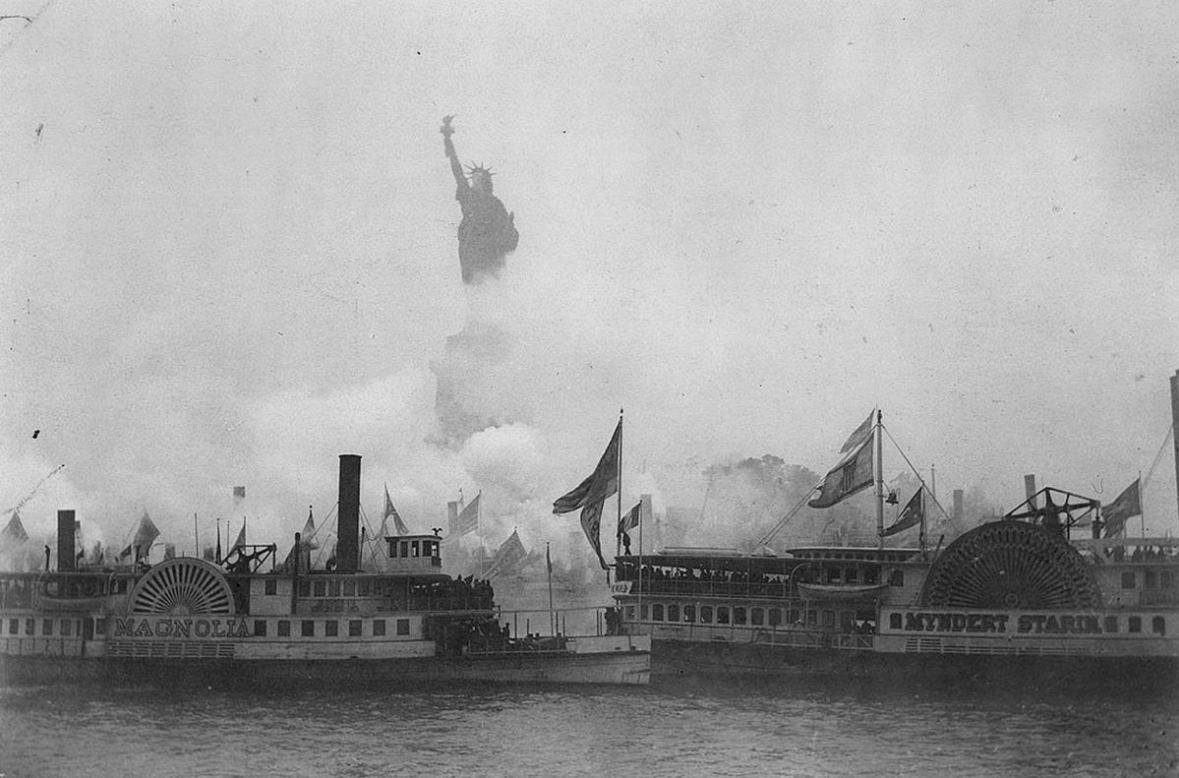
On 28 October 1886 the Statue of Liberty was dedicated in New York Harbor — France's gift to the United States, unveiled by President Grover Cleveland as the harbour erupted in celebration. October 28 is also the day the Cuban Missile Crisis ended, Mussolini took power in Italy, and Bill Gates and Julia Roberts were born.
Choose another date: open the On This Day calendar to browse events, births and deaths for any day of the year.
At a Glance
- The gift
- Conceived in 1865 and given by the people of France; the United States built the pedestal on Bedloe's Island, now Liberty Island
- The makers
- Designed by Frédéric Auguste Bartholdi, with an iron framework engineered with Gustave Eiffel's help
- The journey
- Built in Paris, dismantled into some 350 pieces and shipped to New York in more than 200 crates
- The pedestal
- Paid for largely by small public donations after Joseph Pulitzer's newspaper campaign
- The dedication
- 28 October 1886, by President Grover Cleveland, in New York Harbor
Events on this day
- 1886The Statue of Liberty, a gift from the people of France, is dedicated in New York Harbor by President Grover Cleveland — the featured story above.
- 1886Office workers shower the statue's dedication parade with ticker tape, inventing New York's ticker-tape parade tradition.
- 1919The Volstead Act becomes law as Congress completes its override of President Wilson's veto, setting up the enforcement of Prohibition.
- 1922Benito Mussolini takes control of the government of Italy in the March on Rome, beginning more than two decades of Fascist rule.
- 1936President Franklin D. Roosevelt rededicates the Statue of Liberty on its fiftieth anniversary.
- 1940Greece rejects Italy's ultimatum and Italy invades through Albania, opening the Greco-Italian War.
- 1962The Cuban Missile Crisis ends as Nikita Khrushchev announces that the Soviet missiles in Cuba will be withdrawn.
- 2022Elon Musk completes his $44 billion takeover of Twitter, taking control of the social media platform.
Born on this day
- 1897Edith Head — American costume designer, born in San Bernardino, California, winner of eight Academy Awards.
- 1914Jonas Salk — American medical researcher, born in New York, developer of the first successful polio vaccine.
- 1937Ted Hoff — American engineer, co-inventor of the microprocessor.
- 1955Bill Gates — American software pioneer, born in Seattle, co-founder of Microsoft.
- 1955Indra Nooyi — Indian-born American businesswoman, longtime chief executive of PepsiCo.
- 1967Julia Roberts — American actress, star of Pretty Woman and Erin Brockovich.
Died on this day
- 1704John Locke — English philosopher of liberty, property and government by consent, whose ideas shaped the American founding.
- 1996Morey Amsterdam — American comedian, Buddy Sorrell on The Dick Van Dyke Show, dead in Los Angeles at 81.
- 1998Ted Hughes — English Poet Laureate, husband of Sylvia Plath.
The featured story: the Statue of Liberty is dedicated, 28 October 1886
On 28 October 1886, in a cold rain over New York Harbor, President Grover Cleveland dedicated the Statue of Liberty — a gift from the people of France to the people of the United States, and already, on its first day, the most famous statue in the world. The idea had been conceived in 1865, at a dinner in France where the historian Édouard de Laboulaye proposed that France mark American independence and the recent abolition of slavery with a monument built by the two republics together: France would give the statue, America the pedestal. The sculptor Frédéric Auguste Bartholdi designed a colossal robed woman holding a torch aloft, and built her in Paris, a skin of hammered copper over an iron skeleton engineered with the help of Gustave Eiffel.
The statue was completed in France, shown to Parisians towering over the rooftops, then taken apart into some 350 pieces, packed in more than two hundred crates and shipped across the Atlantic. The American half of the bargain nearly failed: fundraising for the pedestal on Bedloe's Island in New York Harbor lagged until the newspaper publisher Joseph Pulitzer shamed and cajoled small donations out of the public — more than a hundred thousand people, many giving less than a dollar, finally paid for Liberty's base. Reassembly took months. When Cleveland pulled the cord that October afternoon, the French flag veiling Liberty's face fell away, harbour whistles screamed, guns fired — and the ceremony's speeches were largely drowned out by the noise of the celebrating fleet.
What the statue meant shifted with the century. Conceived as a monument to republican liberty and Franco-American friendship, it stood at the gate through which millions of immigrants reached America — Ellis Island, the federal immigration station, opened a few hundred yards away in 1892 — and Emma Lazarus's sonnet, 'The New Colossus', with its 'huddled masses yearning to breathe free', gave it a second identity as the Mother of Exiles. The island itself was renamed Liberty Island in 1956. Fifty years to the day after the dedication, on 28 October 1936, President Franklin D. Roosevelt rededicated the statue before a crowd that included descendants of its makers.
Liberty has been restored, re-lit, closed and reopened — after the attacks of 2001 her crown stayed shut for eight years — but her position in the world's imagination has never moved. She is the rare monument that belongs less to the country that owns her than to everyone who has ever sailed toward her. On the day she was unveiled, in the rain, with the speeches inaudible and the harbour in uproar, that future was already visible: a statue paid for by schoolchildren's pennies on two continents, facing out to sea, welcoming whoever came next.
Why this date matters
October 28 is a day of gifts and seizures. France's gift to America was unveiled on it in 1886 and lovingly rededicated on it fifty years later; but the date also records power taken rather than given — Mussolini's march into office in 1922, and a billionaire's purchase of a global town square exactly a century later. Between those poles sits the day's quieter verdict on brinkmanship: in 1962 the Cuban Missile Crisis ended on 28 October, the superpowers stepping back from the edge. Liberty dedicated, liberty menaced, and catastrophe declined — the whole argument of the twentieth century, compressed into one square of the calendar.
Sources
- Encyclopaedia Britannica — On This Day: October 28
- HISTORY — What Happened on October 28
- Gilder Lehrman Institute — On This Day: The Statue of Liberty Is Dedicated, 1886
- Computer History Museum — This Day in History: October 28
- Wikimedia — On This Day feed: October 28
The facts on this page were checked against these sources on 19 November 2026. The History Trail's permanent pages are researched and written for this site; the live profiles elsewhere on The History Trail are assembled automatically from Wikipedia and Wikidata.
About the Author
Researched and written by the The History Trail Editorial Team — the accountable editorial function behind this site's permanent story pages. The team works from the published sources cited on each page; it does not invent historians, reviewers or credentials, and it corrects errors openly.
Fact Check
Every load-bearing fact on this page traces to one of the sources listed above, and significant claims link to their source in the text. Our checking method is described on the methodology page; errors can be reported via the corrections page.
Sources & Citations
Cite this page as: The History Trail Editorial Team, The History Trail — this article's title, publication and update dates are shown beneath its headline. The full source list appears under Sources above; the site's source standards are on the sources page.