
On This Day
May 8 in History
On 8 May 1945, after nearly six years of war, Germany's unconditional surrender took effect and the Second World War in Europe was over. London, Paris, New York and a hundred other cities poured into the streets for Victory in Europe Day. May 8 is also the day Joan of Arc lifted the siege of Orleans in 1429, Coca-Cola was first served in 1886, and Harry Truman was born in 1884.
Choose another date: open the On This Day calendar to browse events, births and deaths for any day of the year.
At a Glance
- The surrender
- Germany's armed forces surrendered unconditionally; the definitive act was signed in Berlin-Karlshorst late on 8 May
- The first signing
- A first instrument had been signed at Reims at 2:41 a.m. on 7 May, effective at 11:01 p.m. on 8 May
- The succession
- Hitler killed himself on 30 April; his successor, Grand Admiral Karl Donitz, authorised the surrender
- The announcement
- Churchill and King George VI addressed Britain; Truman announced the victory in Washington on his 61st birthday
- The other date
- In Moscow it was already 9 May when the ceasefire took effect, which is why Russia marks Victory Day on 9 May
- The unfinished war
- The war against Japan continued for three more months, until August–September 1945
Events on this day
- 1429Joan of Arc lifts the siege of Orleans, turning the Hundred Years' War and beginning her legend.
- 1794Antoine Lavoisier, founder of modern chemistry, is guillotined in Paris during the Terror.
- 1886Coca-Cola is served for the first time, at Jacobs' Pharmacy in Atlanta, Georgia.
- 1902Mount Pelee erupts on Martinique, destroying Saint-Pierre and killing some 30,000 people in minutes.
- 1933Mahatma Gandhi begins a 21-day fast in protest at the treatment of India's untouchables.
- 1945Victory in Europe Day: Germany's surrender takes effect — the featured story above.
- 1967Muhammad Ali is indicted for refusing induction into the U.S. Army during the Vietnam War.
- 1970The Beatles release Let It Be, their final studio album, as the band breaks apart.
- 1978Reinhold Messner and Peter Habeler reach the summit of Everest without supplementary oxygen, a first.
- 1980The World Health Organization declares smallpox eradicated — the first disease wiped out by human effort.
- 1984The Soviet Union announces it will boycott the Los Angeles Olympic Games.
- 2018The United States withdraws from the Iran nuclear agreement, restoring sanctions.
Born on this day
- 1828Henri Dunant — Swiss founder of the Red Cross and co-winner of the first Nobel Peace Prize.
- 1884Harry S. Truman — 33rd president of the United States, who led it through the war's end in 1945.
- 1899Friedrich Hayek — Austrian-British economist of The Road to Serfdom and a Nobel laureate.
- 1926David Attenborough — English broadcaster and naturalist, the voice of a century of nature film.
- 1937Thomas Pynchon — American novelist of Gravity's Rainbow, famously reclusive.
- 1940Peter Benchley — American author of Jaws, who later became a shark conservationist.
- 1975Enrique Iglesias — Spanish singer who became one of the best-selling Latin artists in history.
Died on this day
- 1794Antoine Lavoisier — French chemist, father of modern chemistry, guillotined at 50.
- 1880Gustave Flaubert — French novelist, author of Madame Bovary, dead at Croisset at 58.
- 1903Paul Gauguin — French post-impressionist painter, dead in the Marquesas at 54.
- 1936Oswald Spengler — German historian whose Decline of the West foresaw civilisational cycles, dead at 55.
- 1988Robert A. Heinlein — American science-fiction writer, author of Stranger in a Strange Land, dead at 80.
- 1999Dana Plato — American actress of Diff'rent Strokes, dead at 34.
The featured story: Victory in Europe Day, 8 May 1945
By the first week of May 1945 the Third Reich had shrunk to a corridor of ruins. Hitler killed himself in his Berlin bunker on 30 April as Soviet troops fought street by street above him; his designated successor, Grand Admiral Karl Donitz, inherited a state that no longer existed outside a few pockets, and a single task: to end the war while surrendering as many soldiers as possible to the Western Allies rather than the Red Army. German forces in Italy had already surrendered; those in the northwest surrendered to Montgomery on Luneburg Heath on 4 May. What remained was the formal, total act.
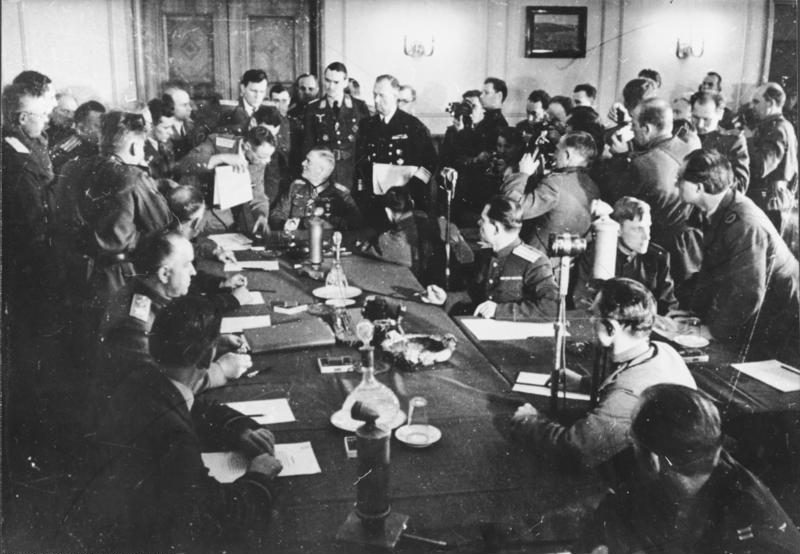
It took two signings. At 2:41 a.m. on 7 May, in a schoolroom headquarters at Reims, General Alfred Jodl signed an unconditional surrender of all German forces, to take effect at 11:01 p.m. on 8 May. The Soviet Union, whose representative at Reims lacked authority and which had borne the war's heaviest fighting, insisted on a second, definitive ceremony in Berlin itself. So late on 8 May, in a Wehrmacht officers' mess at Karlshorst, Field Marshal Wilhelm Keitel signed again before Marshal Zhukov and Air Chief Marshal Tedder, with American and French witnesses. By Central European time the ceasefire hour had nearly arrived; in Moscow it was already 9 May — which is why the victory has two birthdays.
The news, embargoed until the afternoon of 8 May in the West, released a joy that photographs have never exhausted. In London, crowds filled Whitehall and the Mall; Churchill, broadcasting at 3 p.m., told the nation that the German war was over, and appeared on the balcony of the Ministry of Health to roars, telling the crowd: this is your victory. The royal family made eight appearances on the Buckingham Palace balcony, and that night the two princesses, Elizabeth and Margaret, were allowed out — anonymously, in uniform — to join the crowds in the streets. Paris, New York, Toronto, Sydney and a liberated continent celebrated in the same hours, often in the same streets where the war had begun.
Everyone understood that it was an ending with an asterisk. Churchill's broadcast warned that Japan, 'with all her treachery and greed,' remained unbeaten; rationing, demobilisation and the ruins of Europe lay ahead, and in the Pacific the war ran on to August. The peace that followed in Europe was also a partition: the armies that met on the Elbe stayed where they stood, and the continent divided for forty-five years. But none of that cancels what 8 May was to those who lived it — the first day in nearly six years on which no European had to expect the bombers. V-E Day is kept still, on 8 May in the West and 9 May in the East, two dates for one deliverance.
Why this date matters
No date in the calendar carries a larger single announcement than 8 May 1945, and the day seems to know its own weight: it is also the date smallpox was declared eradicated in 1980, the other great deliverance of the century, announced without crowds because it arrived by committee. Around the centrepiece the day gathers its usual range — a saint relieving a siege in 1429, a chemist losing his head in 1794, a volcano erasing a city in 1902, two mountaineers breathing thin air on Everest in 1978. Deliverance and disaster share the date, as they shared the century.
Sources
- Encyclopaedia Britannica — On This Day: May 8
- HISTORY — What Happened on May 8
- Encyclopaedia Britannica — V-E Day
- Wikipedia — May 8
The facts on this page were checked against these sources on 19 November 2026. The History Trail's permanent pages are researched and written for this site; the live profiles elsewhere on The History Trail are assembled automatically from Wikipedia and Wikidata.
About the Author
Researched and written by the The History Trail Editorial Team — the accountable editorial function behind this site's permanent story pages. The team works from the published sources cited on each page; it does not invent historians, reviewers or credentials, and it corrects errors openly.
Fact Check
Every load-bearing fact on this page traces to one of the sources listed above, and significant claims link to their source in the text. Our checking method is described on the methodology page; errors can be reported via the corrections page.
Sources & Citations
Cite this page as: The History Trail Editorial Team, The History Trail — this article's title, publication and update dates are shown beneath its headline. The full source list appears under Sources above; the site's source standards are on the sources page.