
On This Day
May 4 in History
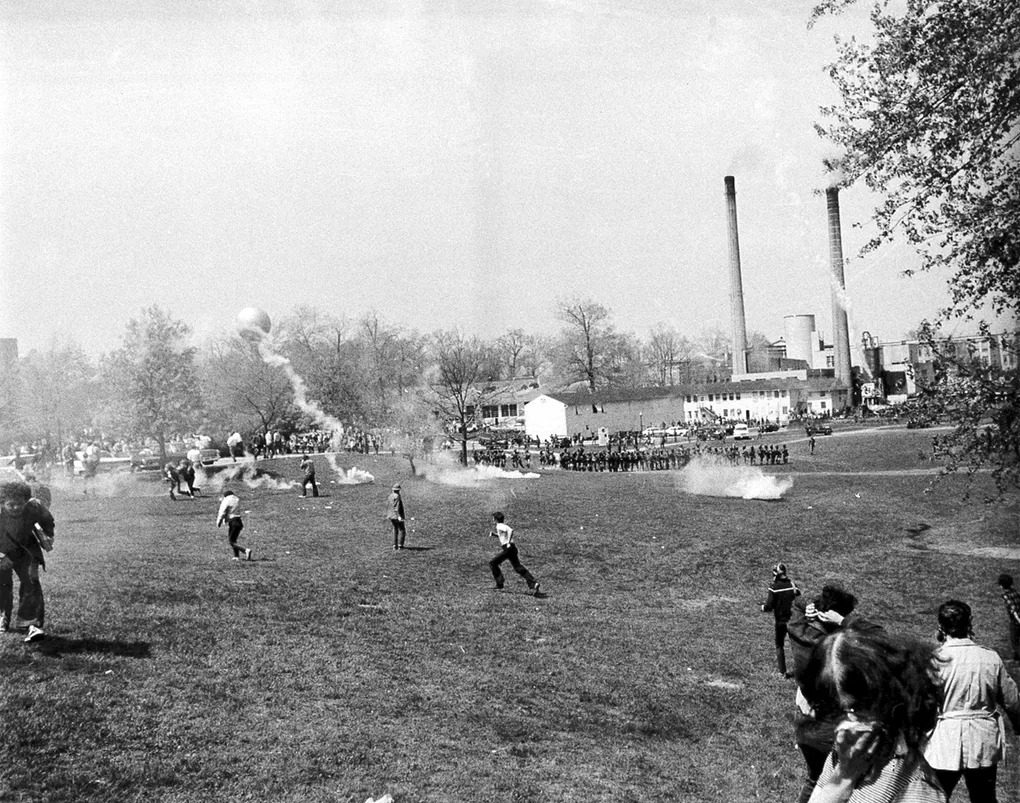
Just after noon on 4 May 1970, Ohio National Guardsmen opened fire on students at Kent State University who were protesting the expansion of the Vietnam War into Cambodia. In thirteen seconds, four students were killed and nine wounded — the moment the war's divisions came home to an American campus. May 4 is also the day of the Haymarket bombing in Chicago in 1886, the completion of the Kuthodaw Pagoda's great stone book in 1868, and Audrey Hepburn's birthday in 1929.
Choose another date: open the On This Day calendar to browse events, births and deaths for any day of the year.
At a Glance
- The setting
- Kent State University, Ohio, after four days of protest against President Nixon's announcement that U.S. troops had entered Cambodia
- The Guard
- About 1,000 Ohio National Guardsmen were in Kent after the campus ROTC building was burned on 2 May
- The volley
- At about 12:24 p.m., 28 guardsmen fired some 67 rounds in about 13 seconds
- The dead
- Jeffrey Miller, Allison Krause, William Schroeder and Sandra Scheuer — two of them were walking to class, not protesting
- The wounded
- Nine students, among them Dean Kahler, who was paralysed for life
- The verdict of history
- The President's Commission on Campus Unrest concluded the shootings were unjustified; eight guardsmen were tried and acquitted
Events on this day
- 1868The Kuthodaw Pagoda in Mandalay is completed, housing the world's largest book: 729 marble tablets inscribed with Buddhist scripture.
- 1886A bomb is thrown at police in Chicago's Haymarket Square during a labour rally; as many as 15 people die, including seven police officers.
- 1919Students in Beijing march in the May Fourth Movement, protesting the Versailles settlement's transfer of German rights in Shandong to Japan.
- 1942The Battle of the Coral Sea begins, the first naval battle fought entirely by carrier aircraft that never sighted each other.
- 1945German forces in the Netherlands, Denmark and northwest Germany surrender to Field Marshal Montgomery at Luneburg Heath.
- 1959The first Grammy Awards are presented in Los Angeles; Ella Fitzgerald is among the inaugural winners.
- 1961The first Freedom Ride leaves Washington, D.C., as integrated groups of activists set out to test desegregation on southern buses.
- 1970Ohio National Guardsmen kill four students at Kent State University — the featured story above.
- 1979Margaret Thatcher takes office as prime minister, the day after her election victory.
- 2000Ken Livingstone is elected the first mayor of London, defeating the official Labour candidate as an independent.
Born on this day
- 1655Bartolomeo Cristofori — Italian maker of musical instruments who invented the piano.
- 1825Thomas Henry Huxley — English biologist known as Darwin's Bulldog for his defence of evolution.
- 1929Audrey Hepburn — Belgian-born actress, star of Roman Holiday and Breakfast at Tiffany's, and later a UNICEF ambassador.
- 1959Randy Travis — American country singer whose traditional style revived the genre in the 1980s.
- 1972Mike Dirnt — American bassist and co-founder of the punk band Green Day.
- 1979Lance Bass — American singer of the boy band NSYNC and later a producer.
Died on this day
- 1938Carl von Ossietzky — German pacifist journalist and Nobel Peace laureate, dead after years in Nazi custody, at 48.
- 1955Louis Bromfield — American novelist and conservationist, dead at 58.
- 1971Seamus Ennis — Irish piper and folk-song collector central to the folk revival, dead at 52.
- 1980Josip Broz Tito — Yugoslav leader who held his federation together for 35 years, dead in Ljubljana at 87.
- 1984Diana Dors — English actress, the post-war pin-up who became a character performer, dead at 52.
- 2012Adam Yauch — American musician, the Beastie Boys' MCA, dead of cancer at 47.
The featured story: the Kent State shootings, 4 May 1970
The road to Blanket Hill began in Washington. On 30 April 1970 President Richard Nixon announced that American and South Vietnamese troops had entered Cambodia, widening a war he had been elected to wind down. Campuses erupted. At Kent State in Ohio, a rally on 1 May was followed by disorder in the town that night; on 2 May the campus ROTC building was set alight and burned while firefighters were hindered by onlookers. The mayor declared an emergency, and the governor, James Rhodes — campaigning in a Senate primary and promising toughness — sent in the Ohio National Guard. By Sunday night about a thousand armed guardsmen occupied the campus, and a rally planned for Monday noon was banned.
On Monday 4 May, classes resumed and several hundred students gathered on the Commons anyway, some protesting, many simply watching or passing between lectures. Guardsmen ordered the crowd to disperse, fired tear gas, and advanced up Blanket Hill in a line, pushing students toward a practice football field and a parking lot. Having reached the field and turned back, at about 12:24 p.m., near the top of the hill, 28 guardsmen turned and fired. The volley lasted some thirteen seconds and loosed about 67 rounds. When it stopped, four students lay dead or dying and nine were wounded, one of them paralysed for life.
The dead were Jeffrey Miller, 20; Allison Krause, 19; William Schroeder, 19; and Sandra Scheuer, 20. Schroeder, an ROTC cadet, and Scheuer were not protesters at all — they were walking to class across the line of fire. The nearest victim was nearly a hundred yards from the rifles. Student photographer John Filo's picture of Mary Ann Vecchio kneeling, screaming, over Miller's body ran on front pages worldwide and won a Pulitzer Prize; within days, Crosby, Stills, Nash and Young had recorded 'Ohio'. A national student strike closed hundreds of campuses, and ten days later police killed two students at Jackson State in Mississippi, in a shooting that received a fraction of the attention.
No guardsman was ever convicted. Eight were indicted on federal civil-rights charges and acquitted in 1974, the judge ruling the evidence could not prove intent; a civil settlement in 1979 brought $675,000 and a signed statement of regret from the defendants. The President's Commission on Campus Unrest had already given the durable verdict in 1970: the shootings were unjustified. The site is now a National Historic Landmark, visited each May by the survivors and the families — a green Ohio hill that remains the sharpest American image of a government turning its guns on its own young.
Why this date matters
May 4 is the calendar's day of the crowd and the state. Students filled Tiananmen's approaches in 1919 and founded a movement that remade China; workers filled Haymarket Square in 1886 and met a bomb; students filled the Kent Commons in 1970 and met rifles. Against that pattern the day sets quieter monuments: a book carved in marble at Mandalay in 1868, meant to outlast empires, and the first Freedom Ride of 1961, when a small, disciplined crowd boarded buses and changed a country without firing a shot. The date asks, repeatedly, what happens when people gather — and who decides the answer.
Sources
- Encyclopaedia Britannica — On This Day: May 4
- HISTORY — What Happened on May 4
- Ohio History Connection — The Kent State University Shooting, 50 Years Later
- Wikipedia — May 4
The facts on this page were checked against these sources on 19 November 2026. The History Trail's permanent pages are researched and written for this site; the live profiles elsewhere on The History Trail are assembled automatically from Wikipedia and Wikidata.
About the Author
Researched and written by the The History Trail Editorial Team — the accountable editorial function behind this site's permanent story pages. The team works from the published sources cited on each page; it does not invent historians, reviewers or credentials, and it corrects errors openly.
Fact Check
Every load-bearing fact on this page traces to one of the sources listed above, and significant claims link to their source in the text. Our checking method is described on the methodology page; errors can be reported via the corrections page.
Sources & Citations
Cite this page as: The History Trail Editorial Team, The History Trail — this article's title, publication and update dates are shown beneath its headline. The full source list appears under Sources above; the site's source standards are on the sources page.