
On This Day
January 8 in History
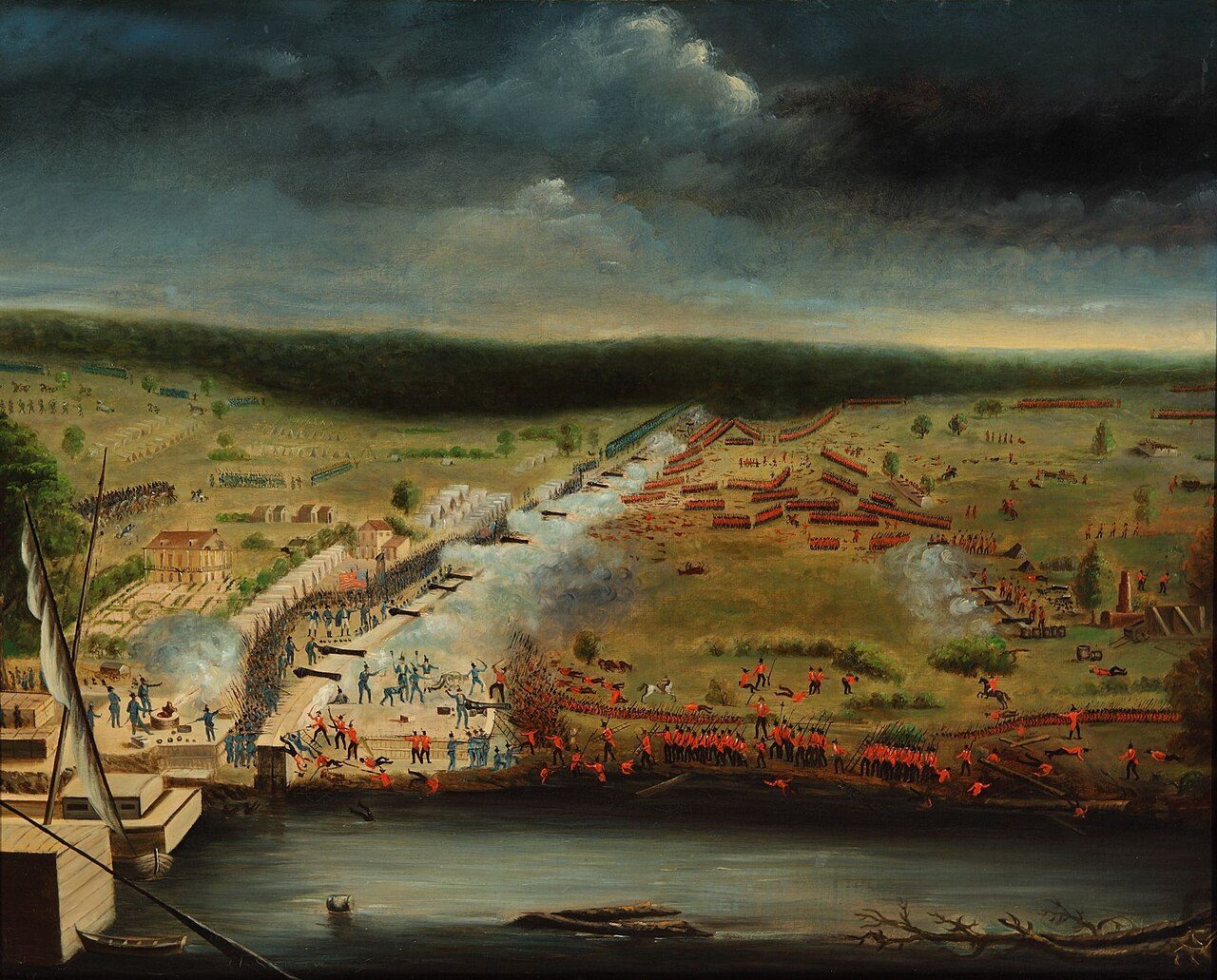
On 8 January 1815 a small, improvised American army under Andrew Jackson annihilated the main British assault below New Orleans, in the most lopsided American victory of the War of 1812 — fought a fortnight after the peace treaty had been signed in Ghent. January 8 is also the day Woodrow Wilson announced his Fourteen Points and Britain introduced wartime food rationing.
Choose another date: open the On This Day calendar to browse events, births and deaths for any day of the year.
At a Glance
- The battle
- On 8 January 1815 Jackson's forces, dug in behind a canal and earthworks at Chalmette below New Orleans, repelled the main British assault in about half an hour
- The imbalance
- The Library of Congress records Jackson leading 'a small, poorly equipped army' against some 8,000 British troops; British losses are usually given at more than 2,000 killed, wounded and captured, against roughly 100 Americans
- The peace already signed
- The Treaty of Ghent, ending the War of 1812, had been signed on 24 December 1814, but the news had not reached the armies; the treaty was not ratified in Washington until February 1815
- The British commander
- Major General Sir Edward Pakenham, Wellington's brother-in-law, was killed in the assault, along with most of his senior officers
- The consequence
- The victory made Jackson a national hero and propelled him to the presidency in 1828; 'The Eighth of January' was celebrated for decades, and a fiddle tune of that name became an American standard
Events on this day
- 871Alfred the Great's West Saxons defeat a Danish army at the Battle of Ashdown in Berkshire.
- 1790George Washington delivers the first State of the Union address, to Congress in New York City.
- 1815Jackson defeats the British at the Battle of New Orleans — the featured story above.
- 1835The United States national debt stands at zero — the only time in the nation's history it has been entirely paid off.
- 1867Congress grants African American men the vote in the District of Columbia, overriding President Andrew Johnson's veto.
- 1912The South African Native National Congress, later the African National Congress, is founded in Bloemfontein.
- 1918President Woodrow Wilson announces the Fourteen Points, his programme for peace, to the United States Congress.
- 1940Britain introduces wartime food rationing, beginning with bacon, butter and sugar.
- 1964President Lyndon B. Johnson declares an 'unconditional war on poverty' in his State of the Union address.
- 1989A Boeing 737 crashes on the M1 motorway at Kegworth, Leicestershire, killing 47 people.
- 2011A gunman shoots Representative Gabrielle Giffords and eighteen others in Tucson, Arizona; six people are killed.
Born on this day
- 1823Alfred Russel Wallace — British naturalist who arrived at the theory of evolution by natural selection independently of Darwin.
- 1824Wilkie Collins — English novelist of The Woman in White and The Moonstone, pioneers of the detective novel.
- 1935Elvis Presley — American singer whose fusion of country, blues and rhythm and blues made him the defining star of rock and roll.
- 1937Shirley Bassey — Welsh singer famed for her James Bond title songs.
- 1942Stephen Hawking — English physicist who explained black holes to science and, in A Brief History of Time, to everyone else.
- 1947David Bowie — English singer and actor who reinvented himself, and popular music, across five decades.
Died on this day
- 1324Marco Polo — Venetian merchant whose account of his travels introduced Europe to the wealth of Asia.
- 1642Galileo Galilei — Italian astronomer, dead at Arcetri under house arrest for his defence of the Copernican system.
- 1825Eli Whitney — American inventor of the cotton gin, which entrenched slavery even as it enriched the South.
- 1941Robert Baden-Powell — British general who founded the Boy Scouts and Girl Guides movements.
- 1996François Mitterrand — president of France for fourteen years, the longest-serving of the Fifth Republic.
The featured story: the Battle of New Orleans, 8 January 1815
The strangest thing about the Battle of New Orleans is that it need not have happened. On Christmas Eve 1814, in Ghent, American and British negotiators had signed the treaty that ended the War of 1812. But news travelled at the speed of sail, and in Louisiana two armies were manoeuvring toward a battle neither government any longer required. The British expedition — some 8,000 troops under Major General Sir Edward Pakenham, veterans among them of the war against Napoleon — had come up from the Gulf to seize New Orleans and the mouth of the Mississippi. Against them stood Andrew Jackson, with a scratch force of regulars, militia, free Black battalions, Choctaw allies and Jean Lafitte's pirates, dug in along the Rodriguez Canal at Chalmette.
Jackson's position was strong and he knew it: a line anchored on the Mississippi on one side and an impassable swamp on the other, fronted by a canal and a mud rampart, with artillery ranged along it. On the morning of 8 January, in fog that lifted too soon, Pakenham sent his columns straight at it. The result was a slaughter measured in minutes. American artillery and riflemen fired into troops advancing in the open with scaling ladders and bundles of cane to fill the canal — some of which had been forgotten in the rear. Pakenham was killed, his senior officers fell around him, and the main assault collapsed in about half an hour. British losses are usually given at more than 2,000 men killed, wounded and captured; American losses were about 100.
The victory was militarily unnecessary and politically enormous. When the news spread — arriving, by a fine irony, alongside word of the peace treaty — it read to Americans as proof that their young republic had beaten the world's greatest empire a second time, and Jackson became the most famous soldier in the country. The anniversary, 'the Eighth of January', was celebrated in the South for generations, Democratic politicians dined on it annually, and a fiddle tune named for the date passed into the American folk repertoire. Jackson rode the fame through the Senate and the White House, winning the presidency in 1828.
The battle's shadows are part of its story too. The peace it postdated restored the status quo, so the victory changed no border; its hero's later career included the forced removal of the Native nations, some of whose warriors had fought beside him at Chalmette. And the British, for their part, withdrew and took Mobile's fort before the ratified treaty reached them in February. But as a demonstration of what preparation, position and firepower could do against an army that had beaten Napoleon, 8 January 1815 stands unmatched in the war — a decisive battle in a war that had already ended, which is precisely why the young republic cherished it.
Why this date matters
January 8 is a day of programmes announced and positions defended. Washington used it to invent the State of the Union; Wilson used it to publish the Fourteen Points; Johnson used it, 174 years after Washington, to declare war on poverty; Britain used it to ration bacon and begin the long discipline of the home front. Its great battle fits the pattern from the other side: Jackson won at New Orleans not by advancing but by holding a prepared line and letting the assault break on it. Declarations and defences — the day rewards those who state their terms clearly and then stand exactly where they said they would.
Sources
- Encyclopaedia Britannica — On This Day: January 8
- HISTORY — What Happened on January 8
- Library of Congress — Today in History: January 8
- Wikipedia — Battle of New Orleans
The facts on this page were checked against these sources on 19 November 2026. The History Trail's permanent pages are researched and written for this site; the live profiles elsewhere on The History Trail are assembled automatically from Wikipedia and Wikidata.
About the Author
Researched and written by the The History Trail Editorial Team — the accountable editorial function behind this site's permanent story pages. The team works from the published sources cited on each page; it does not invent historians, reviewers or credentials, and it corrects errors openly.
Fact Check
Every load-bearing fact on this page traces to one of the sources listed above, and significant claims link to their source in the text. Our checking method is described on the methodology page; errors can be reported via the corrections page.
Sources & Citations
Cite this page as: The History Trail Editorial Team, The History Trail — this article's title, publication and update dates are shown beneath its headline. The full source list appears under Sources above; the site's source standards are on the sources page.