
Years
1854 in History
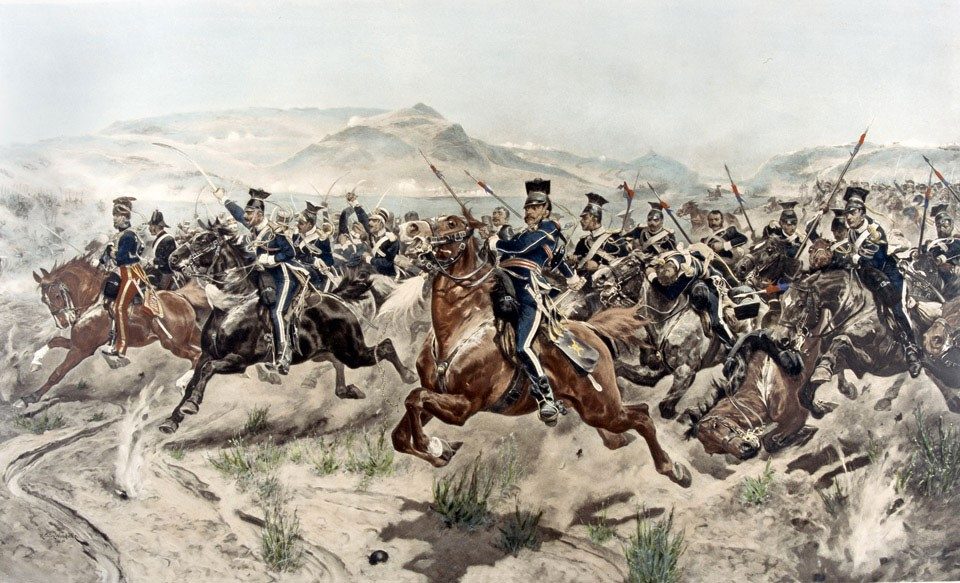
1854 is remembered above all for a misunderstood order: on 25 October, at Balaklava in the Crimea, the Light Brigade charged massed Russian guns and lost some forty per cent of its men. The same crowded March had brought Britain and France into the Crimean War, Commodore Perry's convention opening Japan, and the Ripon meeting that began the Republican Party — while in October Abraham Lincoln set out his case against slavery's spread at Peoria.
At a Glance
- Defining event
- Charge of the Light Brigade at Balaklava, 25 October 1854
- War widens
- Britain and France declare war on Russia, 28 March, joining the Ottoman Empire
- Japan opens
- Convention of Kanagawa signed, 31 March, ending two centuries of seclusion
- A party begins
- Anti-slavery meeting at Ripon, Wisconsin, 20 March, begins the Republican Party
- Lincoln returns
- Peoria speech against the Kansas-Nebraska Act, 16 October
- Closed the year
- Pope Pius IX proclaims the dogma of the Immaculate Conception, 8 December
The defining story: a valley in the Crimea
March 1854 rearranged three continents in eleven days. On 20 March opponents of slavery met at Ripon, Wisconsin, to organise what became the Republican Party. On 28 March Britain and France declared war on Russia, joining the Ottoman Empire in the Crimean War. On 31 March Commodore Matthew Perry signed the Convention of Kanagawa with Japan, opening two Japanese ports to American ships and ending two centuries of seclusion. War, party and opening were all, in their different ways, arguments about the future arriving at once.
The war came first to a conclusion in the Crimea. On 20 September, at the Battle of the Alma, British, French and Ottoman forces defeated the Russians in the war's first major battle, and on 17 October the allies began the siege of Sevastopol, the great Russian naval base. Around its supply port, Balaklava, the campaign settled into the confusion from which the year's defining moment came.
On 25 October, during the Battle of Balaklava, Lord Raglan, watching from the heights, ordered the cavalry to prevent the Russians carrying away captured guns. The written order, carried downhill by Captain Nolan, meant one thing from above and another from the valley floor, where the only guns in sight were the massed Russian battery a mile and a half down the North Valley. Lord Lucan questioned it; the Earl of Cardigan protested and obeyed. Some 670 horsemen rode the length of the valley under fire from front and flanks, reached the guns, and fought their way back. About forty per cent were killed or wounded — the National Army Museum puts the figure at about 260 men — and 475 horses were lost, for nothing that justified the cost.
America's argument ran in parallel. On 16 October, at Peoria, Abraham Lincoln set out his case against the Kansas-Nebraska Act and the spread of slavery — the speech that returned him to national politics on the Ripon party's side of the question. The year also published Thoreau's Walden on 9 August, saw miners and troops clash at the Eureka Stockade in Victoria on 3 December, and closed on 8 December with Pope Pius IX proclaiming the dogma of the Immaculate Conception in the bull Ineffabilis Deus.
Timeline of 1854
- 14 March
Paul Ehrlich, the German physician and Nobel laureate who sought a 'magic bullet' cure for disease, is born.
- 20 March
Opponents of slavery meet at Ripon, Wisconsin, to organise what becomes the Republican Party.
- 28 March
Britain and France declare war on Russia, joining the Ottoman Empire in the Crimean War.
- 31 March
Commodore Matthew Perry signs the Convention of Kanagawa, opening two Japanese ports to American ships.
- 3 July
Leoš Janáček, Czech composer of Jenůfa and the Sinfonietta, is born.
- 9 August
Henry David Thoreau publishes Walden, his account of two years living beside Walden Pond.
- 20 September
At the Battle of the Alma, British, French and Ottoman forces defeat the Russians in the Crimean War's first major battle.
- 16 October
In his Peoria speech, Abraham Lincoln sets out his case against the Kansas-Nebraska Act and the spread of slavery.
- 16 October
Oscar Wilde, Irish playwright and author of The Importance of Being Earnest, is born.
- 17 October
French and British forces begin the siege of Sevastopol.
- 20 October
Arthur Rimbaud, the French poet who wrote his visionary work as a teenager, is born.
- 25 October
The Light Brigade charges Russian artillery at Balaklava after a misunderstood order, losing some forty per cent of its men.
- 6 November
John Philip Sousa, the American 'March King', is born.
- 8 December
Pope Pius IX proclaims the dogma of the Immaculate Conception.
Why 1854 still matters
Balaklava became a permanent parable: armies still study it not for how to win a battle but for how one badly worded sentence, passed down a chain of obedience, can send brave men to be killed for nothing. Tennyson's poem, written within weeks from newspaper reports, fixed the charge in the imagination as the valley of death — the Crimean War's administrative collapse made legend by its most gallant disaster.
The March decisions compounded longer. The Republican Party organised at Ripon won the presidency six years later under the man who spoke at Peoria. Perry's convention began Japan's opening to the world, a process that within a generation transformed the country. The siege of Sevastopol, Walden and the Eureka Stockade each carried their own afterlives — in military reform, in American letters, and in Australian democracy's founding story.
Even the year's births read like a programme for the next half-century: Paul Ehrlich in medicine, Oscar Wilde and Arthur Rimbaud in literature, Leoš Janáček in music and John Philip Sousa in America's public sound. 1854 compressed war, politics, faith and art into a single year whose consequences were still unfolding in 1914.
1854 on The History Trail
The Crimean charge leads this year on The History Trail, with Perry, Peoria and Ripon beside it.
- October 25 in History — The Charge of the Light Brigade at Balaklava, told in full.
- March 28 in History — Britain and France declare war on Russia in the Crimean War.
- March 31 in History — Perry signs the Convention of Kanagawa with Japan.
- March 20 in History — The Ripon meeting begins what becomes the Republican Party.
- October 16 in History — Lincoln's Peoria speech, and the birth of Oscar Wilde.
- Cholera — The disease whose nineteenth-century pandemics shadowed armies and cities alike.
Sources
- Encyclopaedia Britannica — On This Day: March 28
- Encyclopaedia Britannica — On This Day: March 31
- Encyclopaedia Britannica — On This Day: September 20
- Encyclopaedia Britannica — On This Day: October 25
- Encyclopaedia Britannica — On This Day: October 16
- Encyclopaedia Britannica — On This Day: December 8
The facts on this page were checked against these sources on 19 November 2026. The History Trail's permanent pages are researched and written for this site; the live profiles elsewhere on The History Trail are assembled automatically from Wikipedia and Wikidata.
About the Author
Researched and written by the The History Trail Editorial Team — the accountable editorial function behind this site's permanent story pages. The team works from the published sources cited on each page; it does not invent historians, reviewers or credentials, and it corrects errors openly.
Fact Check
Every load-bearing fact on this page traces to one of the sources listed above, and significant claims link to their source in the text. Our checking method is described on the methodology page; errors can be reported via the corrections page.
Sources & Citations
Cite this page as: The History Trail Editorial Team, The History Trail — this article's title, publication and update dates are shown beneath its headline. The full source list appears under Sources above; the site's source standards are on the sources page.