
On This Day
March 28 in History
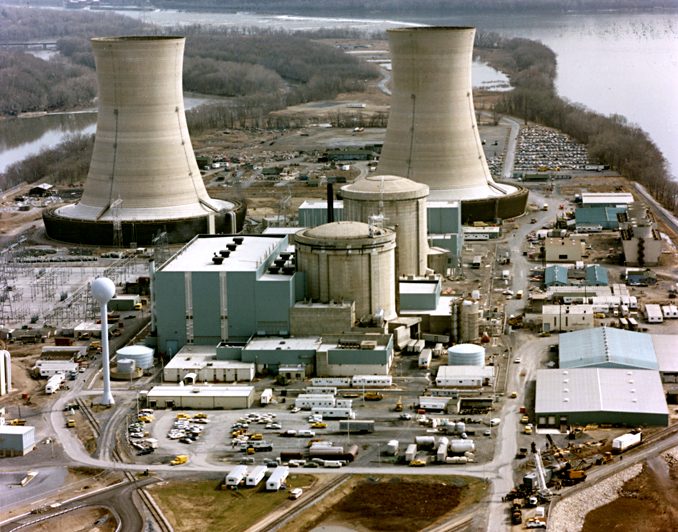
At four in the morning on 28 March 1979, in the Unit 2 reactor of the Three Mile Island nuclear plant on the Susquehanna River in Pennsylvania, a relief valve stuck open, cooling water drained away, and the reactor core began to overheat and partially melt — the worst accident in the history of American commercial nuclear power. No one was killed, and official studies found the radiation released too small to detect in public health; what melted down, permanently, was America's confidence in atomic energy. The date, by coincidence, fell the same week Egypt and Israel signed their peace and twelve days after a hit film about a nuclear cover-up opened.
Choose another date: open the On This Day calendar to browse events, births and deaths for any day of the year.
At a Glance
- The plant
- Three Mile Island Unit 2, a pressurised-water reactor on an island in the Susquehanna River, ten miles from Harrisburg, Pennsylvania; in service barely three months
- The trigger
- 4:00 a.m., 28 March 1979 — a fault in the secondary cooling system, then a pilot-operated relief valve that opened and failed to close
- The confusion
- Instruments showed the valve's signal, not its position; operators, misreading a rising water level, throttled back emergency cooling while the core boiled dry
- The damage
- Roughly half the core melted; the containment building held, and releases of radioactive gas were small
- The fear
- A hydrogen bubble inside the reactor raised explosion fears; the governor advised pregnant women and young children within five miles to leave, and well over 100,000 people fled the area
- The verdict
- Rated 5 of 7 on the International Nuclear Event Scale; the presidential Kemeny Commission blamed equipment, procedures and the 'mindset' of the whole industry
Events on this day
- 1854Britain and France declare war on Russia, joining the Ottoman Empire in the Crimean War.
- 1910Henri Fabre makes the first flight of a seaplane, taking off from the water at Martigues in France in his hydravion.
- 1930Turkey's government formally renames Constantinople as Istanbul and Angora as Ankara, requiring foreign post offices to use the Turkish names.
- 1939Nationalist forces enter Madrid, and the Spanish Civil War effectively ends after nearly three years; Franco's dictatorship begins.
- 1968Martin Luther King Jr. leads a march of Memphis sanitation workers that erupts in violence — his last march before his assassination a week later.
- 1979The partial meltdown begins at Three Mile Island in Pennsylvania — the featured story above.
- 1990President George H. W. Bush posthumously awards Jesse Owens the Congressional Gold Medal, 54 years after his four gold medals at the Berlin Olympics.
- 2005A magnitude 8.6 earthquake off Sumatra, near the zone of the previous December's disaster, kills some 1,300 people, most on the island of Nias.
Born on this day
- 1515Teresa of Ávila — Spanish mystic and reformer of the Carmelite order, one of the great writers of the Spanish Golden Age.
- 1868Maxim Gorky — Russian novelist and playwright, founder of socialist realism and witness of the revolutionary age.
- 1921Dirk Bogarde — British actor and writer, star of Death in Venice.
- 1936Mario Vargas Llosa — Peruvian novelist, Nobel laureate in literature and chronicler of Latin America's politics.
- 1986Lady Gaga — American singer and actress, among the defining pop performers of her generation.
Died on this day
- 1941Virginia Woolf — English novelist of Mrs Dalloway and To the Lighthouse, dead by her own hand in the River Ouse at 59.
- 1943Sergei Rachmaninoff — Russian composer and pianist, dead in exile in Beverly Hills three days after his last concert, at 69.
- 1969Dwight D. Eisenhower — supreme Allied commander in Europe and 34th president of the United States, dead at 78.
- 1985Marc Chagall — Russian-born French artist whose dreamlike paintings made him one of the most beloved modernists, dead at 97.
- 2004Peter Ustinov — British actor, writer and raconteur, two-time Academy Award winner, dead at 82.
The featured story: the Three Mile Island accident, 28 March 1979
Three Mile Island's Unit 2 was nearly new — it had entered commercial service at the end of December 1978 — and in the small hours of 28 March 1979 it was running at almost full power when pumps in its secondary, non-nuclear cooling loop stopped. Turbines and reactor shut down automatically, as designed. Then the accident assembled itself from small failures: a relief valve on the pressuriser opened to shed pressure and failed to reseat, and for more than two hours reactor coolant poured out of the open valve while the control room's light showed only that the valve had been told to close. Worse, the instruments misled the operators about the water level in the core, and, following their training, they cut back the emergency pumps that were trying to refill it.
By the time the error was understood, the top of the core had been uncovered, its fuel cladding had reacted with steam to make hydrogen, and roughly half of the core had melted and slumped. A small explosion of hydrogen gas that afternoon shook the containment building — which did its job and held. Radioactive gases escaped in amounts that the Nuclear Regulatory Commission and later studies judged too small to produce detectable health effects in the surrounding population; the average dose nearby was a fraction of a chest X-ray. But nobody in authority could say such reassuring things with confidence during the five days of crisis, and the public heard instead about a growing bubble of hydrogen inside the reactor that might, officials feared, explode or breach containment.
On 30 March the governor of Pennsylvania advised pregnant women and children under five within five miles of the plant to leave, and schools closed; well over 100,000 people in the Harrisburg area packed and went, in one of the largest peacetime evacuations in American history — most of them beyond any official advice. President Carter, a former naval nuclear officer, walked the control room on 1 April to calm the country. The bubble shrank, the core was stable, and the emergency ebbed — but the reactor was a ruin, its cleanup a twelve-year, billion-dollar undertaking, and Unit 2 never generated power again.
The Kemeny Commission, appointed by Carter, concluded that the fundamental problems were 'people-related' — in training, procedures and an industry and regulator convinced that serious accidents were impossible. Reforms followed across American nuclear power, and an industry institute for self-policing was created. The deeper effect was cultural and final: orders for new reactors, already slowing, stopped altogether for a generation, and the plant's silhouette — two domes between four cooling towers on a river island — became the permanent emblem of a technology that had promised electricity too cheap to meter.
Why this date matters
March 28 specialises in confidence and its collapse. A city sheds an imperial name in 1930; a civil war closes in 1939; an athlete the Reich tried to humiliate is honoured by a president in 1990. And in 1979 the most trusted machine of the postwar age — the peaceful atom, supervised by experts, wrapped in redundancy — failed in the one way its owners had assured the public it could not, not with an explosion but with a stuck valve and a misread gauge. The date remembers that systems fail at their assumptions, not at their strengths.
Sources
- Encyclopaedia Britannica — On This Day: March 28
- HISTORY — This Day in History: March 28
- Smithsonian National Museum of American History — Three Mile Island: The Inside Story
- HISTORY — Three Mile Island (video, This Day in History)
The facts on this page were checked against these sources on 19 November 2026. The History Trail's permanent pages are researched and written for this site; the live profiles elsewhere on The History Trail are assembled automatically from Wikipedia and Wikidata.
About the Author
Researched and written by the The History Trail Editorial Team — the accountable editorial function behind this site's permanent story pages. The team works from the published sources cited on each page; it does not invent historians, reviewers or credentials, and it corrects errors openly.
Fact Check
Every load-bearing fact on this page traces to one of the sources listed above, and significant claims link to their source in the text. Our checking method is described on the methodology page; errors can be reported via the corrections page.
Sources & Citations
Cite this page as: The History Trail Editorial Team, The History Trail — this article's title, publication and update dates are shown beneath its headline. The full source list appears under Sources above; the site's source standards are on the sources page.