
Years
1831 in History
1831 is the year Charles Darwin went to sea. On 27 December HMS Beagle sailed from Plymouth with the 22-year-old Darwin aboard as naturalist, beginning the five-year surveying voyage that led to the theory of evolution by natural selection. The same year Michael Faraday demonstrated electromagnetic induction, Nat Turner's rebellion shook Virginia, James Clark Ross reached the North Magnetic Pole, and James Monroe became the third president to die on the Fourth of July.
At a Glance
- Defining event
- HMS Beagle sails from Plymouth with Charles Darwin aboard, 27 December 1831
- The voyage
- A five-year surveying voyage; Beagle returns to England on 2 October 1836
- The principle
- Michael Faraday demonstrates electromagnetic induction, 29 August — the basis of the generator and transformer
- The rebellion
- Nat Turner launches his rebellion in Virginia, 21 August; he is hanged on 11 November
- The pole
- James Clark Ross reaches the North Magnetic Pole on the Boothia Peninsula, 1 June
- A July Fourth death
- James Monroe dies on 4 July — the third president to die on that date
The defining story: the Beagle sails
HMS Beagle was a small Royal Navy brig, about 27 metres long, sent to complete the hydrographic survey of South America's coasts. Her captain, Robert FitzRoy, wanted a gentleman naturalist who could double as a dining companion on a long commission, and the post was offered, through Cambridge's John Stevens Henslow, to his former student Charles Darwin — a 22-year-old who had abandoned medicine and was drifting toward the clergy. Darwin's father objected that the voyage was a disreputable waste of his son's time, and only his uncle's written intervention argued the family round.
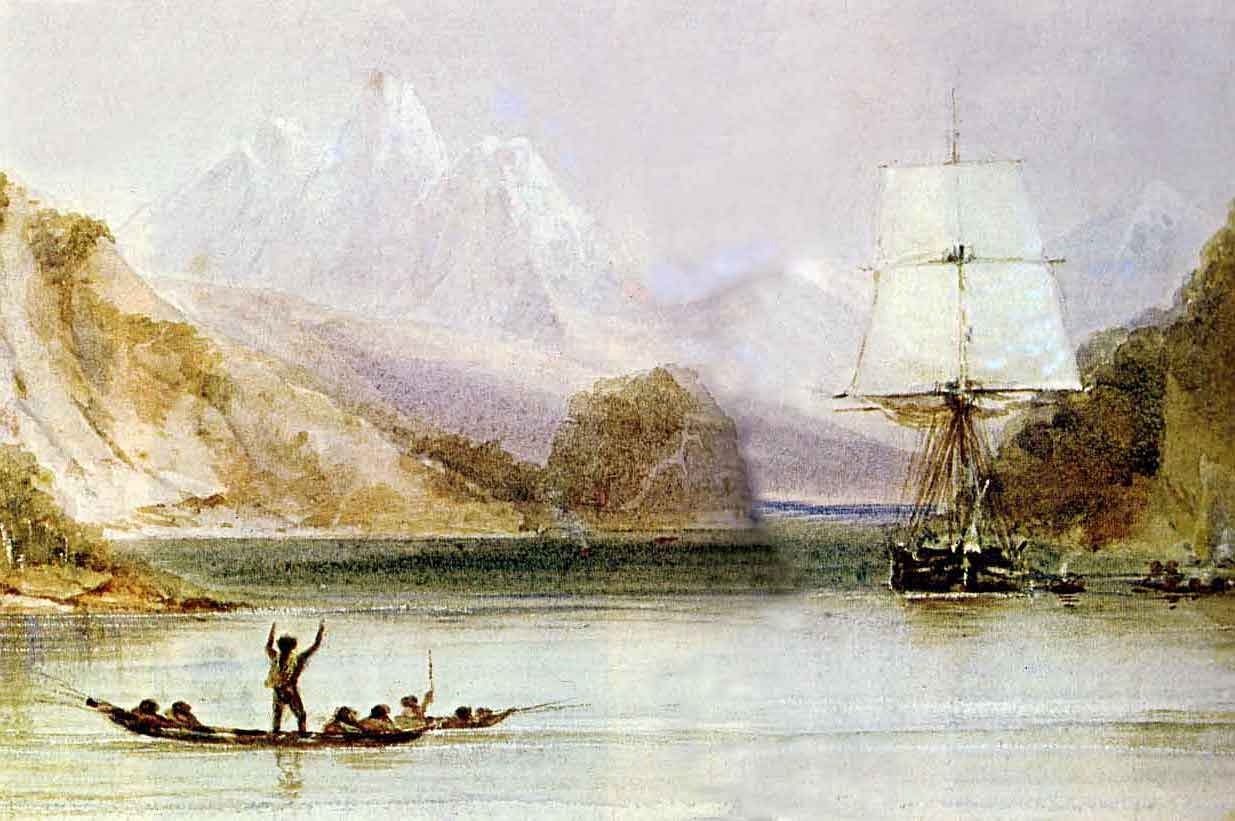
Even then, the sea nearly refused them. The Beagle's first departure attempts that December were beaten back by gales, and the ship waited at anchor in Plymouth's Barn Pool before finally getting away on 27 December 1831. Darwin, wretchedly seasick for much of the five years that followed, shared a cabin with charts and a hammock slung over the table, and spent most of the voyage's duration — some three years of it — ashore, riding into the interiors of Brazil, Argentina, Chile and Peru while the Beagle surveyed the coasts. The watercolour above, by the ship's artist Conrad Martens, shows her in the Beagle Channel at Tierra del Fuego, hailed by a Fuegian canoe.
The year the Beagle sailed was crowded with other beginnings and reckonings. On 29 August Michael Faraday demonstrated electromagnetic induction, the principle behind the electric generator and transformer — the discovery that would eventually electrify the world Darwin was about to describe. On 1 June James Clark Ross reached the North Magnetic Pole on the Boothia Peninsula in the Canadian Arctic. In Edinburgh on 11 April, nearly 80 Lewis Chessmen — medieval walrus-ivory pieces found in a sand bank on the Isle of Lewis — were exhibited, a buried medieval world surfacing in the same season.
America's 1831 was darker. On 19 March the City Bank of New York was robbed of $245,000, the first documented bank robbery in United States history. On 4 July James Monroe, the fifth president, died — the third president to die on the Fourth of July. And on 21 August Nat Turner, an enslaved preacher, launched a rebellion in Southampton County, Virginia; it was suppressed within two days, and Turner was hanged at Jerusalem, Virginia, on 11 November. The largest revolt of enslaved people in United States history, and its suppression, hardened the South's defence of slavery for a generation.
Timeline of 1831
- 19 March
The City Bank of New York is robbed of $245,000 — the first documented bank robbery in United States history.
- 11 April
Nearly 80 newly discovered Lewis Chessmen are exhibited in Edinburgh.
- 1 June
The explorer James Clark Ross reaches the North Magnetic Pole on the Boothia Peninsula.
- 27 June
Sophie Germain, the self-taught French mathematician of number theory and elasticity, dies.
- 4 July
James Monroe, fifth president of the United States, dies — the third president to die on the Fourth of July.
- 21 July
Leopold I is inaugurated as the first king of the Belgians.
- 21 August
Nat Turner launches a rebellion of enslaved people in Southampton County, Virginia.
- 29 August
Michael Faraday demonstrates electromagnetic induction, the principle behind the electric generator and transformer.
- 11 November
Nat Turner is hanged at Jerusalem, Virginia.
- 14 November
Georg Wilhelm Friedrich Hegel, the German philosopher of history and dialectic, dies.
- 19 November
James A. Garfield, the future 20th president of the United States, is born.
- 27 December
HMS Beagle sails from Plymouth with Charles Darwin aboard, beginning his five-year voyage.
Why 1831 still matters
1831 still matters chiefly for two demonstrations, one at sea and one in a laboratory. The Beagle voyage gave Darwin the fossils, the island birds and the deep time he needed; without the five years that began on 27 December 1831 there is no On the Origin of Species in 1859, and no modern biology in its present form. Faraday's induction, shown on 29 August, supplied the physical principle — generation and transformation of electric power — on which the electrified world was built. Together they mark 1831 as a founding year of the modern scientific age, one in nature's history and one in its harnessing.
The year's American story warns against any simple tale of progress. Nat Turner's rebellion was the largest revolt of enslaved people in United States history, and the response — Turner's hanging, and the tightening of slavery's defences across the South — pushed the country further from peaceful emancipation and closer to the civil war thirty years away. Monroe's death on the Fourth of July closed the founding generation's strange calendar of coincidences, and Belgium's first king, inaugurated on 21 July, began a monarchy that still endures.
Smaller entries carry their own long echoes: Sophie Germain, largely self-taught, had made foundational contributions to number theory and elasticity against every institutional barrier; the Lewis Chessmen, exhibited in April, remain among the most beloved medieval objects in any museum; and James A. Garfield, born on 19 November, would become the 20th president — and, in 1881, an assassinated one.
1831 on The History Trail
A voyage, a rebellion and an electric principle — 1831 day by day.
- December 27 in History — Darwin departs on HMS Beagle — the featured story of the voyage.
- August 29 in History — Faraday demonstrates electromagnetic induction.
- August 21 in History — Nat Turner's rebellion begins in Virginia.
- June 1 in History — James Clark Ross reaches the North Magnetic Pole.
- July 4 in History — James Monroe dies on the Fourth of July.
- April 11 in History — The Lewis Chessmen are exhibited in Edinburgh.
Sources
- Darwin Correspondence Project, University of Cambridge — The Voyage of the Beagle
- HISTORY — What Happened on December 27
- Encyclopaedia Britannica — On This Day: December 27
- Encyclopaedia Britannica — On This Day: August 29
- Encyclopaedia Britannica — On This Day: August 21
- Encyclopaedia Britannica — On This Day: June 1
The facts on this page were checked against these sources on 19 November 2026. The History Trail's permanent pages are researched and written for this site; the live profiles elsewhere on The History Trail are assembled automatically from Wikipedia and Wikidata.
About the Author
Researched and written by the The History Trail Editorial Team — the accountable editorial function behind this site's permanent story pages. The team works from the published sources cited on each page; it does not invent historians, reviewers or credentials, and it corrects errors openly.
Fact Check
Every load-bearing fact on this page traces to one of the sources listed above, and significant claims link to their source in the text. Our checking method is described on the methodology page; errors can be reported via the corrections page.
Sources & Citations
Cite this page as: The History Trail Editorial Team, The History Trail — this article's title, publication and update dates are shown beneath its headline. The full source list appears under Sources above; the site's source standards are on the sources page.